{"metadata":{"kernelspec":{"language":"python","display_name":"Python 3","name":"python3"},"language_info":{"pygments_lexer":"ipython3","nbconvert_exporter":"python","version":"3.6.4","file_extension":".py","codemirror_mode":{"name":"ipython","version":3},"name":"python","mimetype":"text/x-python"}},"nbformat_minor":4,"nbformat":4,"cells":[{"cell_type":"markdown","source":" \nimg source: towards data science\n\n# (nested) Cross-Validation⚙️\n\n**What you can expect from this notebook:** This notebook covers cross-validation in theory and practice and emphasises why nested cross-validation can and often should be used instead of simple cross-validation. \n\n**libraries utilised:**","metadata":{"_uuid":"8f2839f25d086af736a60e9eeb907d3b93b6e0e5","_cell_guid":"b1076dfc-b9ad-4769-8c92-a6c4dae69d19"}},{"cell_type":"code","source":"# for implementation\nimport numpy as np # linear algebra\nfrom copy import copy # deep copies of objects\n\n# for evaluation\nfrom sklearn.linear_model import Ridge\nfrom sklearn.tree import DecisionTreeRegressor\nfrom sklearn.ensemble import RandomForestRegressor, GradientBoostingRegressor\n\n# for data handeling and scaling\nimport pandas as pd # data handeling\nfrom sklearn.preprocessing import StandardScaler # Standartise data","metadata":{"execution":{"iopub.status.busy":"2022-07-02T09:40:30.210119Z","iopub.execute_input":"2022-07-02T09:40:30.210496Z","iopub.status.idle":"2022-07-02T09:40:30.217111Z","shell.execute_reply.started":"2022-07-02T09:40:30.210464Z","shell.execute_reply":"2022-07-02T09:40:30.215901Z"},"trusted":true},"execution_count":null,"outputs":[]},{"cell_type":"markdown","source":"****\n# 1 | Basic cross-validation intuition\n\n**Main idea:** utilising ***all*** data avaliable for training ***and*** testing.\n\n**Use cases:**\n* Model evaluation (how does my model perform taking into account *all* my data?)\n* Model selection (which model performs best taking into account *all* my data?)\n* Hyperparameter tuning (Gridsearch -> like model selection but between the same model, just with different hyperparameter settings)\n\n
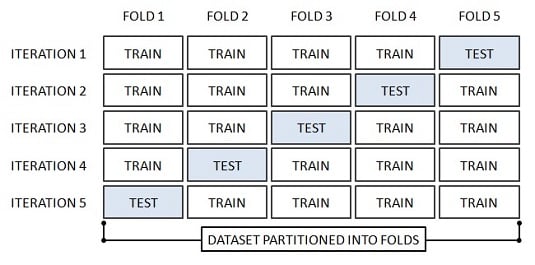 \nimg source: ww.dumies.com\n\n**How it works:**\n* **Partition** data into groups\n* In a **rotating** manner:\n * **Set aside** a group for testing\n * Train models on the **rest**\n * Test these models with the testing group and keep track of the scores\n * Repeat but with **another group** being set aside as testing group\n* After each group was used for testing:\n * **Average scores** to obtain an estimate **based on the whole data**\n \n**Advantages:**\n* The obtained scores are a better estimate of how the model will perform on real-world data than the ones one could obtain by just testing on a fixed subset of the data\n\n**Disadvantages:**\n* Each model has to be trained multiple times \n\n**Some common cross-validation variants:**\n* ***K-Fold Cross-Validation:*** The most widely used one and also the one focussed on in this notebook:\n * Partition data into k folds(groups) of equal size\n * Test on one, train on the rest\n * Then rotate\n * **visualisation above**\n* ***Leave one out Cross-Validation:***\n * Similar to K-Fold Cross-Validation\n * But partitions into n folds equal to the number of observations in the dataset\n * resulting in single item testing sets\n* ***Stratfield Cross-Validation:***\n * Mainly used for classification problems\n * Similar to K-Fold Cross-Validation, it tests on a set percentage of the data\n * But partitions the data in a way that the mean response value is roughly equal across folds\n \n
\n\n#### **Python implementation of K-Fold Cross-Validation:**\nThis implementation will be used in an example after the next section.","metadata":{}},{"cell_type":"code","source":"# sample implementation\ndef k_fold_crossval(models, X, y, k):\n # initialise empty lists to store scores and trained models\n error_scores = []\n trained_models = []\n # split dataset into folds\n folds_X = np.array_split(X, k)\n folds_y = np.array_split(y, k)\n # iterate over folds\n for test_fold_i in range(k):\n # log\n print(f\"fold {test_fold_i+1}: ---------------------------------------------\")\n # specify train/test data\n X_train = folds_X[:test_fold_i] + folds_X[test_fold_i+1:]\n y_train = folds_y[:test_fold_i] + folds_y[test_fold_i+1:]\n X_test = folds_X[test_fold_i]\n y_test = folds_y[test_fold_i]\n # train on everything but the test_fold\n fold_scores = []\n fold_models = []\n for model in self.models:\n # make deep copy of model\n model = copy(model)\n # fit and test\n model.fit(np.concatenate(X_train), np.concatenate(y_train))\n fold_models.append(model)\n score = model.score(X_test, y_test)\n fold_scores.append(score)\n # log\n print(f\"{model} trained, score = {score}\")\n # save fold scores and models\n error_scores.append(np.array(fold_scores))\n trained_models.append(np.array(fold_models, dtype=object))\n return error_scores, trained_models","metadata":{"execution":{"iopub.status.busy":"2022-07-02T08:55:10.551819Z","iopub.execute_input":"2022-07-02T08:55:10.552260Z","iopub.status.idle":"2022-07-02T08:55:10.562708Z","shell.execute_reply.started":"2022-07-02T08:55:10.552226Z","shell.execute_reply":"2022-07-02T08:55:10.561761Z"},"trusted":true},"execution_count":null,"outputs":[]},{"cell_type":"markdown","source":"****\n\n# 2 | The often accuring problem\n\n**Cross-validation can be used for both model evaluation and selection/hyperparameter tuning, but not for both at the same time without running into potential problems.**
\n\n**Example Situation:**\n* Someone performs 5-fold cross-validation to select between a catboost, xgboost and lightgbm algorithm based on which one obtains the lowest loss/highest score\n* Since this already resulted in a loss value he reports that loss as an estimate of how the model is going to perform in production\n* Unfortunately the model ends up performing slightly worse than expected\n\n**What happened?**\n* When selecting the best model, **bias** was introduced, since with that he did also choose the lowest loss as an estimate\n* The obtained loss values are just estimates and have a sampling distribution\n* When choosing the lowest value, it increases the chance of it coming from a lower end of that distribution \n* -> **After selecting a model based on loss, that loss estimate is biased**","metadata":{}},{"cell_type":"markdown","source":"****\n\n# 3 | How it can be fixed with nested cross-validation\n\n**The solution is stunningly simple:** The evaluation process is separated from the selection process, splitting into train, validation and test set, where the validation set is used for the model selection/hyperparameter optimization and the test set for the final evaluation.\n\n**This can be done using all of the data for training, validation and testing, by utilising 2 cross-validation loops, nested into each other:**\n\n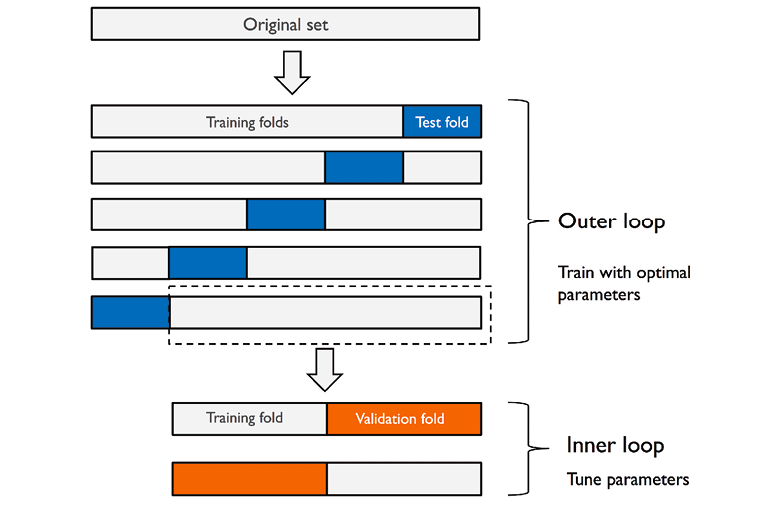 \nimg source: vitalflux.com\n\n**Step for step:**\n* partition training data into folds (outer loop), **rotating testing fold**:\n * set aside testing set\n * partition the training folds in each iteration into folds (inner loop), **rotating the validation fold**:\n * set aside validation set\n * fit models on rest of training set\n * **evaluate on validation set**\n * repeat till all the training data from the outer loop was used for validation\n * **choose best model** based on scores of inner loop\n * **train** that model **on the whole training set** from the outer loop\n * evaluate on testing sett\n * repeat till all the data was used for testing\n \n* This results in one(or more) best model(s) with an unbiased loss estimate\n \n
\n\n#### **Python implementation of K-Fold Cross-Validation:**\nTaking the single loop created in the last section, it is extended in a way that it can be nested into each other. This is done by making it possible to be treated similar to a sklearn model(with .fit and .score):","metadata":{}},{"cell_type":"code","source":"# turn into class to work with sklearn model pipeline and allow for easy nesting of cross-validation loops\nclass KfoldCrossval:\n def __init__(self, k, models, name=\"k_fold_crossval\"):\n self.k = k\n self.models = models\n self.name = name\n \n def evaluate(self, X, y):\n self.fit(X, y)\n return self.error_scores, self.trained_models\n \n def fit(self, X, y, verbose=True):\n # initialise empty lists to store scores and trained models\n self.error_scores = []\n self.trained_models = []\n #self.fold_scores = []\n # split dataset into folds\n folds_X = np.array_split(X, self.k)\n folds_y = np.array_split(y, self.k)\n # iterate over folds\n for test_fold_i in range(self.k):\n # log\n if verbose:\n print(f\"{self.name} fold {test_fold_i+1}: ---------------------------------------------\")\n # specify train/test data\n X_train = folds_X[:test_fold_i] + folds_X[test_fold_i+1:]\n y_train = folds_y[:test_fold_i] + folds_y[test_fold_i+1:]\n X_test = folds_X[test_fold_i]\n y_test = folds_y[test_fold_i]\n # train on everything but the test_fold\n fold_scores = []\n fold_models = []\n for model in self.models:\n # make deep copy of model\n model = copy(model)\n # fit and test\n model.fit(np.concatenate(X_train), np.concatenate(y_train))\n fold_models.append(model)\n score = model.score(X_test, y_test)\n fold_scores.append(score)\n # log\n if verbose:\n print(f\"{model} trained, score = {score}\")\n # save fold scores and models\n self.error_scores.append(np.array(fold_scores))\n self.trained_models.append(np.array(fold_models, dtype=object))\n \n # just neccessary if inner loop:\n # find best model\n scores = np.stack(self.error_scores).mean(axis=0)\n self.best_model = copy(np.array(self.models)[scores == scores.max()][0])\n # fit best model on whole training data\n self.best_model.fit(X, y)\n \n def score(self, X_test, y_test):\n return self.best_model.score(X_test, y_test)","metadata":{"execution":{"iopub.status.busy":"2022-07-02T09:04:05.754888Z","iopub.execute_input":"2022-07-02T09:04:05.755425Z","iopub.status.idle":"2022-07-02T09:04:05.775263Z","shell.execute_reply.started":"2022-07-02T09:04:05.755379Z","shell.execute_reply":"2022-07-02T09:04:05.773273Z"},"trusted":true},"execution_count":null,"outputs":[]},{"cell_type":"markdown","source":"```\nmodels = [model1, model2, ..., modeln]\n\n# example usage\ninner = KfoldCrossval(10, models)\nouter = KfoldCrossval(10, [inner])\n\nouter.evaluate(X, y)\n```","metadata":{}},{"cell_type":"markdown","source":"****\n\n# 4 | Sample usage of nested cross-validation","metadata":{}},{"cell_type":"code","source":"house_data = pd.read_csv(\"../input/house-prices-advanced-regression-techniques/train.csv\")\nscaler = StandardScaler()\n\n# encode categorical features, fill nan values\nfor feature in house_data.columns:\n if house_data[feature].dtype == \"object\":\n # categorical encoding: turns [a, b, b, c] into [1, 2, 2, 3]\n house_data[feature] = house_data[feature].astype(\"category\").cat.codes \n if house_data[feature].isna().sum() != 0:\n # impute missing values with the mode of the corresponding variable\n house_data[feature].fillna(house_data[feature].mode(), inplace=True)\n else:\n if house_data[feature].isna().sum() != 0:\n # impute missing values with the mean of the corresponding variable\n house_data[feature].fillna(house_data[feature].mean(), inplace=True)\n \nfeatures = house_data.loc[:, house_data.columns!=\"SalePrice\"].to_numpy()\nlabels = house_data.loc[:, \"SalePrice\"].to_numpy()\n\nscaler.fit(features)\nfeatures = scaler.transform(features)","metadata":{"execution":{"iopub.status.busy":"2022-07-02T09:39:02.269713Z","iopub.execute_input":"2022-07-02T09:39:02.270124Z","iopub.status.idle":"2022-07-02T09:39:02.378272Z","shell.execute_reply.started":"2022-07-02T09:39:02.270082Z","shell.execute_reply":"2022-07-02T09:39:02.377186Z"},"trusted":true},"execution_count":null,"outputs":[]},{"cell_type":"code","source":"house_data.head()","metadata":{"execution":{"iopub.status.busy":"2022-07-02T09:39:03.510507Z","iopub.execute_input":"2022-07-02T09:39:03.510884Z","iopub.status.idle":"2022-07-02T09:39:03.537675Z","shell.execute_reply.started":"2022-07-02T09:39:03.510854Z","shell.execute_reply":"2022-07-02T09:39:03.536520Z"},"trusted":true},"execution_count":null,"outputs":[]},{"cell_type":"code","source":"# extreamly basic configuration, just for demonstation purposes\nmodels = [\n Ridge(1),\n DecisionTreeRegressor(max_depth=50, min_samples_split=10),\n RandomForestRegressor(n_estimators=50),\n #GradientBoostingRegressor(loss=\"squared_error\", min_samples_split=10)\n]","metadata":{"execution":{"iopub.status.busy":"2022-07-02T09:39:18.714375Z","iopub.execute_input":"2022-07-02T09:39:18.714836Z","iopub.status.idle":"2022-07-02T09:39:18.721680Z","shell.execute_reply.started":"2022-07-02T09:39:18.714795Z","shell.execute_reply":"2022-07-02T09:39:18.720280Z"},"trusted":true},"execution_count":null,"outputs":[]},{"cell_type":"markdown","source":"**6-fold inner, 6-fold outer cross-validation:**","metadata":{}},{"cell_type":"code","source":"inner = KfoldCrossval(6, models, \"inner\")\nouter = KfoldCrossval(6, [inner], \"outer\")\n\nbest_scores, best_models = outer.evaluate(features, labels)","metadata":{"execution":{"iopub.status.busy":"2022-07-02T09:39:19.233911Z","iopub.execute_input":"2022-07-02T09:39:19.234823Z","iopub.status.idle":"2022-07-02T09:40:04.406669Z","shell.execute_reply.started":"2022-07-02T09:39:19.234758Z","shell.execute_reply":"2022-07-02T09:40:04.405407Z"},"trusted":true},"execution_count":null,"outputs":[]},{"cell_type":"code","source":"best_models = [crossval[0].best_model for crossval in best_models]\nprint(best_models, best_scores)","metadata":{"execution":{"iopub.status.busy":"2022-07-02T09:40:05.784972Z","iopub.execute_input":"2022-07-02T09:40:05.785678Z","iopub.status.idle":"2022-07-02T09:40:05.794594Z","shell.execute_reply.started":"2022-07-02T09:40:05.785639Z","shell.execute_reply":"2022-07-02T09:40:05.793207Z"},"trusted":true},"execution_count":null,"outputs":[]},{"cell_type":"markdown","source":"As expectable the random forest regressor showed to be the best model, the mean of the outer crossvalidation score gives an estimate on how it will perform on real world data:","metadata":{}},{"cell_type":"code","source":"# get average score -> better estimate\nnp.stack(best_scores).mean()","metadata":{"execution":{"iopub.status.busy":"2022-07-02T09:40:11.045082Z","iopub.execute_input":"2022-07-02T09:40:11.045534Z","iopub.status.idle":"2022-07-02T09:40:11.054250Z","shell.execute_reply.started":"2022-07-02T09:40:11.045498Z","shell.execute_reply":"2022-07-02T09:40:11.052836Z"},"trusted":true},"execution_count":null,"outputs":[]},{"cell_type":"markdown","source":"**That's all for this notebook, have a great day and happy learning!👋**","metadata":{}}]}