
Hello everyone! Here is a write-up of my best private leaderboard solution (top 13 with 0.641814 score, 0.723345 on public LB).
\nI am very grateful to organizers and participants for this competition, it was very interesting and challenging. I've learned a lot about segmentation and had a lot of fun! Some of the ideas I have used in the solution came from code / discussion tabs on Kaggle, hopefully I have mentioned them all.
\nIf you have any questions, please do not hesitate to reach me in comments.
\nData:
\nTraining:
\nInference:
\nEnvironment & tools:
\nInspired by this analysis, I plot the mean intensity of each layer of each fragment for full image, only for ink and only for backgound.
\n
Here it could be observed that fragments 1 and 3 are more or less similar in terms of both intencity values and minimum and maximum positions, while fragment 2 is different.
\nMy physical intuition behind this is following: papirus seems not being aligned by depth inside 3D volume, moreover papirus thinknes seems to vary between fragments 1, 3 and fragment 2.
\nSo, I've decided to align and stretch / compress papirus in z dimension by shift and scale operation:
\nz_shift parameter to minimize following loss (y_target here is the intensity curve of full fragment 3)z_shifted = z + z_shift\nf = interpolate.interp1d(z_shifted, y, =, =)\nreturn f(z_target) - y_target\nz_scale (assuming pairus thickness is same for same fragment) in a similar manner.z_shift and z_scale maps to full volume size and save them on disk.z_shift and z_scale to full volume via scipy.ndimage.geometric_transform with transform writen as C module for speed.Resulting z_shift maps and z_scale values are following:
| Fragment 1 | \nFragment 2 | \nFragment 3 | \n
|---|---|---|
 | \n | \n | \n
Z scale is ~ 1.0 for fragments 1 and 3 and ~ 0.6 for fragment 2 which could indicate the fragment 2 being ~ twice thicker that others.
\nSuch operation should be beneficial for 2D approaches. It seems to improve CV on ~0.03-0.05 F05, but I did not run full comparison due to time constraints.
\nAlso, I've tried to fit / calculate normalization for each fragment separately to completely fit the intencity curve, but it did not work well.
\nPre-trained maxvit encoder + SMP 2D unet with aggregation has shown the best CV score, so maxvit_rmlp_base_rw_384.sw_in12k_ft_in1k is the one used in best solution.
2D unet with aggregation works as follows: unet model is applied on each slice of the input with size = step = 3 along z dimention (total 6 slices), then 6 resulting logits are aggregated via linear layer.
\nUsage of pre-trained models is yielding far better results that random initialization. Unfortunately I did not came up with better architecture allowing to handle 3D inputs and 2D outputs while allowing to use pre-trained models.
\nBest CV scores of ths model and corresponding predictions are following:
\n| Fragment | \nF05 | \nPrediction | \n
|---|---|---|
| 1 | \n0.6544 | \n | \n
| 2a | \n0.6643 | \n | \n
| 2b | \n0.7489 | \n | \n
| 2c | \n0.6583 | \n | \n
| 3 | \n0.7027 | \n | \n
Tried, but did not work well
\nMultiple backbone models:
\nAnd multiple full model approaches: full 3D with aggregation on the last layer, 2.5D, 2D with aggregation, custom 3D models with pre-trained weights conversion from 2D to 3D.
\nFollowing augmentations are used for training
\ntrain_transform = A.Compose(\n [\n RandomCropVolumeInside2dMask(\n =self.hparams.img_size, \n =self.hparams.img_size_z,\n scale=(0.5, 2.0),\n ratio=(0.9, 1.1),\n scale_z=(1 / self.hparams.z_scale_limit, self.hparams.z_scale_limit),\n =,\n =0,\n ),\n A.Rotate(\n =0.5, \n =rotate_limit_degrees_xy, \n =,\n ),\n ResizeVolume(\n =self.hparams.img_size, \n =self.hparams.img_size,\n =self.hparams.img_size_z,\n =,\n ),\n A.HorizontalFlip(=0.5),\n A.VerticalFlip(=0.5),\n A.RandomRotate90(=0.5),\n A.RandomBrightnessContrast(=0.5, =0.1, =0.1),\n A.OneOf(\n [\n A.GaussNoise(var_limit=[10, 50]),\n A.GaussianBlur(),\n A.MotionBlur(),\n ], \n =0.4\n ),\n A.GridDistortion(=5, =0.3, =0.5),\n A.CoarseDropout(\n =1, \n =int(self.hparams.img_size * 0.3), \n =int(self.hparams.img_size * 0.3), \n =0, =0.5\n ),\n A.Normalize(\n =MAX_PIXEL_VALUE,\n =self.train_volume_mean,\n =self.train_volume_std,\n =,\n ),\n ToTensorV2(),\n ToCHWD(=),\n ],\n)\nHere, RandomCropVolumeInside2dMask crops random 3D patch from volume so that its center's (x, y) are inside mask, ResizeVolume is trilinear 3D resize and ToCHWD simply permutes dimentions. img_size = 384, img_size_z = 18, z_scale_limit = 1.33, rotate_limit_degrees_xy = 45, train_volume_mean and train_volume_std are average of imagenet stats.
For inference, following transforms are used
\ntest_transform = A.Compose(\n [\n CenterCropVolume(\n =None, \n =None,\n =math.ceil(self.hparams.img_size_z * self.hparams.z_scale_limit),\n =,\n =,\n =1.0,\n ),\n ResizeVolume(\n =self.hparams.img_size, \n =self.hparams.img_size,\n =self.hparams.img_size_z,\n =,\n ),\n A.Normalize(\n =MAX_PIXEL_VALUE,\n =self.train_volume_mean,\n =self.train_volume_std,\n =,\n ),\n ToTensorV2(),\n ToCHWD(=),\n ],\n)\nHere, CenterCropVolume is center crop of 3D volume.
Mixing approaches (cutmix, mixup, custom stuff like copy-paste the positive class voxels) also were tried but shown contradicting results, so were not included.
\nCartesian product of no flip / H flip / V flip and no 90 rotation / 90 rotation / 180 rotation / 270 rotation is used for TTA yielding total 12 predictions.
Update: project source code for training could be found here
", "messages": [ { "id": 2304186, "postDate": "2023-06-15T18:50:15.517Z", "content": "Hello everyone! Here is a write-up of my best private leaderboard solution (top 13 with 0.641814 score, 0.723345 on public LB).
\nI am very grateful to organizers and participants for this competition, it was very interesting and challenging. I've learned a lot about segmentation and had a lot of fun! Some of the ideas I have used in the solution came from code / discussion tabs on Kaggle, hopefully I have mentioned them all.
\nIf you have any questions, please do not hesitate to reach me in comments.
\nData:
\nTraining:
\nInference:
\nEnvironment & tools:
\nInspired by this analysis, I plot the mean intensity of each layer of each fragment for full image, only for ink and only for backgound.
\n
Here it could be observed that fragments 1 and 3 are more or less similar in terms of both intencity values and minimum and maximum positions, while fragment 2 is different.
\nMy physical intuition behind this is following: papirus seems not being aligned by depth inside 3D volume, moreover papirus thinknes seems to vary between fragments 1, 3 and fragment 2.
\nSo, I've decided to align and stretch / compress papirus in z dimension by shift and scale operation:
\nz_shift parameter to minimize following loss (y_target here is the intensity curve of full fragment 3)z_shifted = z + z_shift\nf = interpolate.interp1d(z_shifted, y, =, =)\nreturn f(z_target) - y_target\nz_scale (assuming pairus thickness is same for same fragment) in a similar manner.z_shift and z_scale maps to full volume size and save them on disk.z_shift and z_scale to full volume via scipy.ndimage.geometric_transform with transform writen as C module for speed.Resulting z_shift maps and z_scale values are following:
| Fragment 1 | \nFragment 2 | \nFragment 3 | \n
|---|---|---|
| \n | \n | \n
Z scale is ~ 1.0 for fragments 1 and 3 and ~ 0.6 for fragment 2 which could indicate the fragment 2 being ~ twice thicker that others.
\nSuch operation should be beneficial for 2D approaches. It seems to improve CV on ~0.03-0.05 F05, but I did not run full comparison due to time constraints.
\nAlso, I've tried to fit / calculate normalization for each fragment separately to completely fit the intencity curve, but it did not work well.
\nPre-trained maxvit encoder + SMP 2D unet with aggregation has shown the best CV score, so maxvit_rmlp_base_rw_384.sw_in12k_ft_in1k is the one used in best solution.
2D unet with aggregation works as follows: unet model is applied on each slice of the input with size = step = 3 along z dimention (total 6 slices), then 6 resulting logits are aggregated via linear layer.
\nUsage of pre-trained models is yielding far better results that random initialization. Unfortunately I did not came up with better architecture allowing to handle 3D inputs and 2D outputs while allowing to use pre-trained models.
\nBest CV scores of ths model and corresponding predictions are following:
\n| Fragment | \nF05 | \nPrediction | \n
|---|---|---|
| 1 | \n0.6544 | \n | \n
| 2a | \n0.6643 | \n | \n
| 2b | \n0.7489 | \n | \n
| 2c | \n0.6583 | \n | \n
| 3 | \n0.7027 | \n | \n
Tried, but did not work well
\nMultiple backbone models:
\nAnd multiple full model approaches: full 3D with aggregation on the last layer, 2.5D, 2D with aggregation, custom 3D models with pre-trained weights conversion from 2D to 3D.
\nFollowing augmentations are used for training
\ntrain_transform = A.Compose(\n [\n RandomCropVolumeInside2dMask(\n =self.hparams.img_size, \n =self.hparams.img_size_z,\n scale=(0.5, 2.0),\n ratio=(0.9, 1.1),\n scale_z=(1 / self.hparams.z_scale_limit, self.hparams.z_scale_limit),\n =,\n =0,\n ),\n A.Rotate(\n =0.5, \n =rotate_limit_degrees_xy, \n =,\n ),\n ResizeVolume(\n =self.hparams.img_size, \n =self.hparams.img_size,\n =self.hparams.img_size_z,\n =,\n ),\n A.HorizontalFlip(=0.5),\n A.VerticalFlip(=0.5),\n A.RandomRotate90(=0.5),\n A.RandomBrightnessContrast(=0.5, =0.1, =0.1),\n A.OneOf(\n [\n A.GaussNoise(var_limit=[10, 50]),\n A.GaussianBlur(),\n A.MotionBlur(),\n ], \n =0.4\n ),\n A.GridDistortion(=5, =0.3, =0.5),\n A.CoarseDropout(\n =1, \n =int(self.hparams.img_size * 0.3), \n =int(self.hparams.img_size * 0.3), \n =0, =0.5\n ),\n A.Normalize(\n =MAX_PIXEL_VALUE,\n =self.train_volume_mean,\n =self.train_volume_std,\n =,\n ),\n ToTensorV2(),\n ToCHWD(=),\n ],\n)\nHere, RandomCropVolumeInside2dMask crops random 3D patch from volume so that its center's (x, y) are inside mask, ResizeVolume is trilinear 3D resize and ToCHWD simply permutes dimentions. img_size = 384, img_size_z = 18, z_scale_limit = 1.33, rotate_limit_degrees_xy = 45, train_volume_mean and train_volume_std are average of imagenet stats.
For inference, following transforms are used
\ntest_transform = A.Compose(\n [\n CenterCropVolume(\n =None, \n =None,\n =math.ceil(self.hparams.img_size_z * self.hparams.z_scale_limit),\n =,\n =,\n =1.0,\n ),\n ResizeVolume(\n =self.hparams.img_size, \n =self.hparams.img_size,\n =self.hparams.img_size_z,\n =,\n ),\n A.Normalize(\n =MAX_PIXEL_VALUE,\n =self.train_volume_mean,\n =self.train_volume_std,\n =,\n ),\n ToTensorV2(),\n ToCHWD(=),\n ],\n)\nHere, CenterCropVolume is center crop of 3D volume.
Mixing approaches (cutmix, mixup, custom stuff like copy-paste the positive class voxels) also were tried but shown contradicting results, so were not included.
\nCartesian product of no flip / H flip / V flip and no 90 rotation / 90 rotation / 180 rotation / 270 rotation is used for TTA yielding total 12 predictions.
Update: project source code for training could be found here
", "rawMarkdown": "Hello everyone! Here is a write-up of my best private leaderboard solution (top 13 with 0.641814 score, 0.723345 on public LB). \n\nI am very grateful to organizers and participants for this competition, it was very interesting and challenging. I've learned a lot about segmentation and had a lot of fun! Some of the ideas I have used in the solution came from code / discussion tabs on Kaggle, hopefully I have mentioned them all.\n\nIf you have any questions, please do not hesitate to reach me in comments.\n\n# Overview\n\nData:\n- Z shift and scale pre-processing based on mean layer intensity curve fitting to fragment 3's mean intensity curve (inspired by [this](https://www.kaggle.com/code/ajland/eda-a-slice-by-slice-analysis) notebook)\n- 5 fold training (1, 2a, 2b, 2c, 3 fragments, 2nd fragment is split by scroll mask area: top part + 2 bottom parts)\n- weighted sampling from fragments according to scroll mask area\n- patch size is 384, on test overlap is 192 via spline-weighted averaging (inspired by [this](https://github.com/bnsreenu/python_for_microscopists/blob/master/229_smooth_predictions_by_blending_patches/smooth_tiled_predictions.py) approach)\n- 24 slices with indices in [20, 44), random crop of 18 of them, each 3 slices window is fed to model and 6 resulting logits aggregated via linear layer\n\nTraining:\n- model is SMP Unet with 2D pre-trained encoder + linear layer aggregation\n- random crop inside scroll mask + standard vision augmentations\n- BCE loss with 0.5 weight of positive examples, selection by F0.5 score on validation fold\n- 64 epoch training, epoch length is ~ number of patches in train set (it is not constant because of random cropping)\n- LR is 1e-4, no layers freezing / LR decay, schedule is cosine annealing with warmup (1e-1, 1, 1e-2 factors, 10% warmup), optimizer is AdamW\n\nInference:\n- TTA: cartesian product of 4 rotations (0, 90, 180, 270) and 3 flips (no flip, horizontal, vertical) -> 12 predictions per volume (brought this idea from [here](https://www.kaggle.com/code/yoyobar/2-5d-segmentaion-model-with-rotate-tta))\n- TTA probabilities are averaged, writen to image file, then 5 models images averaged\n\nEnvironment & tools:\n- docker, pytorch lightning CLI, wandb\n- 1 x 3090, 1 x 3080Ti mobile\n\n# Some details\n## Data\n\nInspired by [this](https://www.kaggle.com/code/ajland/eda-a-slice-by-slice-analysis) analysis, I plot the mean intensity of each layer of each fragment for full image, only for ink and only for backgound.\n\n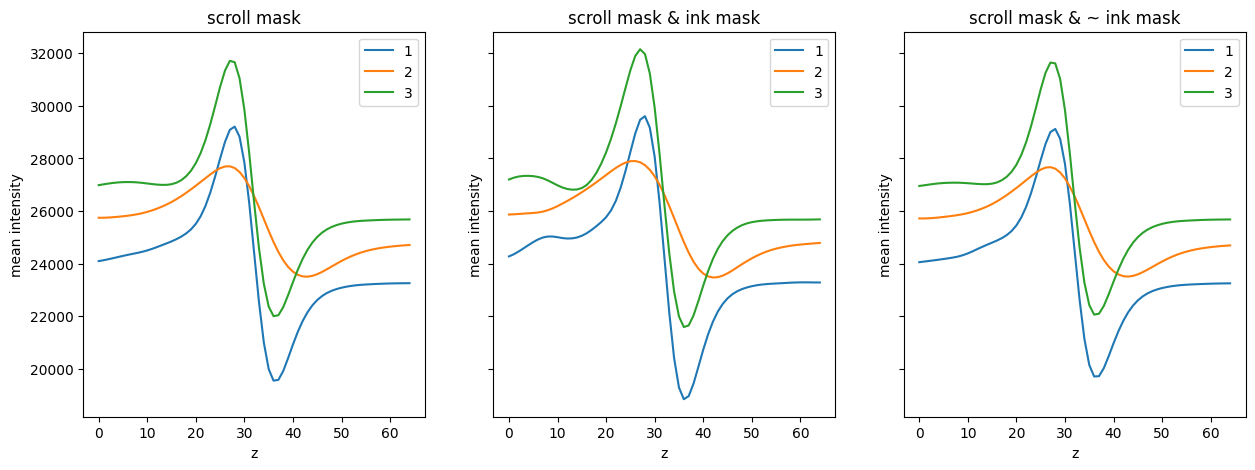\n\nHere it could be observed that fragments 1 and 3 are more or less similar in terms of both intencity values and minimum and maximum positions, while fragment 2 is different. \n\nMy physical intuition behind this is following: papirus seems not being aligned by depth inside 3D volume, moreover papirus thinknes seems to vary between fragments 1, 3 and fragment 2. \n\nSo, I've decided to align and stretch / compress papirus in z dimension by shift and scale operation:\n\n1. Split the volume on overlapping patches in H and W dimentions\n2. For each patch \n- calculate mean intensity of each layer\n- fit `z_shift` parameter to minimize following loss (`y_target` here is the intensity curve of full fragment 3)\n```\nz_shifted = z + z_shift\nf = interpolate.interp1d(z_shifted, y, bounds_error=False, fill_value='extrapolate')\nreturn f(z_target) - y_target\n```\n3. For full volume fit single `z_scale` (assuming pairus thickness is same for same fragment) in a similar manner.\n4. Linearly upsample resulting `z_shift` and `z_scale` maps to full volume size and save them on disk.\n5. Apply `z_shift` and `z_scale` to full volume via `scipy.ndimage.geometric_transform` with transform writen as C module for speed.\n6. For training save it on disk, for inference apply on the fly.\n\nResulting `z_shift` maps and `z_scale` values are following:\n|Fragment 1|Fragment 2|Fragment 3|\n| -------- | ------ | ---------- |\n||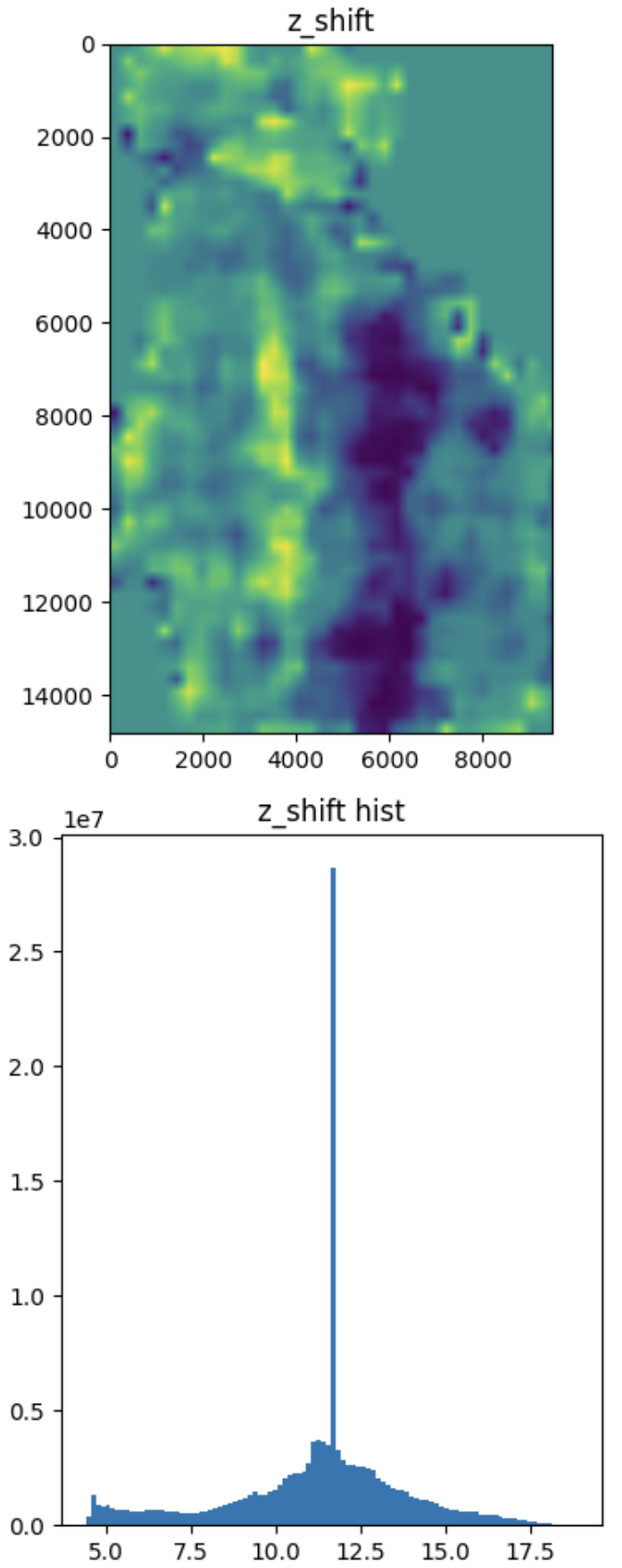|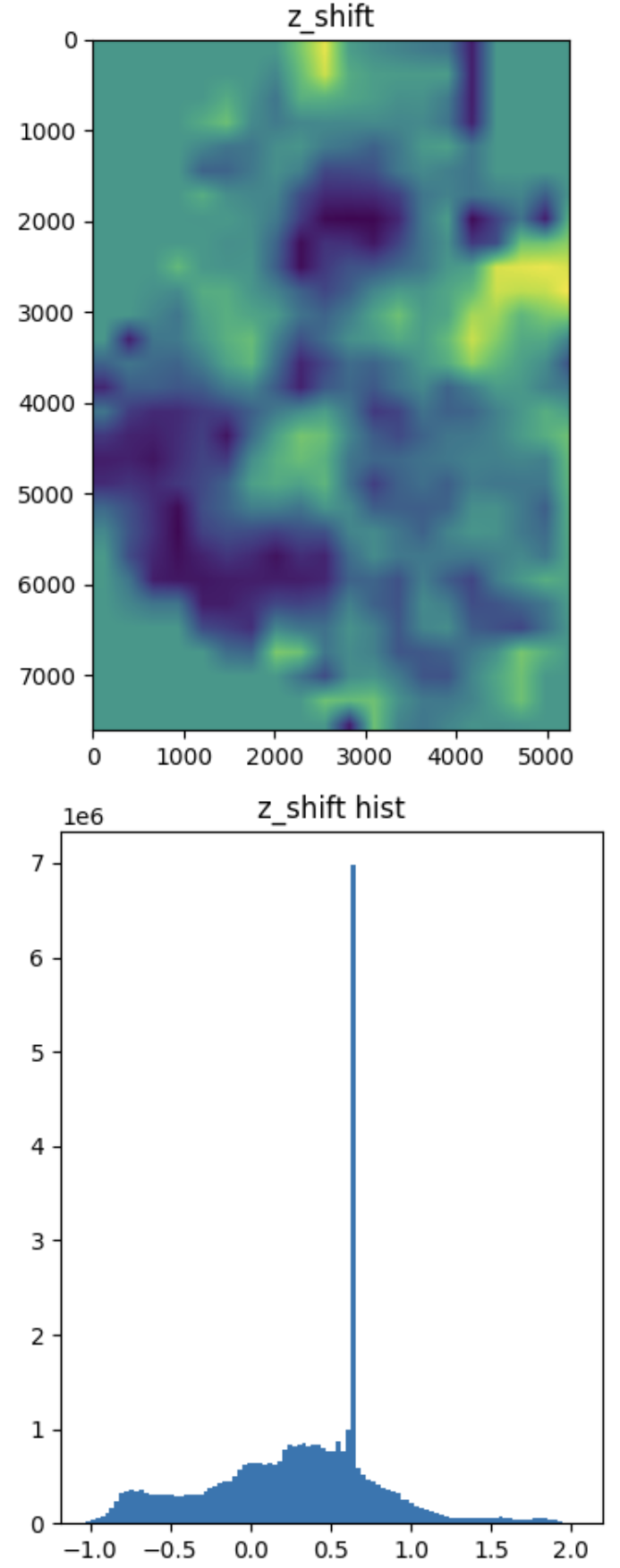|\n\nZ scale is ~ 1.0 for fragments 1 and 3 and ~ 0.6 for fragment 2 which could indicate the fragment 2 being ~ twice thicker that others.\n\nSuch operation should be beneficial for 2D approaches. It seems to improve CV on ~0.03-0.05 F05, but I did not run full comparison due to time constraints.\n\nAlso, I've tried to fit / calculate normalization for each fragment separately to completely fit the intencity curve, but it did not work well.\n\n## Model\n\nPre-trained maxvit encoder + SMP 2D unet with aggregation has shown the best CV score, so `maxvit_rmlp_base_rw_384.sw_in12k_ft_in1k` is the one used in best solution. \n\n2D unet with aggregation works as follows: unet model is applied on each slice of the input with size = step = 3 along z dimention (total 6 slices), then 6 resulting logits are aggregated via linear layer.\n\nUsage of pre-trained models is yielding far better results that random initialization. Unfortunately I did not came up with better architecture allowing to handle 3D inputs and 2D outputs while allowing to use pre-trained models.\n\nBest CV scores of ths model and corresponding predictions are following:\n\n| Fragment | F05 | Prediction |\n| -------- | ------ | ---------- |\n|1 | 0.6544 |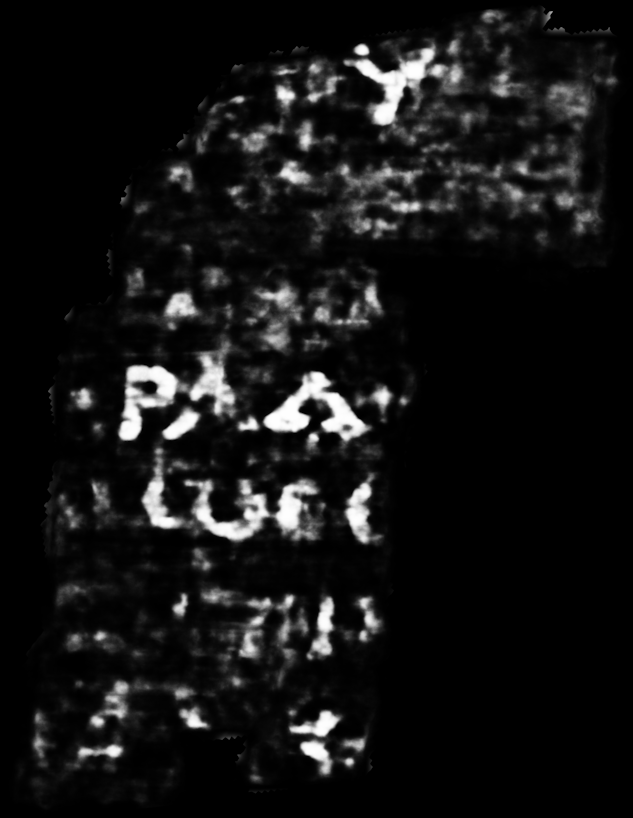|\n|2a | 0.6643 |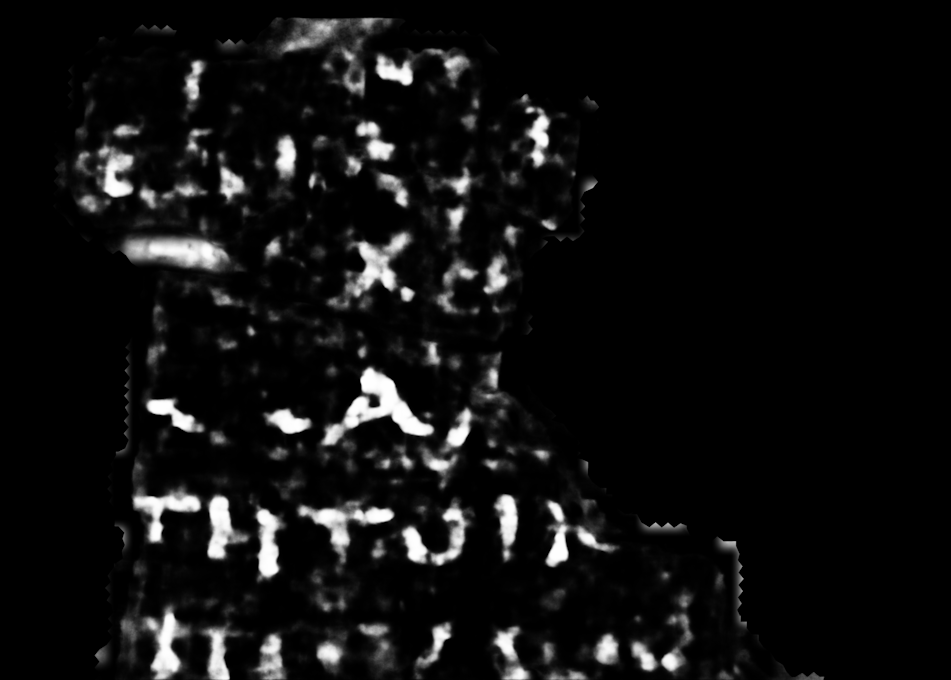|\n|2b | 0.7489 |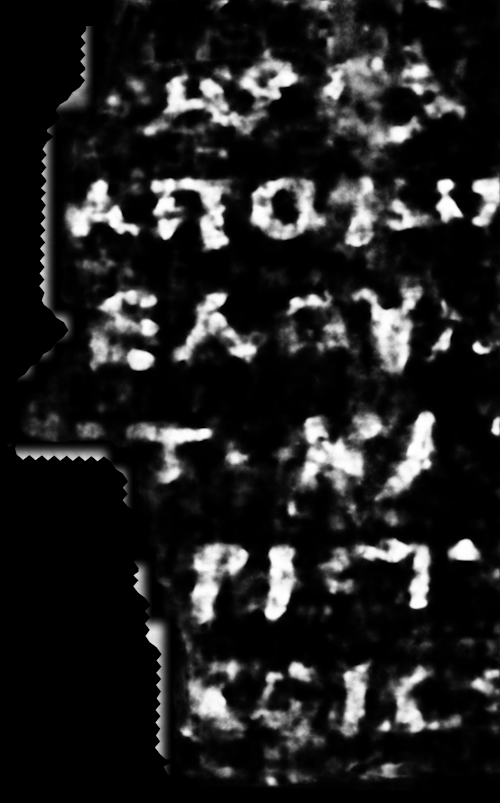|\n|2c | 0.6583 |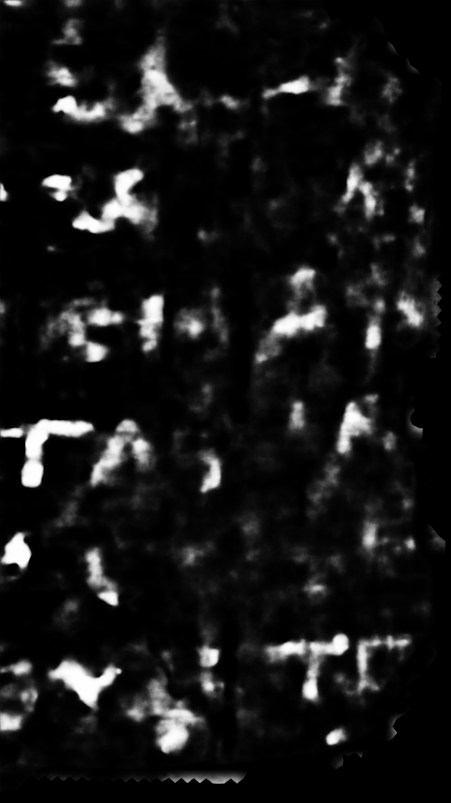|\n|3 | 0.7027 |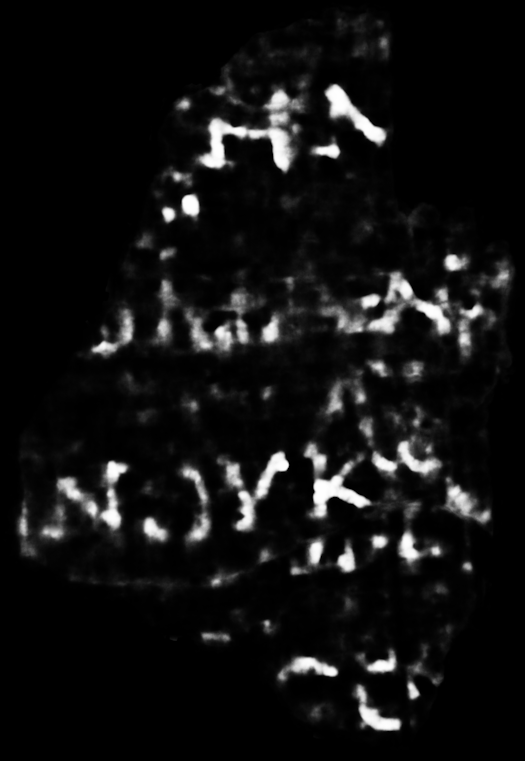|\n\n**Tried, but did not work well**\n\nMultiple backbone models:\n- convnext v2\n- swin transformer v2\n- caformer\n- eve02\n- maxvit \n\nAnd multiple full model approaches: full 3D with aggregation on the last layer, 2.5D, 2D with aggregation, custom 3D models with pre-trained weights conversion from 2D to 3D.\n\n## Transforms\n\nFollowing augmentations are used for training\n```\ntrain_transform = A.Compose(\n [\n RandomCropVolumeInside2dMask(\n base_size=self.hparams.img_size, \n base_depth=self.hparams.img_size_z,\n scale=(0.5, 2.0),\n ratio=(0.9, 1.1),\n scale_z=(1 / self.hparams.z_scale_limit, self.hparams.z_scale_limit),\n always_apply=True,\n crop_mask_index=0,\n ),\n A.Rotate(\n p=0.5, \n limit=rotate_limit_degrees_xy, \n crop_border=False,\n ),\n ResizeVolume(\n height=self.hparams.img_size, \n width=self.hparams.img_size,\n depth=self.hparams.img_size_z,\n always_apply=True,\n ),\n A.HorizontalFlip(p=0.5),\n A.VerticalFlip(p=0.5),\n A.RandomRotate90(p=0.5),\n A.RandomBrightnessContrast(p=0.5, brightness_limit=0.1, contrast_limit=0.1),\n A.OneOf(\n [\n A.GaussNoise(var_limit=[10, 50]),\n A.GaussianBlur(),\n A.MotionBlur(),\n ], \n p=0.4\n ),\n A.GridDistortion(num_steps=5, distort_limit=0.3, p=0.5),\n A.CoarseDropout(\n max_holes=1, \n max_width=int(self.hparams.img_size * 0.3), \n max_height=int(self.hparams.img_size * 0.3), \n mask_fill_value=0, p=0.5\n ),\n A.Normalize(\n max_pixel_value=MAX_PIXEL_VALUE,\n mean=self.train_volume_mean,\n std=self.train_volume_std,\n always_apply=True,\n ),\n ToTensorV2(),\n ToCHWD(always_apply=True),\n ],\n)\n```\n\nHere, `RandomCropVolumeInside2dMask` crops random 3D patch from volume so that its center's (x, y) are inside mask, `ResizeVolume` is trilinear 3D resize and `ToCHWD` simply permutes dimentions. `img_size` = 384, `img_size_z` = 18, `z_scale_limit` = 1.33, `rotate_limit_degrees_xy` = 45, `train_volume_mean` and `train_volume_std` are average of imagenet stats.\n\nFor inference, following transforms are used\n\n```\ntest_transform = A.Compose(\n [\n CenterCropVolume(\n height=None, \n width=None,\n depth=math.ceil(self.hparams.img_size_z * self.hparams.z_scale_limit),\n strict=True,\n always_apply=True,\n p=1.0,\n ),\n ResizeVolume(\n height=self.hparams.img_size, \n width=self.hparams.img_size,\n depth=self.hparams.img_size_z,\n always_apply=True,\n ),\n A.Normalize(\n max_pixel_value=MAX_PIXEL_VALUE,\n mean=self.train_volume_mean,\n std=self.train_volume_std,\n always_apply=True,\n ),\n ToTensorV2(),\n ToCHWD(always_apply=True),\n ],\n)\n```\n\nHere, `CenterCropVolume` is center crop of 3D volume.\n\nMixing approaches (cutmix, mixup, custom stuff like copy-paste the positive class voxels) also were tried but shown contradicting results, so were not included.\n\nCartesian product of `no flip / H flip / V flip` and `no 90 rotation / 90 rotation / 180 rotation / 270 rotation` is used for TTA yielding total 12 predictions.\n\n**Update**: project source code for training could be found [here](https://github.com/mkotyushev/scrolls)", "votes": 10 } ], "comments": [], "raw_markdown_by_id": { "2304186": "Hello everyone! Here is a write-up of my best private leaderboard solution (top 13 with 0.641814 score, 0.723345 on public LB). \n\nI am very grateful to organizers and participants for this competition, it was very interesting and challenging. I've learned a lot about segmentation and had a lot of fun! Some of the ideas I have used in the solution came from code / discussion tabs on Kaggle, hopefully I have mentioned them all.\n\nIf you have any questions, please do not hesitate to reach me in comments.\n\n# Overview\n\nData:\n- Z shift and scale pre-processing based on mean layer intensity curve fitting to fragment 3's mean intensity curve (inspired by [this](https://www.kaggle.com/code/ajland/eda-a-slice-by-slice-analysis) notebook)\n- 5 fold training (1, 2a, 2b, 2c, 3 fragments, 2nd fragment is split by scroll mask area: top part + 2 bottom parts)\n- weighted sampling from fragments according to scroll mask area\n- patch size is 384, on test overlap is 192 via spline-weighted averaging (inspired by [this](https://github.com/bnsreenu/python_for_microscopists/blob/master/229_smooth_predictions_by_blending_patches/smooth_tiled_predictions.py) approach)\n- 24 slices with indices in [20, 44), random crop of 18 of them, each 3 slices window is fed to model and 6 resulting logits aggregated via linear layer\n\nTraining:\n- model is SMP Unet with 2D pre-trained encoder + linear layer aggregation\n- random crop inside scroll mask + standard vision augmentations\n- BCE loss with 0.5 weight of positive examples, selection by F0.5 score on validation fold\n- 64 epoch training, epoch length is ~ number of patches in train set (it is not constant because of random cropping)\n- LR is 1e-4, no layers freezing / LR decay, schedule is cosine annealing with warmup (1e-1, 1, 1e-2 factors, 10% warmup), optimizer is AdamW\n\nInference:\n- TTA: cartesian product of 4 rotations (0, 90, 180, 270) and 3 flips (no flip, horizontal, vertical) -> 12 predictions per volume (brought this idea from [here](https://www.kaggle.com/code/yoyobar/2-5d-segmentaion-model-with-rotate-tta))\n- TTA probabilities are averaged, writen to image file, then 5 models images averaged\n\nEnvironment & tools:\n- docker, pytorch lightning CLI, wandb\n- 1 x 3090, 1 x 3080Ti mobile\n\n# Some details\n## Data\n\nInspired by [this](https://www.kaggle.com/code/ajland/eda-a-slice-by-slice-analysis) analysis, I plot the mean intensity of each layer of each fragment for full image, only for ink and only for backgound.\n\n\n\nHere it could be observed that fragments 1 and 3 are more or less similar in terms of both intencity values and minimum and maximum positions, while fragment 2 is different. \n\nMy physical intuition behind this is following: papirus seems not being aligned by depth inside 3D volume, moreover papirus thinknes seems to vary between fragments 1, 3 and fragment 2. \n\nSo, I've decided to align and stretch / compress papirus in z dimension by shift and scale operation:\n\n1. Split the volume on overlapping patches in H and W dimentions\n2. For each patch \n- calculate mean intensity of each layer\n- fit `z_shift` parameter to minimize following loss (`y_target` here is the intensity curve of full fragment 3)\n```\nz_shifted = z + z_shift\nf = interpolate.interp1d(z_shifted, y, bounds_error=False, fill_value='extrapolate')\nreturn f(z_target) - y_target\n```\n3. For full volume fit single `z_scale` (assuming pairus thickness is same for same fragment) in a similar manner.\n4. Linearly upsample resulting `z_shift` and `z_scale` maps to full volume size and save them on disk.\n5. Apply `z_shift` and `z_scale` to full volume via `scipy.ndimage.geometric_transform` with transform writen as C module for speed.\n6. For training save it on disk, for inference apply on the fly.\n\nResulting `z_shift` maps and `z_scale` values are following:\n|Fragment 1|Fragment 2|Fragment 3|\n| -------- | ------ | ---------- |\n||||\n\nZ scale is ~ 1.0 for fragments 1 and 3 and ~ 0.6 for fragment 2 which could indicate the fragment 2 being ~ twice thicker that others.\n\nSuch operation should be beneficial for 2D approaches. It seems to improve CV on ~0.03-0.05 F05, but I did not run full comparison due to time constraints.\n\nAlso, I've tried to fit / calculate normalization for each fragment separately to completely fit the intencity curve, but it did not work well.\n\n## Model\n\nPre-trained maxvit encoder + SMP 2D unet with aggregation has shown the best CV score, so `maxvit_rmlp_base_rw_384.sw_in12k_ft_in1k` is the one used in best solution. \n\n2D unet with aggregation works as follows: unet model is applied on each slice of the input with size = step = 3 along z dimention (total 6 slices), then 6 resulting logits are aggregated via linear layer.\n\nUsage of pre-trained models is yielding far better results that random initialization. Unfortunately I did not came up with better architecture allowing to handle 3D inputs and 2D outputs while allowing to use pre-trained models.\n\nBest CV scores of ths model and corresponding predictions are following:\n\n| Fragment | F05 | Prediction |\n| -------- | ------ | ---------- |\n|1 | 0.6544 ||\n|2a | 0.6643 ||\n|2b | 0.7489 ||\n|2c | 0.6583 ||\n|3 | 0.7027 ||\n\n**Tried, but did not work well**\n\nMultiple backbone models:\n- convnext v2\n- swin transformer v2\n- caformer\n- eve02\n- maxvit \n\nAnd multiple full model approaches: full 3D with aggregation on the last layer, 2.5D, 2D with aggregation, custom 3D models with pre-trained weights conversion from 2D to 3D.\n\n## Transforms\n\nFollowing augmentations are used for training\n```\ntrain_transform = A.Compose(\n [\n RandomCropVolumeInside2dMask(\n base_size=self.hparams.img_size, \n base_depth=self.hparams.img_size_z,\n scale=(0.5, 2.0),\n ratio=(0.9, 1.1),\n scale_z=(1 / self.hparams.z_scale_limit, self.hparams.z_scale_limit),\n always_apply=True,\n crop_mask_index=0,\n ),\n A.Rotate(\n p=0.5, \n limit=rotate_limit_degrees_xy, \n crop_border=False,\n ),\n ResizeVolume(\n height=self.hparams.img_size, \n width=self.hparams.img_size,\n depth=self.hparams.img_size_z,\n always_apply=True,\n ),\n A.HorizontalFlip(p=0.5),\n A.VerticalFlip(p=0.5),\n A.RandomRotate90(p=0.5),\n A.RandomBrightnessContrast(p=0.5, brightness_limit=0.1, contrast_limit=0.1),\n A.OneOf(\n [\n A.GaussNoise(var_limit=[10, 50]),\n A.GaussianBlur(),\n A.MotionBlur(),\n ], \n p=0.4\n ),\n A.GridDistortion(num_steps=5, distort_limit=0.3, p=0.5),\n A.CoarseDropout(\n max_holes=1, \n max_width=int(self.hparams.img_size * 0.3), \n max_height=int(self.hparams.img_size * 0.3), \n mask_fill_value=0, p=0.5\n ),\n A.Normalize(\n max_pixel_value=MAX_PIXEL_VALUE,\n mean=self.train_volume_mean,\n std=self.train_volume_std,\n always_apply=True,\n ),\n ToTensorV2(),\n ToCHWD(always_apply=True),\n ],\n)\n```\n\nHere, `RandomCropVolumeInside2dMask` crops random 3D patch from volume so that its center's (x, y) are inside mask, `ResizeVolume` is trilinear 3D resize and `ToCHWD` simply permutes dimentions. `img_size` = 384, `img_size_z` = 18, `z_scale_limit` = 1.33, `rotate_limit_degrees_xy` = 45, `train_volume_mean` and `train_volume_std` are average of imagenet stats.\n\nFor inference, following transforms are used\n\n```\ntest_transform = A.Compose(\n [\n CenterCropVolume(\n height=None, \n width=None,\n depth=math.ceil(self.hparams.img_size_z * self.hparams.z_scale_limit),\n strict=True,\n always_apply=True,\n p=1.0,\n ),\n ResizeVolume(\n height=self.hparams.img_size, \n width=self.hparams.img_size,\n depth=self.hparams.img_size_z,\n always_apply=True,\n ),\n A.Normalize(\n max_pixel_value=MAX_PIXEL_VALUE,\n mean=self.train_volume_mean,\n std=self.train_volume_std,\n always_apply=True,\n ),\n ToTensorV2(),\n ToCHWD(always_apply=True),\n ],\n)\n```\n\nHere, `CenterCropVolume` is center crop of 3D volume.\n\nMixing approaches (cutmix, mixup, custom stuff like copy-paste the positive class voxels) also were tried but shown contradicting results, so were not included.\n\nCartesian product of `no flip / H flip / V flip` and `no 90 rotation / 90 rotation / 180 rotation / 270 rotation` is used for TTA yielding total 12 predictions.\n\n**Update**: project source code for training could be found [here](https://github.com/mkotyushev/scrolls)" } }