{
"id": 460192,
"title": "11th place solution: Transformer with MFE distance embeddings (with code)",
"url": "/competitions/stanford-ribonanza-rna-folding/writeups/maxim-tsygankov-11th-place-solution-transformer-wi",
"author_name": "",
"post_date": "2023-12-08T06:35:24.887123700Z",
"votes": 16,
"comment_count": 1,
"views": 0,
"content": "I greatly appreciate the efforts of the hosts in organizing this competition. This was an unfamiliar domain filled with both challenges and fun. I wonder if the competition was worth it for organizers after all. Hopefully, the solutions shared by kagglers will prove beneficial to you and other researchers.
\nHere is a quick summary of my solution:
\nFeatures
\n\n- Eternafold MFE and BPPs: I experimented with other packages (RNAstructure, Vienna, CONTRAfold, rnasoft, ipknot). I found that only the features from Eternafold contributed significantly to my model.
\n- CapR structure. This led to faster convergence of the model.
\n- bpRNA structure. I am unsure of its contribution to the score.
\n
\nModel architecture
\nI forked Huggingface's BERT and implemented several modifications:
\n\n- Attention injection support: I added BPPs with 2d cnn on top to 8/16 of model's attention heads. The most effective variant involved a separate CNN layer for each attention head. However, this significantly increased training time with only a marginal improvement in score. I sacrificed a few score points in favor of faster experimentation. Most of my models in the final ensemble only use one 2d cnn layer per transformer block.
\n- 1d CNN layers between transformer layers: This addition was based on the premise that closely situated nucleotides influence each other, and a CNN layer could effectively extract these features.
\n- Relative embeddings: I only used relative embeddings in my model. Initially, they seemed a safer choice due to the length differences between train/test sequences. More importantly, they appeared more intuitive in the context of RNA structure, as opposed to absolute embeddings. I used two distance types:
\n- The shortest distance along ribose-phosphate chain.
\n- The shortest distance along the MFE structure.
\n- To illustrate this point, consider the image below, which depicts an RNA molecule from this notebook. C and G are encircled and located at opposite ends of the RNA chain. Despite their positioning, they are actually paired with each other, indicating that the distance between them is merely 1 in terms of the RNA folding structure.
\n
\n
\nPerformance
\nThe single model achieved a public score of approximately 0.1432. However, by averaging models with minor variations, I was able to achieve a score below 0.14.
\nThe code is available at https://github.com/chubasik/stanford-ribonanza-rna-folding
\nP.S: I had to post it a second time for it to be marked as a write-up
",
"messages": [
{
"id": "2553321",
"postDate": "12/08/2023 06:35:24",
"content": "I greatly appreciate the efforts of the hosts in organizing this competition. This was an unfamiliar domain filled with both challenges and fun. I wonder if the competition was worth it for organizers after all. Hopefully, the solutions shared by kagglers will prove beneficial to you and other researchers.
\nHere is a quick summary of my solution:
\nFeatures
\n\n- Eternafold MFE and BPPs: I experimented with other packages (RNAstructure, Vienna, CONTRAfold, rnasoft, ipknot). I found that only the features from Eternafold contributed significantly to my model.
\n- CapR structure. This led to faster convergence of the model.
\n- bpRNA structure. I am unsure of its contribution to the score.
\n
\nModel architecture
\nI forked Huggingface's BERT and implemented several modifications:
\n\n- Attention injection support: I added BPPs with 2d cnn on top to 8/16 of model's attention heads. The most effective variant involved a separate CNN layer for each attention head. However, this significantly increased training time with only a marginal improvement in score. I sacrificed a few score points in favor of faster experimentation. Most of my models in the final ensemble only use one 2d cnn layer per transformer block.
\n- 1d CNN layers between transformer layers: This addition was based on the premise that closely situated nucleotides influence each other, and a CNN layer could effectively extract these features.
\n- Relative embeddings: I only used relative embeddings in my model. Initially, they seemed a safer choice due to the length differences between train/test sequences. More importantly, they appeared more intuitive in the context of RNA structure, as opposed to absolute embeddings. I used two distance types:
\n- The shortest distance along ribose-phosphate chain.
\n- The shortest distance along the MFE structure.
\n- To illustrate this point, consider the image below, which depicts an RNA molecule from this notebook. C and G are encircled and located at opposite ends of the RNA chain. Despite their positioning, they are actually paired with each other, indicating that the distance between them is merely 1 in terms of the RNA folding structure.
\n
\n
\nPerformance
\nThe single model achieved a public score of approximately 0.1432. However, by averaging models with minor variations, I was able to achieve a score below 0.14.
\nThe code is available at https://github.com/chubasik/stanford-ribonanza-rna-folding
\nP.S: I had to post it a second time for it to be marked as a write-up
",
"rawMarkdown": "I greatly appreciate the efforts of the hosts in organizing this competition. This was an unfamiliar domain filled with both challenges and fun. I wonder if the competition was worth it for organizers after all. Hopefully, the solutions shared by kagglers will prove beneficial to you and other researchers.\n\nHere is a quick summary of my solution:\n## Features\n* **Eternafold MFE and BPPs**: I experimented with other packages (RNAstructure, Vienna, CONTRAfold, rnasoft, ipknot). I found that only the features from Eternafold contributed significantly to my model.\n* **CapR structure**. This led to faster convergence of the model.\n* **bpRNA structure**. I am unsure of its contribution to the score.\n\n## Model architecture\nI forked Huggingface's BERT and implemented several modifications:\n* **Attention injection support**: I added BPPs with 2d cnn on top to 8/16 of model's attention heads. The most effective variant involved a separate CNN layer for each attention head. However, this significantly increased training time with only a marginal improvement in score. I sacrificed a few score points in favor of faster experimentation. Most of my models in the final ensemble only use one 2d cnn layer per transformer block.\n* **1d CNN layers between transformer layers**: This addition was based on the premise that closely situated nucleotides influence each other, and a CNN layer could effectively extract these features.\n* **Relative embeddings**: I only used relative embeddings in my model. Initially, they seemed a safer choice due to the length differences between train/test sequences. More importantly, they appeared more intuitive in the context of RNA structure, as opposed to absolute embeddings. I used two distance types:\n * The shortest distance along ribose-phosphate chain.\n * The shortest distance along the MFE structure. \n * To illustrate this point, consider the image below, which depicts an RNA molecule from [this notebook](https://www.kaggle.com/code/brainbowrna/rna-science-computational-environment). C and G are encircled and located at opposite ends of the RNA chain. Despite their positioning, they are actually paired with each other, indicating that the distance between them is merely 1 in terms of the RNA folding structure. \n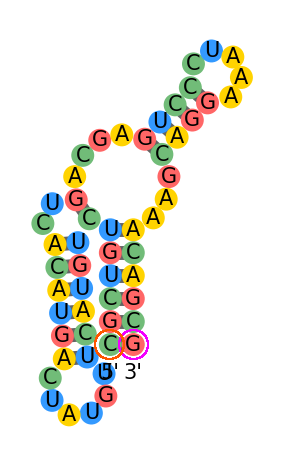\n\n## Performance\nThe single model achieved a public score of approximately 0.1432. However, by averaging models with minor variations, I was able to achieve a score below 0.14. \n\nThe code is available at https://github.com/chubasik/stanford-ribonanza-rna-folding\n\nP.S: I had to post it a second time for it to be marked as a write-up",
"votes": null
},
{
"id": "2553470",
"postDate": "12/08/2023 09:20:58",
"content": "Congratulations on being the topper in the competition. Also, thank you for sharing the method.
",
"rawMarkdown": "Congratulations on being the topper in the competition. Also, thank you for sharing the method.",
"votes": null
}
],
"comments": [
{
"id": 2553470,
"author_name": "sarunpm",
"author_url": "",
"post_date": "12/08/2023 09:20:58",
"content": "Congratulations on being the topper in the competition. Also, thank you for sharing the method.
",
"votes": null,
"replies": []
}
],
"raw_markdown_by_id": {
"2553321": "I greatly appreciate the efforts of the hosts in organizing this competition. This was an unfamiliar domain filled with both challenges and fun. I wonder if the competition was worth it for organizers after all. Hopefully, the solutions shared by kagglers will prove beneficial to you and other researchers.\n\nHere is a quick summary of my solution:\n## Features\n* **Eternafold MFE and BPPs**: I experimented with other packages (RNAstructure, Vienna, CONTRAfold, rnasoft, ipknot). I found that only the features from Eternafold contributed significantly to my model.\n* **CapR structure**. This led to faster convergence of the model.\n* **bpRNA structure**. I am unsure of its contribution to the score.\n\n## Model architecture\nI forked Huggingface's BERT and implemented several modifications:\n* **Attention injection support**: I added BPPs with 2d cnn on top to 8/16 of model's attention heads. The most effective variant involved a separate CNN layer for each attention head. However, this significantly increased training time with only a marginal improvement in score. I sacrificed a few score points in favor of faster experimentation. Most of my models in the final ensemble only use one 2d cnn layer per transformer block.\n* **1d CNN layers between transformer layers**: This addition was based on the premise that closely situated nucleotides influence each other, and a CNN layer could effectively extract these features.\n* **Relative embeddings**: I only used relative embeddings in my model. Initially, they seemed a safer choice due to the length differences between train/test sequences. More importantly, they appeared more intuitive in the context of RNA structure, as opposed to absolute embeddings. I used two distance types:\n * The shortest distance along ribose-phosphate chain.\n * The shortest distance along the MFE structure. \n * To illustrate this point, consider the image below, which depicts an RNA molecule from [this notebook](https://www.kaggle.com/code/brainbowrna/rna-science-computational-environment). C and G are encircled and located at opposite ends of the RNA chain. Despite their positioning, they are actually paired with each other, indicating that the distance between them is merely 1 in terms of the RNA folding structure. \n\n\n## Performance\nThe single model achieved a public score of approximately 0.1432. However, by averaging models with minor variations, I was able to achieve a score below 0.14. \n\nThe code is available at https://github.com/chubasik/stanford-ribonanza-rna-folding\n\nP.S: I had to post it a second time for it to be marked as a write-up",
"2553470": "Congratulations on being the topper in the competition. Also, thank you for sharing the method."
},
"source": "meta"
}