 \n
\n \n
\n
```\ndef hair_remove(image):\n # convert image to grayScale\n grayScale = cv2.cvtColor(image, cv2.COLOR_RGB2GRAY)
\n\n# kernel for morphologyEx\nkernel = cv2.getStructuringElement(1,(17,17))\n\n# apply MORPH_BLACKHAT to grayScale image\nblackhat = cv2.morphologyEx(grayScale, cv2.MORPH_BLACKHAT, kernel)\n\n# apply thresholding to blackhat\n_,threshold = cv2.threshold(blackhat,10,255,cv2.THRESH_BINARY)\n\n# inpaint with original image and threshold image\nfinal_image = cv2.inpaint(image,threshold,1,cv2.INPAINT_TELEA)\n\nreturn final_image\n```
\n\n\n\n

```\ndef hair_remove(image):\n # convert image to grayScale\n grayScale = cv2.cvtColor(image, cv2.COLOR_RGB2GRAY)
\n\n# kernel for morphologyEx\nkernel = cv2.getStructuringElement(1,(17,17))\n\n# apply MORPH_BLACKHAT to grayScale image\nblackhat = cv2.morphologyEx(grayScale, cv2.MORPH_BLACKHAT, kernel)\n\n# apply thresholding to blackhat\n_,threshold = cv2.threshold(blackhat,10,255,cv2.THRESH_BINARY)\n\n# inpaint with original image and threshold image\nfinal_image = cv2.inpaint(image,threshold,1,cv2.INPAINT_TELEA)\n\nreturn final_image\n```
\n\n\n\n
I used this augmentation. But It's performance is low. I used both in TTA and Without TTA.\nWith Hair :- 0.937\nWithout Hair :- 0.928\nWithout hair and Test data also without hair:- 0.926
", "rawMarkdown": "I used this augmentation. But It's performance is low. I used both in TTA and Without TTA.\nWith Hair :- 0.937\nWithout Hair :- 0.928\nWithout hair and Test data also without hair:- 0.926", "votes": 7 }, { "id": 930120, "postDate": "2020-07-15T08:01:21.350Z", "content": "I used hair removal early on but abandoned it as it does not seem to improve over adding of hair.
", "rawMarkdown": "I used hair removal early on but abandoned it as it does not seem to improve over adding of hair.", "votes": 3 }, { "id": 948482, "postDate": "2020-07-28T02:13:32.103Z", "content": "Hi, by applying hair removal, my LB score get lower. So, I give up applying such augmentation.
", "rawMarkdown": "Hi, by applying hair removal, my LB score get lower. So, I give up applying such augmentation.", "votes": 1 }, { "id": 922737, "postDate": "2020-07-10T09:58:55.377Z", "content": "Hair removal techniques were already discussed several weeks ago. Thank you for sharing Python code though 👍
\n\nIn training data, there are about 100 images with hair out of 584 Malignant.
\n\nPlease check this thread Augmentation technique to add hair, where several participants (Roman, PC Jimmy, Aykhan.py) reported improvement of score.
", "rawMarkdown": "[Hair removal](https://www.kaggle.com/c/siim-isic-melanoma-classification/discussion/154859) techniques were already discussed several weeks ago. Thank you for sharing Python code though 👍 \n\nIn training data, there are about 100 images with hair out of 584 Malignant.\n\nPlease check this thread [Augmentation technique to add hair](https://www.kaggle.com/c/siim-isic-melanoma-classification/discussion/159176), where several participants (Roman, PC Jimmy, Aykhan.py) reported improvement of score.", "votes": 1, "replies": [ { "id": 923707, "postDate": "2020-07-11T05:01:40.897Z", "content": "My hair removal code the same basic - assume we both found the same two year old git.
\n\nI used mine with a 0.5 probability and results got worse - about the same change as Gyanendra reported. As you noted the hair percentage in images is around 20% - when I used with a probability of 0.10 than I did see a gain. So I think to use with benefit you don't want to over use it. The real trick would be to use it only on images with hair :)
\n\nI think the issue is that the method also will remove some not hair features - features that are likely helpful. You can see the features that will be removed in the threshold images that Vatsal generated. There are 4 of the images where stuff other than air is being removed.
", "rawMarkdown": "My hair removal code the same basic - assume we both found the same two year old git.\n\nI used mine with a 0.5 probability and results got worse - about the same change as Gyanendra reported. As you noted the hair percentage in images is around 20% - when I used with a probability of 0.10 than I did see a gain. So I think to use with benefit you don't want to over use it. The real trick would be to use it only on images with hair :)\n\nI think the issue is that the method also will remove some not hair features - features that are likely helpful. You can see the features that will be removed in the threshold images that Vatsal generated. There are 4 of the images where stuff other than air is being removed.", "votes": 2 } ] }, { "id": 2888101, "postDate": "2024-06-24T15:38:20.117Z", "content": "oh great dataset
", "rawMarkdown": "oh great dataset\n" }, { "id": 932751, "postDate": "2020-07-17T08:54:42.873Z", "content": "Thank you for this! I was thinking along this line for a while.
\n\nCan you share to what extent this altered the overall performance?
", "rawMarkdown": "Thank you for this! I was thinking along this line for a while.\n\nCan you share to what extent this altered the overall performance?" }, { "id": 929410, "postDate": "2020-07-14T16:47:01.213Z", "content": "Very nice work!!
", "rawMarkdown": "Very nice work!!" }, { "id": 923628, "postDate": "2020-07-11T03:18:15.773Z", "rawMarkdown": "", "votes": 1, "isDeleted": true, "replies": [ { "id": 923647, "postDate": "2020-07-11T03:56:17.210Z", "content": "Yes, threshold give you final mask image with detected hair.
", "rawMarkdown": "Yes, threshold give you final mask image with detected hair." } ] } ], "comments": [ { "id": 922706, "author_name": "PIkachu", "author_url": "", "post_date": "2020-07-10T09:30:47.057000", "content": "I used this augmentation. But It's performance is low. I used both in TTA and Without TTA.\nWith Hair :- 0.937\nWithout Hair :- 0.928\nWithout hair and Test data also without hair:- 0.926
", "votes": 7, "replies": [] }, { "id": 930120, "author_name": "Signal", "author_url": "", "post_date": "2020-07-15T08:01:21.350000", "content": "I used hair removal early on but abandoned it as it does not seem to improve over adding of hair.
", "votes": 3, "replies": [] }, { "id": 948482, "author_name": "Zhiwei Ren", "author_url": "", "post_date": "2020-07-28T02:13:32.103000", "content": "Hi, by applying hair removal, my LB score get lower. So, I give up applying such augmentation.
", "votes": 1, "replies": [] }, { "id": 922737, "author_name": "Sirish Somanchi", "author_url": "", "post_date": "2020-07-10T09:58:55.377000", "content": "Hair removal techniques were already discussed several weeks ago. Thank you for sharing Python code though 👍
\n\nIn training data, there are about 100 images with hair out of 584 Malignant.
\n\nPlease check this thread Augmentation technique to add hair, where several participants (Roman, PC Jimmy, Aykhan.py) reported improvement of score.
", "votes": 1, "replies": [ { "id": 923707, "author_name": "PC Jimmmy", "author_url": "", "post_date": "2020-07-11T05:01:40.897000", "content": "My hair removal code the same basic - assume we both found the same two year old git.
\n\nI used mine with a 0.5 probability and results got worse - about the same change as Gyanendra reported. As you noted the hair percentage in images is around 20% - when I used with a probability of 0.10 than I did see a gain. So I think to use with benefit you don't want to over use it. The real trick would be to use it only on images with hair :)
\n\nI think the issue is that the method also will remove some not hair features - features that are likely helpful. You can see the features that will be removed in the threshold images that Vatsal generated. There are 4 of the images where stuff other than air is being removed.
", "votes": 2, "replies": [] } ] }, { "id": 2888101, "author_name": "Wizbi_k", "author_url": "", "post_date": "2024-06-24T15:38:20.117000", "content": "oh great dataset
", "votes": 0, "replies": [] }, { "id": 932751, "author_name": "Aditya Baurai", "author_url": "", "post_date": "2020-07-17T08:54:42.873000", "content": "Thank you for this! I was thinking along this line for a while.
\n\nCan you share to what extent this altered the overall performance?
", "votes": 0, "replies": [] }, { "id": 929410, "author_name": "Anubhav Sharma", "author_url": "", "post_date": "2020-07-14T16:47:01.213000", "content": "Very nice work!!
", "votes": 0, "replies": [] }, { "id": 923628, "author_name": "", "author_url": "", "post_date": "2020-07-11T03:18:15.773000", "content": "", "votes": 1, "replies": [ { "id": 923647, "author_name": "Vatsal Parsaniya", "author_url": "", "post_date": "2020-07-11T03:56:17.210000", "content": "Yes, threshold give you final mask image with detected hair.
", "votes": 0, "replies": [] } ] } ], "raw_markdown_by_id": { "922673": "* There are many images with body hair covering the lesion so, hair remove operation can be useful for model focus on lesion part.\n* Method for hair remove using CV2 \n\n```\ndef hair_remove(image):\n # convert image to grayScale\n grayScale = cv2.cvtColor(image, cv2.COLOR_RGB2GRAY)\n \n # kernel for morphologyEx\n kernel = cv2.getStructuringElement(1,(17,17))\n \n # apply MORPH_BLACKHAT to grayScale image\n blackhat = cv2.morphologyEx(grayScale, cv2.MORPH_BLACKHAT, kernel)\n \n # apply thresholding to blackhat\n _,threshold = cv2.threshold(blackhat,10,255,cv2.THRESH_BINARY)\n \n # inpaint with original image and threshold image\n final_image = cv2.inpaint(image,threshold,1,cv2.INPAINT_TELEA)\n \n return final_image\n```\n\n* this technique works on black-Hair only (Not white hair)\n#### check notebook [here](https://www.kaggle.com/vatsalparsaniya/melanoma-hair-remove) \n## Example of body hair remove with this method:\n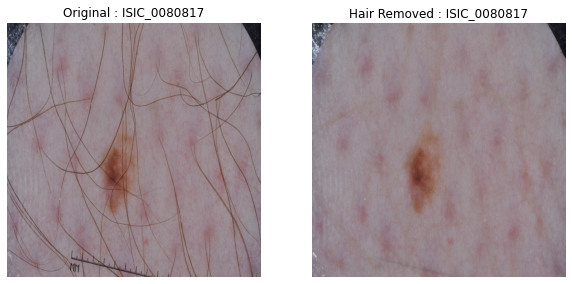\n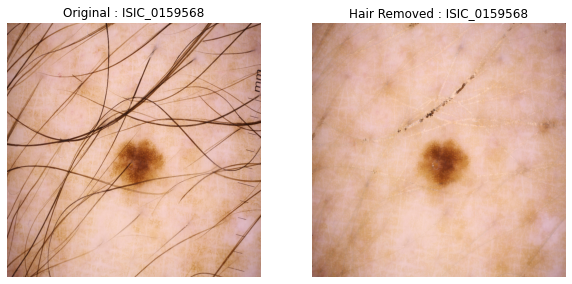\n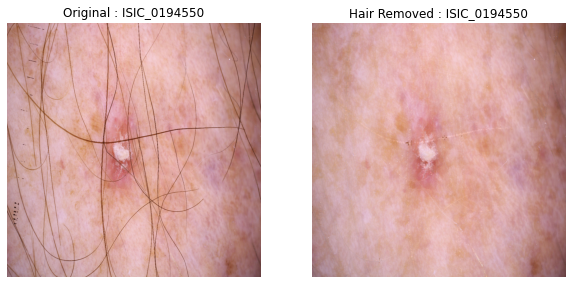\n\n## Visualizing all CV2 Operations \n\n\n### apply this method on data, please share how much it affects to your LB score\n\n### what do you think?? any suggestions for improvement.\n\n", "922706": "I used this augmentation. But It's performance is low. I used both in TTA and Without TTA.\nWith Hair :- 0.937\nWithout Hair :- 0.928\nWithout hair and Test data also without hair:- 0.926", "930120": "I used hair removal early on but abandoned it as it does not seem to improve over adding of hair.", "948482": "Hi, by applying hair removal, my LB score get lower. So, I give up applying such augmentation.", "922737": "[Hair removal](https://www.kaggle.com/c/siim-isic-melanoma-classification/discussion/154859) techniques were already discussed several weeks ago. Thank you for sharing Python code though 👍 \n\nIn training data, there are about 100 images with hair out of 584 Malignant.\n\nPlease check this thread [Augmentation technique to add hair](https://www.kaggle.com/c/siim-isic-melanoma-classification/discussion/159176), where several participants (Roman, PC Jimmy, Aykhan.py) reported improvement of score.", "2888101": "oh great dataset\n", "932751": "Thank you for this! I was thinking along this line for a while.\n\nCan you share to what extent this altered the overall performance?", "929410": "Very nice work!!", "923628": "" } }