\n

I was kind of surprised that only 3 out of 6 channels did so well identifying needle. I was able to get 0.93 on LB using this notebook
\nOne method we use to isolate candidate technosignatures from RFI is to look for signals that appear to be coming from particular positions on the sky. Typically we do this by alternating observations of our primary target star with observations of three nearby stars: 5 minutes on star “A”, then 5 minutes on star “B”, then back to star “A” for 5 minutes, then “C”, then back to “A”, then finishing with 5 minutes on star “D”. One set of six observations (ABACAD) is referred to as a “cadence”.\nThe yellow diagonal line is the radio signal coming from Voyager. It’s detected when we point at the spacecraft, and it disappears when we point away. It’s a diagonal line in this plot because the relative motion of the Earth and the spacecraft imparts a Doppler drift, causing the frequency to change over time. As it happens, that’s another possible way to reject RFI, which has a higher tendency to remain at a fixed frequency over time.\nAs it was mentioned here
\nNot all of the “needle” signals look like diagonal lines, and they may not be present for the entirety of all three “A” observations, but what they do have in common is that they are only present in some or all of the “A” observations (panels 1, 3, and 5 in the cadence snippets)\nSo, channel 1, 3, 5 contains information regarding the needle but channel 2, 4, 6 helps to isolate it from RFI(Radio Frequency Interference) as RFI is likely to have a fixed frequency over time.
\n
I was kind of surprised that only 3 out of 6 channels did so well identifying needle. I was able to get 0.93 on LB using this notebook
\nOne method we use to isolate candidate technosignatures from RFI is to look for signals that appear to be coming from particular positions on the sky. Typically we do this by alternating observations of our primary target star with observations of three nearby stars: 5 minutes on star “A”, then 5 minutes on star “B”, then back to star “A” for 5 minutes, then “C”, then back to “A”, then finishing with 5 minutes on star “D”. One set of six observations (ABACAD) is referred to as a “cadence”.\nThe yellow diagonal line is the radio signal coming from Voyager. It’s detected when we point at the spacecraft, and it disappears when we point away. It’s a diagonal line in this plot because the relative motion of the Earth and the spacecraft imparts a Doppler drift, causing the frequency to change over time. As it happens, that’s another possible way to reject RFI, which has a higher tendency to remain at a fixed frequency over time.\nAs it was mentioned here
\nNot all of the “needle” signals look like diagonal lines, and they may not be present for the entirety of all three “A” observations, but what they do have in common is that they are only present in some or all of the “A” observations (panels 1, 3, and 5 in the cadence snippets)\nSo, channel 1, 3, 5 contains information regarding the needle but channel 2, 4, 6 helps to isolate it from RFI(Radio Frequency Interference) as RFI is likely to have a fixed frequency over time.
\n
Thank you ! Now i understand it!
", "rawMarkdown": "Thank you ! Now i understand it!" } ], "comments": [ { "id": 1337896, "author_name": "Jackie Mai", "author_url": "", "post_date": "2021-06-06T02:19:29.240000", "content": "Thank you ! Now i understand it!
", "votes": 0, "replies": [] } ], "raw_markdown_by_id": { "1302992": "I was kind of surprised that only **3** out of **6** channels did so well identifying **needle**. I was able to get **0.93** on **LB** using this [notebook](https://www.kaggle.com/awsaf49/seti-bl-tf-starter-tpu)\n### Why 6 channels?\n```\nOne method we use to isolate candidate technosignatures from RFI is to look for signals that appear to be coming from particular positions on the sky. Typically we do this by alternating observations of our primary target star with observations of three nearby stars: 5 minutes on star “A”, then 5 minutes on star “B”, then back to star “A” for 5 minutes, then “C”, then back to “A”, then finishing with 5 minutes on star “D”. One set of six observations (ABACAD) is referred to as a “cadence”.\n```\n### How does it help?\n```\nThe yellow diagonal line is the radio signal coming from Voyager. It’s detected when we point at the spacecraft, and it disappears when we point away. It’s a diagonal line in this plot because the relative motion of the Earth and the spacecraft imparts a Doppler drift, causing the frequency to change over time. As it happens, that’s another possible way to reject RFI, which has a higher tendency to remain at a fixed frequency over time.\n```\n### Why only 3 works?\nAs it was mentioned [here](https://www.kaggle.com/c/seti-breakthrough-listen/overview/data-information)\n```\nNot all of the “needle” signals look like diagonal lines, and they may not be present for the entirety of all three “A” observations, but what they do have in common is that they are only present in some or all of the “A” observations (panels 1, 3, and 5 in the cadence snippets)\n```\nSo, channel **1, 3, 5** contains information regarding the **needle** but channel **2, 4, 6** helps to **isolate** it from **RFI(Radio Frequency Interference)** as **RFI** is likely to have a **fixed frequency over time**.\n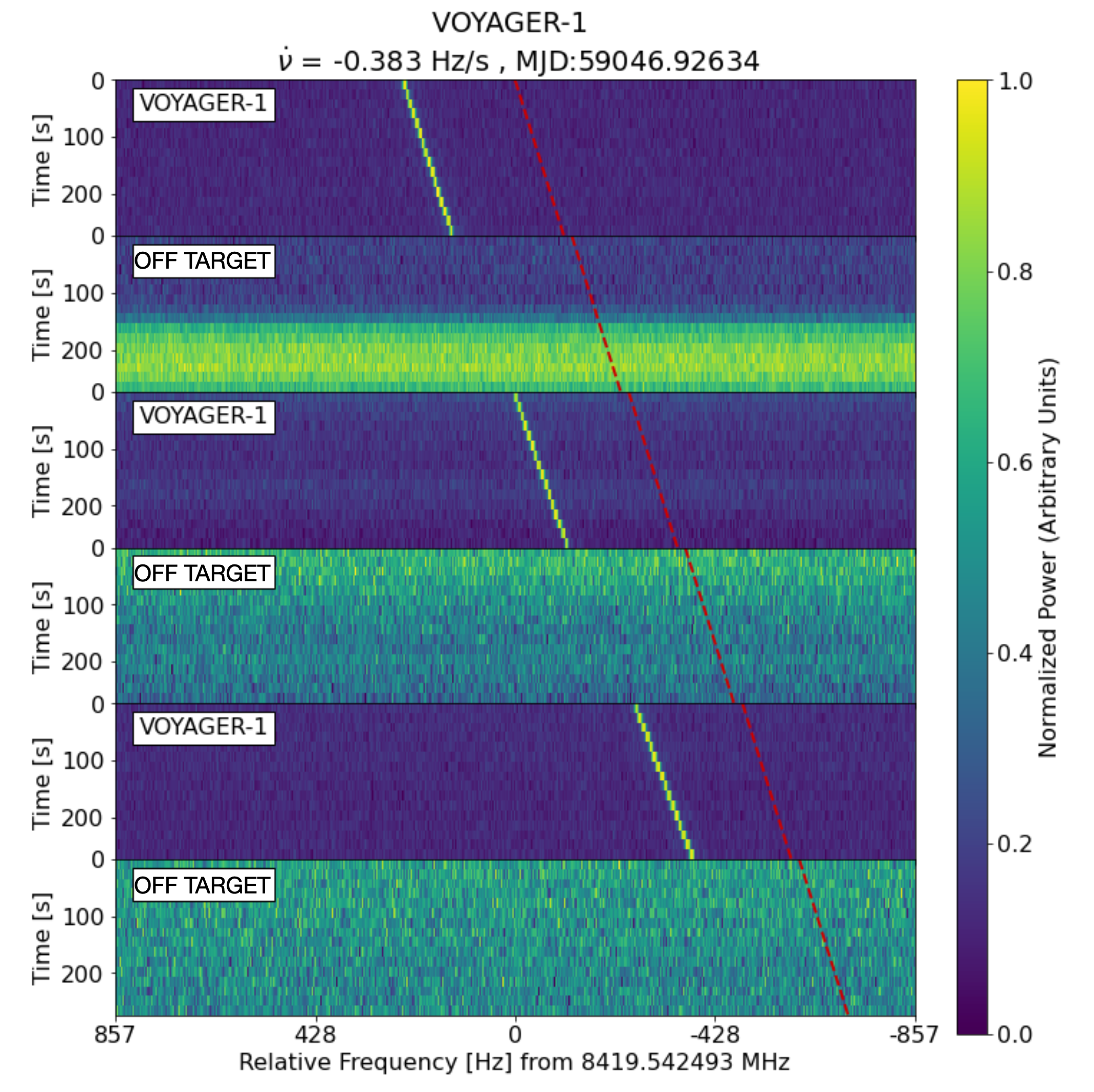\n\n", "1337896": "Thank you ! Now i understand it!" } }