\n

\nFrom my experience, the most important things in this competition were:
Congrats to the winners and thanks to organizers for hosting this competition! I was only able to join three weeks ago and did not have time to test all ideas (not using external data and annotations). Still, I am glad to reach top-5% and happy to share my solution. Although there are many Grandmasters among the winners, I hope my summary will provide some value for some of you :)
\nMy solution is an ensemble of 5+2 CNN models; see the diagram below. All models are implemented in PyTorch and trained using Google Colab or a local machine with Quadro RTX 6000.
\n
\nFrom my experience, the most important things in this competition were:
- RandomResizedCrop(scale = (0.8, 1))\n- ShiftScaleRotate(0.05, 0.05, 0.05)\n- HorizontalFlip\n- HueSaturationValue\n- RandomBrightnessContrast\n- Blur and Distortion\n- Cutout\nHorizontalFlipThe table below from Neptune.ai provides the main parameters of the 5 base models:
\n
Although all CNNs have a full 11-label head, I was considering each label separately on the ensembling stage. For each of the labels, I compared two options to mix model predictions:
\nUsing OOF predictions, I found power mean with p = 1/11 to perform best for 6 labels. The intuition behind such a low p is the desire to assign higher scores to images where at least one model suspects a positive class. For 5 other labels, stacking performed slightly better.
Combining stacking and power mean allowed me to reach the local CV of 0.9660. As usual, it was tempting to choose another sub with a better public LB score, but trusting CV paid off: selecting a higher-scoring sub on public LB would have kicked me out of the medal zone.
\nFinally, I blended my best CV ensemble (w = 75%) with the 2 public models (w = 25%):
The final solution achieves 0.97156 on the private LB (71st place). Happy to answer any questions in the comments and see you in the next competitions! 😊
", "messages": [ { "id": 1241843, "postDate": "2021-03-17T08:33:28.563Z", "content": "Congrats to the winners and thanks to organizers for hosting this competition! I was only able to join three weeks ago and did not have time to test all ideas (not using external data and annotations). Still, I am glad to reach top-5% and happy to share my solution. Although there are many Grandmasters among the winners, I hope my summary will provide some value for some of you :)
\nMy solution is an ensemble of 5+2 CNN models; see the diagram below. All models are implemented in PyTorch and trained using Google Colab or a local machine with Quadro RTX 6000.
\n
\nFrom my experience, the most important things in this competition were:
- RandomResizedCrop(scale = (0.8, 1))\n- ShiftScaleRotate(0.05, 0.05, 0.05)\n- HorizontalFlip\n- HueSaturationValue\n- RandomBrightnessContrast\n- Blur and Distortion\n- Cutout\nHorizontalFlipThe table below from Neptune.ai provides the main parameters of the 5 base models:
\n
Although all CNNs have a full 11-label head, I was considering each label separately on the ensembling stage. For each of the labels, I compared two options to mix model predictions:
\nUsing OOF predictions, I found power mean with p = 1/11 to perform best for 6 labels. The intuition behind such a low p is the desire to assign higher scores to images where at least one model suspects a positive class. For 5 other labels, stacking performed slightly better.
Combining stacking and power mean allowed me to reach the local CV of 0.9660. As usual, it was tempting to choose another sub with a better public LB score, but trusting CV paid off: selecting a higher-scoring sub on public LB would have kicked me out of the medal zone.
\nFinally, I blended my best CV ensemble (w = 75%) with the 2 public models (w = 25%):
The final solution achieves 0.97156 on the private LB (71st place). Happy to answer any questions in the comments and see you in the next competitions! 😊
", "rawMarkdown": "## Summary\n\nCongrats to the winners and thanks to organizers for hosting this competition! I was only able to join three weeks ago and did not have time to test all ideas (not using external data and annotations). Still, I am glad to reach top-5% and happy to share my solution. Although there are many Grandmasters among the winners, I hope my summary will provide some value for some of you :)\n\nMy solution is an ensemble of 5+2 CNN models; see the diagram below. All models are implemented in PyTorch and trained using Google Colab or a local machine with Quadro RTX 6000.\n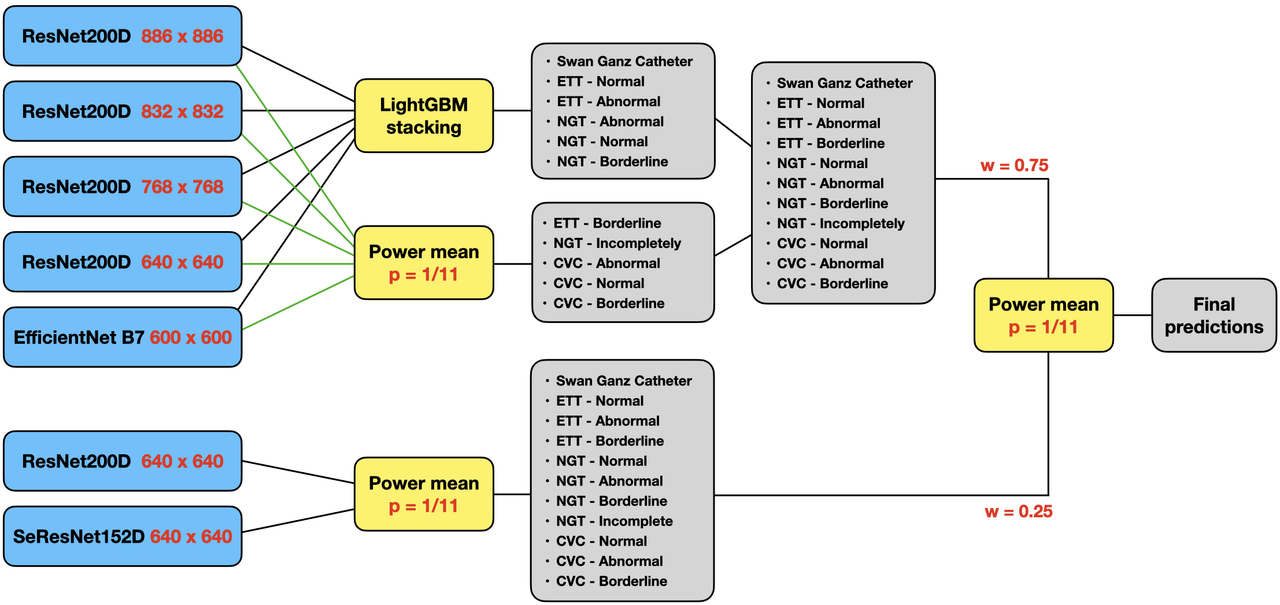\nFrom my experience, the most important things in this competition were:\n- large image size, which required gradient accumulation to have a decent batch size\n- careful augmentations, as heavy rotation/crop were harming CNN performance\n- ensembling with power mean to maximize AUC, which is a ranking indicator\n\n## Code\n- [Kaggle notebook](https://www.kaggle.com/kozodoi/71st-place-ensembling-pipeline) reproducing my submission and detailing the ensembling pipeline\n- [GitHub repo](https://github.com/kozodoi/Kaggle_RANZCR_Challenge) with the complete training codes and notebooks\n\n## Data\n- [Group stratified 5-fold CV](https://www.kaggle.com/underwearfitting/how-to-properly-split-folds) proposed by @underwearfitting \n- Augmenting training folds with up to 1% of pseudo-labeled public test data\n\n## Augmentations\n- Training augmentations:\n```\n- RandomResizedCrop(scale = (0.8, 1))\n- ShiftScaleRotate(0.05, 0.05, 0.05)\n- HorizontalFlip\n- HueSaturationValue\n- RandomBrightnessContrast\n- Blur and Distortion\n- Cutout\n```\n- TTA: averaging over 2 images with `HorizontalFlip `\n- Image size: between 600 and 886\n\n## Base models\nThe table below from Neptune.ai provides the main parameters of the 5 base models:\n\n- ResNet models were initialized from the [public pretrained weights](https://www.kaggle.com/underwearfitting/resnet200d-baseline-benchmark-public)\n- Scheduler: 1-epoch warmup + cosine annealing afterwards\n\n## Ensembling\n\nAlthough all CNNs have a full 11-label head, I was considering each label separately on the ensembling stage. For each of the labels, I compared two options to mix model predictions:\n- simple blends (arithmetic, geometric, power or rank mean)\n- stacking with LightGBM (including predictions for all labels as features)\n\nUsing OOF predictions, I found power mean with `p = 1/11` to perform best for 6 labels. The intuition behind such a low `p` is the desire to assign higher scores to images where at least one model suspects a positive class. For 5 other labels, stacking performed slightly better.\n\nCombining stacking and power mean allowed me to reach the local CV of **0.9660**. As usual, it was tempting to choose another sub with a better public LB score, but trusting CV paid off: selecting a higher-scoring sub on public LB would have kicked me out of the medal zone.\n\nFinally, I blended my best CV ensemble (`w = 75%`) with the 2 public models (`w = 25%`):\n- [SeResNet152D](https://www.kaggle.com/ammarali32/seresnet152d-cv9615) by @ammarali32\n- [ResNet200D](https://www.kaggle.com/ammarali32/resnet200d-public) by @ammarali32\n\nThe final solution achieves **0.97156** on the private LB (71st place). Happy to answer any questions in the comments and see you in the next competitions! 😊", "votes": 32 }, { "id": 1242068, "postDate": "2021-03-17T11:34:47.387Z", "content": "Thank you for sharing @kozodoi. Very informative and congratulations.keep rocking 👍
", "rawMarkdown": "Thank you for sharing @kozodoi. Very informative and congratulations.keep rocking 👍", "votes": 1 }, { "id": 1242014, "postDate": "2021-03-17T10:48:05.400Z", "content": "@kozodoi Congratulations on Silver Finish . Great writeup .
", "rawMarkdown": "@kozodoi Congratulations on Silver Finish . Great writeup .", "votes": 1, "replies": [ { "id": 1242111, "postDate": "2021-03-17T12:03:23.950Z", "content": "Thanks @usharengaraju!
", "rawMarkdown": "Thanks @usharengaraju!" } ] }, { "id": 1241930, "postDate": "2021-03-17T09:32:45.393Z", "content": "Strong finish. Congrats.
", "rawMarkdown": "Strong finish. Congrats.", "votes": 1, "replies": [ { "id": 1242037, "postDate": "2021-03-17T11:03:15.830Z", "content": "Thank you @underwearfitting for all your contributions and congrats with the second place!
", "rawMarkdown": "Thank you @underwearfitting for all your contributions and congrats with the second place!" } ] }, { "id": 1241886, "postDate": "2021-03-17T09:05:25.747Z", "content": "Congratulation!
\nI would like to see the code for power mean. Please.
\nI am a google collab pro user, Do you recommend using Neptune.ai with colab?
\nThank you :)
", "rawMarkdown": "Congratulation!\n\nI would like to see the code for power mean. Please.\n\nI am a google collab pro user, Do you recommend using Neptune.ai with colab?\n\nThank you :)\n", "replies": [ { "id": 1241969, "postDate": "2021-03-17T10:03:34.597Z", "content": "Thanks @faisalalsrheed! I just made the notebook reproducing my submission public, please have a look if you are interested. The power mean is implemented as np.mean(np.power(preds, p) * w, axis = 1) ** (1/p), where p is a parameter that can be tuned and w are model weights.
I recommend using Neptune.ai regardless of the environment :) I personally do not use their JupyterLab extension for versioning notebooks and create a separate file for each experiment. But I rely on Neptune API to track CV performance and upload model weights and configurations.
", "rawMarkdown": "Thanks @faisalalsrheed! I just made [the notebook reproducing my submission](https://www.kaggle.com/kozodoi/71st-place-ensembling-pipeline) public, please have a look if you are interested. The power mean is implemented as `np.mean(np.power(preds, p) * w, axis = 1) ** (1/p)`, where `p` is a parameter that can be tuned and `w` are model weights.\n\nI recommend using Neptune.ai regardless of the environment :) I personally do not use their JupyterLab extension for versioning notebooks and create a separate file for each experiment. But I rely on Neptune API to track CV performance and upload model weights and configurations.", "votes": 1 }, { "id": 1242130, "postDate": "2021-03-17T12:23:10.910Z", "content": "Thank you @kozodo I appreciate it
\nall the best :)
thanks for sharing
", "rawMarkdown": "thanks for sharing" } ], "comments": [ { "id": 1242068, "author_name": "Thrinesh Duvvuru", "author_url": "", "post_date": "2021-03-17T11:34:47.387000", "content": "Thank you for sharing @kozodoi. Very informative and congratulations.keep rocking 👍
", "votes": 1, "replies": [] }, { "id": 1242014, "author_name": "Tensor Girl", "author_url": "", "post_date": "2021-03-17T10:48:05.400000", "content": "@kozodoi Congratulations on Silver Finish . Great writeup .
", "votes": 1, "replies": [ { "id": 1242111, "author_name": "Nikita Kozodoi", "author_url": "", "post_date": "2021-03-17T12:03:23.950000", "content": "Thanks @usharengaraju!
", "votes": 0, "replies": [] } ] }, { "id": 1241930, "author_name": "sin", "author_url": "", "post_date": "2021-03-17T09:32:45.393000", "content": "Strong finish. Congrats.
", "votes": 1, "replies": [ { "id": 1242037, "author_name": "Nikita Kozodoi", "author_url": "", "post_date": "2021-03-17T11:03:15.830000", "content": "Thank you @underwearfitting for all your contributions and congrats with the second place!
", "votes": 0, "replies": [] } ] }, { "id": 1241886, "author_name": "Faisal Alsrheed", "author_url": "", "post_date": "2021-03-17T09:05:25.747000", "content": "Congratulation!
\nI would like to see the code for power mean. Please.
\nI am a google collab pro user, Do you recommend using Neptune.ai with colab?
\nThank you :)
", "votes": 0, "replies": [ { "id": 1241969, "author_name": "Nikita Kozodoi", "author_url": "", "post_date": "2021-03-17T10:03:34.597000", "content": "Thanks @faisalalsrheed! I just made the notebook reproducing my submission public, please have a look if you are interested. The power mean is implemented as np.mean(np.power(preds, p) * w, axis = 1) ** (1/p), where p is a parameter that can be tuned and w are model weights.
I recommend using Neptune.ai regardless of the environment :) I personally do not use their JupyterLab extension for versioning notebooks and create a separate file for each experiment. But I rely on Neptune API to track CV performance and upload model weights and configurations.
", "votes": 1, "replies": [] }, { "id": 1242130, "author_name": "Faisal Alsrheed", "author_url": "", "post_date": "2021-03-17T12:23:10.910000", "content": "Thank you @kozodo I appreciate it
\nall the best :)
thanks for sharing
", "votes": 0, "replies": [] } ], "raw_markdown_by_id": { "1241843": "## Summary\n\nCongrats to the winners and thanks to organizers for hosting this competition! I was only able to join three weeks ago and did not have time to test all ideas (not using external data and annotations). Still, I am glad to reach top-5% and happy to share my solution. Although there are many Grandmasters among the winners, I hope my summary will provide some value for some of you :)\n\nMy solution is an ensemble of 5+2 CNN models; see the diagram below. All models are implemented in PyTorch and trained using Google Colab or a local machine with Quadro RTX 6000.\n\nFrom my experience, the most important things in this competition were:\n- large image size, which required gradient accumulation to have a decent batch size\n- careful augmentations, as heavy rotation/crop were harming CNN performance\n- ensembling with power mean to maximize AUC, which is a ranking indicator\n\n## Code\n- [Kaggle notebook](https://www.kaggle.com/kozodoi/71st-place-ensembling-pipeline) reproducing my submission and detailing the ensembling pipeline\n- [GitHub repo](https://github.com/kozodoi/Kaggle_RANZCR_Challenge) with the complete training codes and notebooks\n\n## Data\n- [Group stratified 5-fold CV](https://www.kaggle.com/underwearfitting/how-to-properly-split-folds) proposed by @underwearfitting \n- Augmenting training folds with up to 1% of pseudo-labeled public test data\n\n## Augmentations\n- Training augmentations:\n```\n- RandomResizedCrop(scale = (0.8, 1))\n- ShiftScaleRotate(0.05, 0.05, 0.05)\n- HorizontalFlip\n- HueSaturationValue\n- RandomBrightnessContrast\n- Blur and Distortion\n- Cutout\n```\n- TTA: averaging over 2 images with `HorizontalFlip `\n- Image size: between 600 and 886\n\n## Base models\nThe table below from Neptune.ai provides the main parameters of the 5 base models:\n\n- ResNet models were initialized from the [public pretrained weights](https://www.kaggle.com/underwearfitting/resnet200d-baseline-benchmark-public)\n- Scheduler: 1-epoch warmup + cosine annealing afterwards\n\n## Ensembling\n\nAlthough all CNNs have a full 11-label head, I was considering each label separately on the ensembling stage. For each of the labels, I compared two options to mix model predictions:\n- simple blends (arithmetic, geometric, power or rank mean)\n- stacking with LightGBM (including predictions for all labels as features)\n\nUsing OOF predictions, I found power mean with `p = 1/11` to perform best for 6 labels. The intuition behind such a low `p` is the desire to assign higher scores to images where at least one model suspects a positive class. For 5 other labels, stacking performed slightly better.\n\nCombining stacking and power mean allowed me to reach the local CV of **0.9660**. As usual, it was tempting to choose another sub with a better public LB score, but trusting CV paid off: selecting a higher-scoring sub on public LB would have kicked me out of the medal zone.\n\nFinally, I blended my best CV ensemble (`w = 75%`) with the 2 public models (`w = 25%`):\n- [SeResNet152D](https://www.kaggle.com/ammarali32/seresnet152d-cv9615) by @ammarali32\n- [ResNet200D](https://www.kaggle.com/ammarali32/resnet200d-public) by @ammarali32\n\nThe final solution achieves **0.97156** on the private LB (71st place). Happy to answer any questions in the comments and see you in the next competitions! 😊", "1242068": "Thank you for sharing @kozodoi. Very informative and congratulations.keep rocking 👍", "1242014": "@kozodoi Congratulations on Silver Finish . Great writeup .", "1241930": "Strong finish. Congrats.", "1241886": "Congratulation!\n\nI would like to see the code for power mean. Please.\n\nI am a google collab pro user, Do you recommend using Neptune.ai with colab?\n\nThank you :)\n", "1246826": "", "1246398": "thanks for sharing" } }