{
"id": 209600,
"title": "Private 2nd Public 1st rank Solution",
"url": "/competitions/predict-volcanic-eruptions-ingv-oe/writeups/byungsunbae-private-2nd-public-1st-rank-solution",
"author_name": "",
"post_date": "2021-01-08T01:40:33.100Z",
"votes": 28,
"comment_count": 3,
"views": 0,
"content": "I had a really good experience thanks to the INGV competition. Thank you to the organization that hosted this event.
\nWhen I made the solution (= model) in this contest, I went through the following sequence.
\n1. Data Preprocessing
\n\n- NA -> 0
\n- Normalizing Data per segment_id
\n- Normalization was performed for each column. The execution method is:
\n1) Subtract the average to find the deviation.
\n2) Divide the deviation by the maximum of the absolute deviation value. Add 0.00001 to prevent the denominator from becoming zero.
\n- Feature Extraction : I extract features from raw data with
librosa module in python.\n- rms
\n- spectral_centroid
\n- spectral_bandwidth
\n- zero_crossing_rate
\n- mel frequency cepstral coefficient
\n- poly_features
\n- spectral_contrast
\n- chroma_stft after applying stft (or not)
\n- My dataset is divided as follows depending on whether chroma_stft is applied or not.
\n- First set : chroma_stft X, shape of data per segment_id : (Channel, Time) => (340, 118)
\n- Second set : chroma_stft O shape of data per segment_id : (Channel, Time) => (460, 118)
\n- Save to numpy array per segment_id ( ex 212423.csv -> 212423.npy )
\n- It takes 3 hours to configure one set. ( Total 6 hours contain train and test )
\n- In fact, I didn't really understand the Waveform dataset. If I had understood it much better, I would have been able to create a model with better performance than it is now.
\n
\n2. Training Model
\n\n- Model Architecture\n

\n- Activation Function : Leaky ReLU except Bi-LSTM and FC layer
\n- From :
\n- Using Stratified 5-Fold Cross Validation through K-Means based on train's Target
time-to-eruption\n- After doing K-Means with K=5, Stratified sampling was performed using sklearn's StratifiedKFold.
\n- I proceeded with the idea that the target values were evenly distributed for each hold-out set.
\n- Loss Function : LogCoshLoss
\n- Optimizing
\n- AdamW with weight_decay 0.001
\n- Learning Rate Scheduler : CosineAnnealingWarmRestarts (period : 10 epochs)
\n- I make 2 models with differences like below:
\n- (1) First set => Epochs 1200, base lr = 0.005 ( First Model )
\n- (2) Second set => Epochs 1000, base lr = 0.004 ( Second Model )
\n- Training models with different seed ( 5 different seed )
\n
\n3. Blending Results
\n\n- Simple Averaging two results.
\n
\nEveryone has a hard time. Thank you for reading.
",
"messages": [
{
"id": "1143630",
"postDate": "01/08/2021 01:21:41",
"content": "I had a really good experience thanks to the INGV competition. Thank you to the organization that hosted this event.
\nWhen I made the solution (= model) in this contest, I went through the following sequence.
\n1. Data Preprocessing
\n\n- NA -> 0
\n- Normalizing Data per segment_id
\n- Normalization was performed for each column. The execution method is:
\n1) Subtract the average to find the deviation.
\n2) Divide the deviation by the maximum of the absolute deviation value. Add 0.00001 to prevent the denominator from becoming zero.
\n- Feature Extraction : I extract features from raw data with
librosa module in python.\n- rms
\n- spectral_centroid
\n- spectral_bandwidth
\n- zero_crossing_rate
\n- mel frequency cepstral coefficient
\n- poly_features
\n- spectral_contrast
\n- chroma_stft after applying stft (or not)
\n- My dataset is divided as follows depending on whether chroma_stft is applied or not.
\n- First set : chroma_stft X, shape of data per segment_id : (Channel, Time) => (340, 118)
\n- Second set : chroma_stft O shape of data per segment_id : (Channel, Time) => (460, 118)
\n- Save to numpy array per segment_id ( ex 212423.csv -> 212423.npy )
\n- It takes 3 hours to configure one set. ( Total 6 hours contain train and test )
\n- In fact, I didn't really understand the Waveform dataset. If I had understood it much better, I would have been able to create a model with better performance than it is now.
\n
\n2. Training Model
\n\n- Model Architecture\n
\n- Activation Function : Leaky ReLU except Bi-LSTM and FC layer
\n- From :
\n- Using Stratified 5-Fold Cross Validation through K-Means based on train's Target
time-to-eruption\n- After doing K-Means with K=5, Stratified sampling was performed using sklearn's StratifiedKFold.
\n- I proceeded with the idea that the target values were evenly distributed for each hold-out set.
\n- Loss Function : LogCoshLoss
\n- Optimizing
\n- AdamW with weight_decay 0.001
\n- Learning Rate Scheduler : CosineAnnealingWarmRestarts (period : 10 epochs)
\n- I make 2 models with differences like below:
\n- (1) First set => Epochs 1200, base lr = 0.005 ( First Model )
\n- (2) Second set => Epochs 1000, base lr = 0.004 ( Second Model )
\n- Training models with different seed ( 5 different seed )
\n
\n3. Blending Results
\n\n- Simple Averaging two results.
\n
\nEveryone has a hard time. Thank you for reading.
",
"rawMarkdown": "I had a really good experience thanks to the INGV competition. Thank you to the organization that hosted this event.\n\nWhen I made the solution (= model) in this contest, I went through the following sequence.\n\n**1. Data Preprocessing**\n - NA -> 0\n - Normalizing Data per segment_id\n + Normalization was performed for each column. The execution method is: \n 1) Subtract the average to find the deviation.\n 2) Divide the deviation by the maximum of the absolute deviation value. Add 0.00001 to prevent the denominator from becoming zero.\n - Feature Extraction : I extract features from raw data with `librosa` module in python.\n + rms\n + spectral_centroid\n + spectral_bandwidth\n + zero_crossing_rate\n + mel frequency cepstral coefficient\n + poly_features\n + spectral_contrast\n + chroma_stft after applying stft (or not)\n - My dataset is divided as follows depending on whether chroma_stft is applied or not.\n + First set : chroma_stft X, shape of data per segment_id : (Channel, Time) => (340, 118) \n + Second set : chroma_stft O shape of data per segment_id : (Channel, Time) => (460, 118)\n - Save to numpy array per segment_id ( ex 212423.csv -> 212423.npy )\n + It takes 3 hours to configure one set. ( Total 6 hours contain train and test )\n - In fact, I didn't really understand the Waveform dataset. If I had understood it much better, I would have been able to create a model with better performance than it is now.\n\n**2. Training Model**\n - Model Architecture\n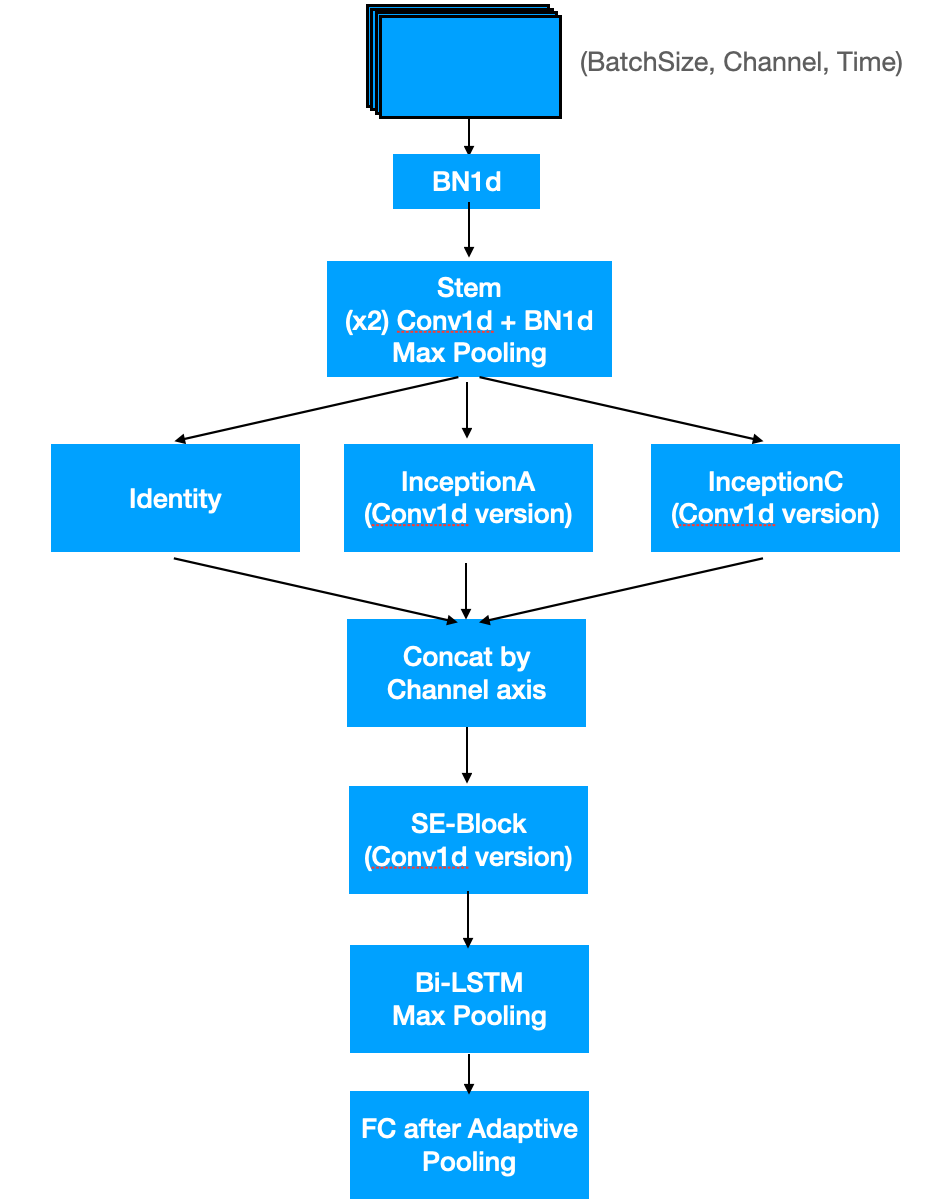\n + Activation Function : Leaky ReLU except Bi-LSTM and FC layer\n + From : \n + https://github.com/pytorch/vision/blob/master/torchvision/models/inception.py\n + https://amaarora.github.io/2020/07/24/SeNet.html\n - Using Stratified 5-Fold Cross Validation through K-Means based on train's Target `time-to-eruption`\n + After doing K-Means with K=5, Stratified sampling was performed using sklearn's StratifiedKFold.\n + I proceeded with the idea that the target values were evenly distributed for each hold-out set.\n - Loss Function : LogCoshLoss\n + I also used Huber loss. but not better than LogCoshLoss\n + From : https://github.com/tuantle/regression-losses-pytorch\n - Optimizing\n + AdamW with weight_decay 0.001\n + Learning Rate Scheduler : CosineAnnealingWarmRestarts (period : 10 epochs)\n - I make 2 models with differences like below:\n + (1) First set => Epochs 1200, base lr = 0.005 ( First Model )\n + (2) Second set => Epochs 1000, base lr = 0.004 ( Second Model )\n - Training models with different seed ( 5 different seed )\n\n**3. Blending Results**\n - Simple Averaging two results.\n\nEveryone has a hard time. Thank you for reading.",
"votes": null
},
{
"id": "1143852",
"postDate": "01/08/2021 05:17:05",
"content": "good nn solution, thanks for your sharing
",
"rawMarkdown": "good nn solution, thanks for your sharing",
"votes": null
},
{
"id": "1144163",
"postDate": "01/08/2021 09:18:18",
"content": "Great work. Congrats on the rank and thank you for sharing.
",
"rawMarkdown": "Great work. Congrats on the rank and thank you for sharing.",
"votes": null
},
{
"id": "1147096",
"postDate": "01/10/2021 09:33:57",
"content": "thx for sharing. look forward to understanding and learning from your solution when i have a moment.
",
"rawMarkdown": "thx for sharing. look forward to understanding and learning from your solution when i have a moment.",
"votes": null
}
],
"comments": [
{
"id": 1143852,
"author_name": "laplaceplanet",
"author_url": "",
"post_date": "01/08/2021 05:17:05",
"content": "good nn solution, thanks for your sharing
",
"votes": null,
"replies": []
},
{
"id": 1144163,
"author_name": "obougacha",
"author_url": "",
"post_date": "01/08/2021 09:18:18",
"content": "Great work. Congrats on the rank and thank you for sharing.
",
"votes": null,
"replies": []
},
{
"id": 1147096,
"author_name": "davidedwards1",
"author_url": "",
"post_date": "01/10/2021 09:33:57",
"content": "thx for sharing. look forward to understanding and learning from your solution when i have a moment.
",
"votes": null,
"replies": []
}
],
"raw_markdown_by_id": {
"1143630": "I had a really good experience thanks to the INGV competition. Thank you to the organization that hosted this event.\n\nWhen I made the solution (= model) in this contest, I went through the following sequence.\n\n**1. Data Preprocessing**\n - NA -> 0\n - Normalizing Data per segment_id\n + Normalization was performed for each column. The execution method is: \n 1) Subtract the average to find the deviation.\n 2) Divide the deviation by the maximum of the absolute deviation value. Add 0.00001 to prevent the denominator from becoming zero.\n - Feature Extraction : I extract features from raw data with `librosa` module in python.\n + rms\n + spectral_centroid\n + spectral_bandwidth\n + zero_crossing_rate\n + mel frequency cepstral coefficient\n + poly_features\n + spectral_contrast\n + chroma_stft after applying stft (or not)\n - My dataset is divided as follows depending on whether chroma_stft is applied or not.\n + First set : chroma_stft X, shape of data per segment_id : (Channel, Time) => (340, 118) \n + Second set : chroma_stft O shape of data per segment_id : (Channel, Time) => (460, 118)\n - Save to numpy array per segment_id ( ex 212423.csv -> 212423.npy )\n + It takes 3 hours to configure one set. ( Total 6 hours contain train and test )\n - In fact, I didn't really understand the Waveform dataset. If I had understood it much better, I would have been able to create a model with better performance than it is now.\n\n**2. Training Model**\n - Model Architecture\n\n + Activation Function : Leaky ReLU except Bi-LSTM and FC layer\n + From : \n + https://github.com/pytorch/vision/blob/master/torchvision/models/inception.py\n + https://amaarora.github.io/2020/07/24/SeNet.html\n - Using Stratified 5-Fold Cross Validation through K-Means based on train's Target `time-to-eruption`\n + After doing K-Means with K=5, Stratified sampling was performed using sklearn's StratifiedKFold.\n + I proceeded with the idea that the target values were evenly distributed for each hold-out set.\n - Loss Function : LogCoshLoss\n + I also used Huber loss. but not better than LogCoshLoss\n + From : https://github.com/tuantle/regression-losses-pytorch\n - Optimizing\n + AdamW with weight_decay 0.001\n + Learning Rate Scheduler : CosineAnnealingWarmRestarts (period : 10 epochs)\n - I make 2 models with differences like below:\n + (1) First set => Epochs 1200, base lr = 0.005 ( First Model )\n + (2) Second set => Epochs 1000, base lr = 0.004 ( Second Model )\n - Training models with different seed ( 5 different seed )\n\n**3. Blending Results**\n - Simple Averaging two results.\n\nEveryone has a hard time. Thank you for reading.",
"1143852": "good nn solution, thanks for your sharing",
"1144163": "Great work. Congrats on the rank and thank you for sharing.",
"1147096": "thx for sharing. look forward to understanding and learning from your solution when i have a moment."
},
"source": "meta"
}