
First of all, Thanks to Kaggle and INGV (Istituto nazionale di geofisica e vulcanologia) National Institute of Geophysics and Volcanology for organizing this competition.
\nSecondly, Shout out to people who posted great notebooks which helped me and my teammate to get started. I believe lot of participants have found those notebooks useful too.
\nFinally, Thanks to my teammate @laplaceplanet who provided valuable efforts in this competition.
\nSOLUTION:
\n
a) Feature Engineering:
\nWe mostly used the public features. Credits to @amanooo https://www.kaggle.com/amanooo/ingv-volcanic-basic-solution-stft and @carpediemamigo https://www.kaggle.com/carpediemamigo/ingv-catboost-baseline-tsfresh (for creating 7730 features).
\nApart from aforementioned notebooks used Librosa https://librosa.org/doc/latest/index.html for creating mfcc (Mel-Frequency Cepstral Coefficients) features.
\nEnded with ~8000 (public 7830 and 200 different features)
b) Feature selection:
\nWe spent a lot of time in finding the important features, as what we have seen in the past, that less features have helped in similar competitions. One important insight in this https://www.kaggle.com/c/LANL-Earthquake-Prediction/discussion/94390 is
\n\n\nOne of our best final LGB model only used four features: (i) number of peaks of at least support 2 on the denoised signal, (ii) 20% percentile on std of rolling window of size 50, (iii) 4th and (iv) 18th Mel-frequency cepstral coefficients mean.
\n
We used this insights to keep less features. For feature selection we incorporated couple of methods.
\n1) Used tsfresh https://tsfresh.readthedocs.io/en/latest/api/tsfresh.feature_selection.html to reduce 7730 features to 2000.
\n2) Used Permutation importance https://www.kaggle.com/dansbecker/permutation-importance on 2300 features and selected top 189 features.
c) Model Training:
\n1) Trained NN model ( we found it is better than catboost and lightgbm). Used 5 fold cross validation strategy. NN architecture is:-
\n`
\ndef get_model():
\ntf.keras.backend.clear_session()
\ninp = Input(shape=(len(features + added_features)))
\nx = BatchNormalization()(inp)
\nx = Dropout(0.1)(x)
for n in [512, 1024, 2048, 3072, 2048, 1024, 512, 256]:
\n x = Dense(n)(x)
\n x = Activation(tf.keras.activations.swish)(x)
\n x = Dropout(rate=0.1)(x)
out = Dense(1, activation=\"linear\")(x)
\nmodel = Model(inp, out)
\nmodel.compile(loss=\"mean_absolute_error\", optimizer=tf.keras.optimizers.Adam(learning_rate=1e-3))
\nmodel.summary()
\nreturn model
\n`
\ncredit to @laplaceplanet for NN architecture. Swish activation provided better results over other activation functions.
2) Extracted last layer of NN architecture and used that as input to catboost Model. This improved lb quite a bit.
\nThis pipeline helped us achieve 3822095 on LB.
\nModel Robustness:
\nUsed the above pipeline and trained model with different seed ( 5 different seed), then average results over 5 seeds, that achieved Public LB 3730808 and Private LB 3830808
", "messages": [ { "id": "1142211", "postDate": "01/07/2021 08:31:23", "content": "First of all, Thanks to Kaggle and INGV (Istituto nazionale di geofisica e vulcanologia) National Institute of Geophysics and Volcanology for organizing this competition.
\nSecondly, Shout out to people who posted great notebooks which helped me and my teammate to get started. I believe lot of participants have found those notebooks useful too.
\nFinally, Thanks to my teammate @laplaceplanet who provided valuable efforts in this competition.
\nSOLUTION:
\n
a) Feature Engineering:
\nWe mostly used the public features. Credits to @amanooo https://www.kaggle.com/amanooo/ingv-volcanic-basic-solution-stft and @carpediemamigo https://www.kaggle.com/carpediemamigo/ingv-catboost-baseline-tsfresh (for creating 7730 features).
\nApart from aforementioned notebooks used Librosa https://librosa.org/doc/latest/index.html for creating mfcc (Mel-Frequency Cepstral Coefficients) features.
\nEnded with ~8000 (public 7830 and 200 different features)
b) Feature selection:
\nWe spent a lot of time in finding the important features, as what we have seen in the past, that less features have helped in similar competitions. One important insight in this https://www.kaggle.com/c/LANL-Earthquake-Prediction/discussion/94390 is
\n\n\nOne of our best final LGB model only used four features: (i) number of peaks of at least support 2 on the denoised signal, (ii) 20% percentile on std of rolling window of size 50, (iii) 4th and (iv) 18th Mel-frequency cepstral coefficients mean.
\n
We used this insights to keep less features. For feature selection we incorporated couple of methods.
\n1) Used tsfresh https://tsfresh.readthedocs.io/en/latest/api/tsfresh.feature_selection.html to reduce 7730 features to 2000.
\n2) Used Permutation importance https://www.kaggle.com/dansbecker/permutation-importance on 2300 features and selected top 189 features.
c) Model Training:
\n1) Trained NN model ( we found it is better than catboost and lightgbm). Used 5 fold cross validation strategy. NN architecture is:-
\n`
\ndef get_model():
\ntf.keras.backend.clear_session()
\ninp = Input(shape=(len(features + added_features)))
\nx = BatchNormalization()(inp)
\nx = Dropout(0.1)(x)
for n in [512, 1024, 2048, 3072, 2048, 1024, 512, 256]:
\n x = Dense(n)(x)
\n x = Activation(tf.keras.activations.swish)(x)
\n x = Dropout(rate=0.1)(x)
out = Dense(1, activation=\"linear\")(x)
\nmodel = Model(inp, out)
\nmodel.compile(loss=\"mean_absolute_error\", optimizer=tf.keras.optimizers.Adam(learning_rate=1e-3))
\nmodel.summary()
\nreturn model
\n`
\ncredit to @laplaceplanet for NN architecture. Swish activation provided better results over other activation functions.
2) Extracted last layer of NN architecture and used that as input to catboost Model. This improved lb quite a bit.
\nThis pipeline helped us achieve 3822095 on LB.
\nModel Robustness:
\nUsed the above pipeline and trained model with different seed ( 5 different seed), then average results over 5 seeds, that achieved Public LB 3730808 and Private LB 3830808
", "rawMarkdown": "First of all, Thanks to Kaggle and INGV (Istituto nazionale di geofisica e vulcanologia) National Institute of Geophysics and Volcanology for organizing this competition.\n\nSecondly, Shout out to people who posted great notebooks which helped me and my teammate to get started. I believe lot of participants have found those notebooks useful too.\n\nFinally, Thanks to my teammate @laplaceplanet who provided valuable efforts in this competition.\n\n**SOLUTION:**\n\n\n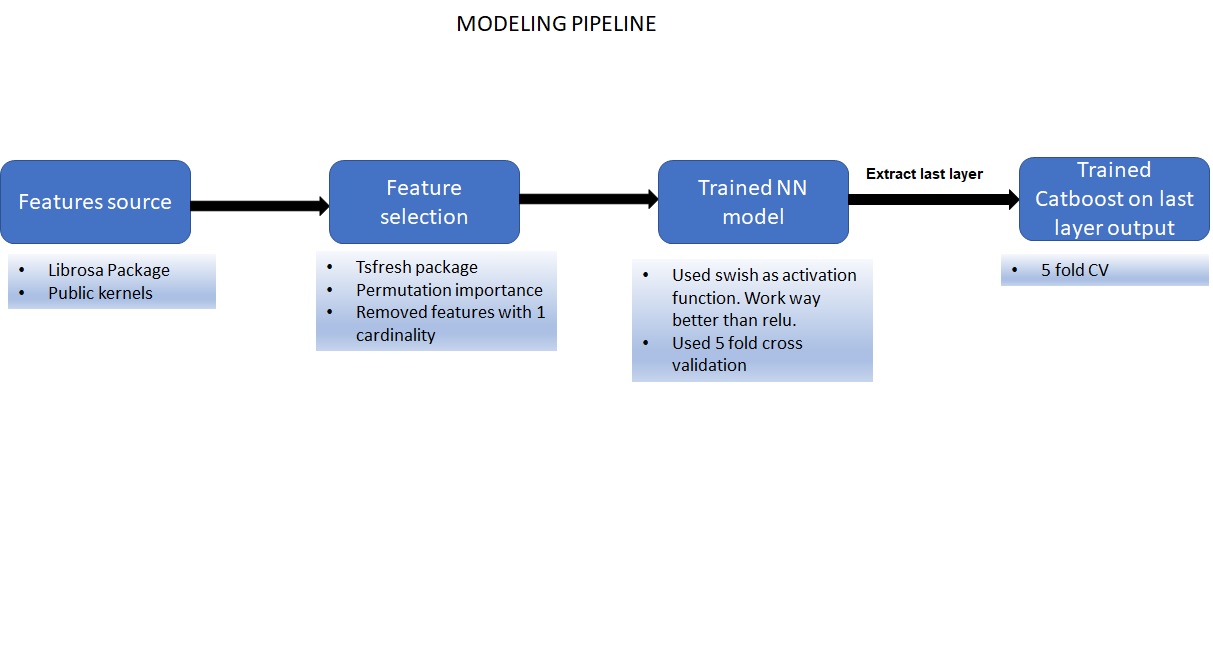\n\na) **Feature Engineering:**\n\nWe mostly used the public features. Credits to @amanooo https://www.kaggle.com/amanooo/ingv-volcanic-basic-solution-stft and @carpediemamigo https://www.kaggle.com/carpediemamigo/ingv-catboost-baseline-tsfresh (for creating 7730 features).\nApart from aforementioned notebooks used Librosa https://librosa.org/doc/latest/index.html for creating mfcc (Mel-Frequency Cepstral Coefficients) features. \nEnded with ~8000 (public 7830 and 200 different features)\n\nb) **Feature selection:**\n\nWe spent a lot of time in finding the important features, as what we have seen in the past, that less features have helped in similar competitions. One important insight in this https://www.kaggle.com/c/LANL-Earthquake-Prediction/discussion/94390 is \n> One of our best final LGB model only used four features: (i) number of peaks of at least support 2 on the denoised signal, (ii) 20% percentile on std of rolling window of size 50, (iii) 4th and (iv) 18th Mel-frequency cepstral coefficients mean. \n\nWe used this insights to keep less features. For feature selection we incorporated couple of methods. \n1) Used tsfresh https://tsfresh.readthedocs.io/en/latest/api/tsfresh.feature_selection.html to reduce 7730 features to 2000.\n2) Used Permutation importance https://www.kaggle.com/dansbecker/permutation-importance on 2300 features and selected top 189 features. \n\nc) **Model Training:**\n\n1) Trained NN model ( we found it is better than catboost and lightgbm). Used 5 fold cross validation strategy. NN architecture is:-\n`\ndef get_model():\ntf.keras.backend.clear_session()\ninp = Input(shape=(len(features + added_features)))\nx = BatchNormalization()(inp)\nx = Dropout(0.1)(x)\n\nfor n in [512, 1024, 2048, 3072, 2048, 1024, 512, 256]:\n x = Dense(n)(x)\n x = Activation(tf.keras.activations.swish)(x)\n x = Dropout(rate=0.1)(x)\n\nout = Dense(1, activation=\"linear\")(x)\nmodel = Model(inp, out)\nmodel.compile(loss=\"mean_absolute_error\", optimizer=tf.keras.optimizers.Adam(learning_rate=1e-3))\nmodel.summary()\nreturn model\n`\ncredit to @laplaceplanet for NN architecture. **Swish activation** provided better results over other activation functions.\n\n2) Extracted last layer of NN architecture and used that as input to catboost Model. This improved lb quite a bit.\n\nThis pipeline helped us achieve 3822095 on LB.\n\n**Model Robustness:**\n\nUsed the above pipeline and trained model with different seed ( 5 different seed), then average results over 5 seeds, that achieved Public LB 3730808 and Private LB 3830808", "votes": null }, { "id": "1142272", "postDate": "01/07/2021 09:13:05", "content": "Great Job. Thanks for sharing your work.
", "rawMarkdown": "Great Job. Thanks for sharing your work.", "votes": null }, { "id": "1142278", "postDate": "01/07/2021 09:21:52", "content": "Good solution. Thanks for sharing
", "rawMarkdown": "Good solution. Thanks for sharing", "votes": null }, { "id": "1142280", "postDate": "01/07/2021 09:22:25", "content": "Great job, congrats!. Btw, how much do you think the swish activation helped?
", "rawMarkdown": "Great job, congrats!. Btw, how much do you think the swish activation helped?", "votes": null }, { "id": "1142376", "postDate": "01/07/2021 10:43:48", "content": "Congrats, nice solution! How did you come up with the NN architecture, i.e. the number of hidden layers and the number of neurons in the layers?
", "rawMarkdown": "Congrats, nice solution! How did you come up with the NN architecture, i.e. the number of hidden layers and the number of neurons in the layers?", "votes": null }, { "id": "1142452", "postDate": "01/07/2021 11:48:11", "content": "Congratulations ! Thanks for sharing.
", "rawMarkdown": "Congratulations ! Thanks for sharing.", "votes": null }, { "id": "1142768", "postDate": "01/07/2021 15:26:55", "content": "Great job, thank you!
", "rawMarkdown": "Great job, thank you!", "votes": null }, { "id": "1142929", "postDate": "01/07/2021 17:11:41", "content": "Great job and thanks for sharing!
\nWhich other activation functions you used and how was their performance?
@manjjimnav used relu, leaky relu and tanh. Later found that people have mentioned about using swish and getting better results, so tried that.
", "rawMarkdown": "manjjimnav used relu, leaky relu and tanh. Later found that people have mentioned about using swish and getting better results, so tried that.", "votes": null }, { "id": "1143661", "postDate": "01/08/2021 01:50:09", "content": "@leventelippenszky Tried different combinations and checked local MAE loss. It is preferable to use neurons in 2^n .
", "rawMarkdown": "leventelippenszky Tried different combinations and checked local MAE loss. It is preferable to use neurons in 2^n .", "votes": null }, { "id": "1143664", "postDate": "01/08/2021 01:51:57", "content": "@enric1296 , when used activations other than swash, results were worse compared to decision trees results, so i would say that swash helped a lot.
", "rawMarkdown": "enric1296 , when used activations other than swash, results were worse compared to decision trees results, so i would say that swash helped a lot.", "votes": null }, { "id": "1147095", "postDate": "01/10/2021 09:33:43", "content": "thx for sharing. look forward to understanding and learning from your solution when i have a moment.
", "rawMarkdown": "thx for sharing. look forward to understanding and learning from your solution when i have a moment.", "votes": null }, { "id": "1260915", "postDate": "04/02/2021 14:23:44", "content": "Congrats!! Just for my curiosity, how much time did it take all the work? (I'm trying to understand it and I just wanted to have an estimative time :)) ) Thank you!!
", "rawMarkdown": "Congrats!! Just for my curiosity, how much time did it take all the work? (I'm trying to understand it and I just wanted to have an estimative time :)) ) Thank you!!", "votes": null }, { "id": "1262114", "postDate": "04/03/2021 19:50:25", "content": "2-3 weeks should be sufficient, with 3-4 hours each day. Lot of help was taken from public kernel too
", "rawMarkdown": "2-3 weeks should be sufficient, with 3-4 hours each day. Lot of help was taken from public kernel too", "votes": null } ], "comments": [ { "id": 1142272, "author_name": "obougacha", "author_url": "", "post_date": "01/07/2021 09:13:05", "content": "Great Job. Thanks for sharing your work.
", "votes": null, "replies": [] }, { "id": 1142278, "author_name": "byungsunbae", "author_url": "", "post_date": "01/07/2021 09:21:52", "content": "Good solution. Thanks for sharing
", "votes": null, "replies": [] }, { "id": 1142280, "author_name": "enric1296", "author_url": "", "post_date": "01/07/2021 09:22:25", "content": "Great job, congrats!. Btw, how much do you think the swish activation helped?
", "votes": null, "replies": [ { "id": 1143664, "author_name": "harshit92", "author_url": "", "post_date": "01/08/2021 01:51:57", "content": "@enric1296 , when used activations other than swash, results were worse compared to decision trees results, so i would say that swash helped a lot.
", "votes": null, "replies": [] } ] }, { "id": 1142376, "author_name": "leventelippenszky", "author_url": "", "post_date": "01/07/2021 10:43:48", "content": "Congrats, nice solution! How did you come up with the NN architecture, i.e. the number of hidden layers and the number of neurons in the layers?
", "votes": null, "replies": [ { "id": 1143661, "author_name": "harshit92", "author_url": "", "post_date": "01/08/2021 01:50:09", "content": "@leventelippenszky Tried different combinations and checked local MAE loss. It is preferable to use neurons in 2^n .
", "votes": null, "replies": [] } ] }, { "id": 1142452, "author_name": "adaubas", "author_url": "", "post_date": "01/07/2021 11:48:11", "content": "Congratulations ! Thanks for sharing.
", "votes": null, "replies": [] }, { "id": 1142768, "author_name": "sergey7", "author_url": "", "post_date": "01/07/2021 15:26:55", "content": "Great job, thank you!
", "votes": null, "replies": [] }, { "id": 1142929, "author_name": "manjjimnav", "author_url": "", "post_date": "01/07/2021 17:11:41", "content": "Great job and thanks for sharing!
\nWhich other activation functions you used and how was their performance?
@manjjimnav used relu, leaky relu and tanh. Later found that people have mentioned about using swish and getting better results, so tried that.
", "votes": null, "replies": [] } ] }, { "id": 1147095, "author_name": "davidedwards1", "author_url": "", "post_date": "01/10/2021 09:33:43", "content": "thx for sharing. look forward to understanding and learning from your solution when i have a moment.
", "votes": null, "replies": [] }, { "id": 1260915, "author_name": "andreeatodor", "author_url": "", "post_date": "04/02/2021 14:23:44", "content": "Congrats!! Just for my curiosity, how much time did it take all the work? (I'm trying to understand it and I just wanted to have an estimative time :)) ) Thank you!!
", "votes": null, "replies": [ { "id": 1262114, "author_name": "harshit92", "author_url": "", "post_date": "04/03/2021 19:50:25", "content": "2-3 weeks should be sufficient, with 3-4 hours each day. Lot of help was taken from public kernel too
", "votes": null, "replies": [] } ] } ], "raw_markdown_by_id": { "1142211": "First of all, Thanks to Kaggle and INGV (Istituto nazionale di geofisica e vulcanologia) National Institute of Geophysics and Volcanology for organizing this competition.\n\nSecondly, Shout out to people who posted great notebooks which helped me and my teammate to get started. I believe lot of participants have found those notebooks useful too.\n\nFinally, Thanks to my teammate @laplaceplanet who provided valuable efforts in this competition.\n\n**SOLUTION:**\n\n\n\n\na) **Feature Engineering:**\n\nWe mostly used the public features. Credits to @amanooo https://www.kaggle.com/amanooo/ingv-volcanic-basic-solution-stft and @carpediemamigo https://www.kaggle.com/carpediemamigo/ingv-catboost-baseline-tsfresh (for creating 7730 features).\nApart from aforementioned notebooks used Librosa https://librosa.org/doc/latest/index.html for creating mfcc (Mel-Frequency Cepstral Coefficients) features. \nEnded with ~8000 (public 7830 and 200 different features)\n\nb) **Feature selection:**\n\nWe spent a lot of time in finding the important features, as what we have seen in the past, that less features have helped in similar competitions. One important insight in this https://www.kaggle.com/c/LANL-Earthquake-Prediction/discussion/94390 is \n> One of our best final LGB model only used four features: (i) number of peaks of at least support 2 on the denoised signal, (ii) 20% percentile on std of rolling window of size 50, (iii) 4th and (iv) 18th Mel-frequency cepstral coefficients mean. \n\nWe used this insights to keep less features. For feature selection we incorporated couple of methods. \n1) Used tsfresh https://tsfresh.readthedocs.io/en/latest/api/tsfresh.feature_selection.html to reduce 7730 features to 2000.\n2) Used Permutation importance https://www.kaggle.com/dansbecker/permutation-importance on 2300 features and selected top 189 features. \n\nc) **Model Training:**\n\n1) Trained NN model ( we found it is better than catboost and lightgbm). Used 5 fold cross validation strategy. NN architecture is:-\n`\ndef get_model():\ntf.keras.backend.clear_session()\ninp = Input(shape=(len(features + added_features)))\nx = BatchNormalization()(inp)\nx = Dropout(0.1)(x)\n\nfor n in [512, 1024, 2048, 3072, 2048, 1024, 512, 256]:\n x = Dense(n)(x)\n x = Activation(tf.keras.activations.swish)(x)\n x = Dropout(rate=0.1)(x)\n\nout = Dense(1, activation=\"linear\")(x)\nmodel = Model(inp, out)\nmodel.compile(loss=\"mean_absolute_error\", optimizer=tf.keras.optimizers.Adam(learning_rate=1e-3))\nmodel.summary()\nreturn model\n`\ncredit to @laplaceplanet for NN architecture. **Swish activation** provided better results over other activation functions.\n\n2) Extracted last layer of NN architecture and used that as input to catboost Model. This improved lb quite a bit.\n\nThis pipeline helped us achieve 3822095 on LB.\n\n**Model Robustness:**\n\nUsed the above pipeline and trained model with different seed ( 5 different seed), then average results over 5 seeds, that achieved Public LB 3730808 and Private LB 3830808", "1142272": "Great Job. Thanks for sharing your work.", "1142278": "Good solution. Thanks for sharing", "1142280": "Great job, congrats!. Btw, how much do you think the swish activation helped?", "1142376": "Congrats, nice solution! How did you come up with the NN architecture, i.e. the number of hidden layers and the number of neurons in the layers?", "1142452": "Congratulations ! Thanks for sharing.", "1142768": "Great job, thank you!", "1142929": "Great job and thanks for sharing! \nWhich other activation functions you used and how was their performance?", "1143659": "manjjimnav used relu, leaky relu and tanh. Later found that people have mentioned about using swish and getting better results, so tried that.", "1143661": "leventelippenszky Tried different combinations and checked local MAE loss. It is preferable to use neurons in 2^n .", "1143664": "enric1296 , when used activations other than swash, results were worse compared to decision trees results, so i would say that swash helped a lot.", "1147095": "thx for sharing. look forward to understanding and learning from your solution when i have a moment.", "1260915": "Congrats!! Just for my curiosity, how much time did it take all the work? (I'm trying to understand it and I just wanted to have an estimative time :)) ) Thank you!!", "1262114": "2-3 weeks should be sufficient, with 3-4 hours each day. Lot of help was taken from public kernel too" }, "source": "meta" }