
if you check the centernet baseline kernel of this competition you will find in 3D Visualization section the author converted euler angle to rotation matrix\ni think that not everyone understand the reason behind that well.
\n\n

According to Euler's rotation theorem, any rotation may be described using three angles. If the rotations are written in terms of rotation matrices D, C, and B, then a general rotation A can be written as \nA = BCD\nThe three angles giving the three rotation matrices are called Euler angles.
\n\nTo build a matrix from a set of euler angles we just multiply a sequence of rotation matrices together
\n\nthat's why in centernet baseline kernel and under 3D visualization section we have euler_to_Rot() function which returns dot product of Y,P and R
", "messages": [ { "id": "684334", "postDate": "11/29/2019 15:35:57", "content": "if you check the centernet baseline kernel of this competition you will find in 3D Visualization section the author converted euler angle to rotation matrix\ni think that not everyone understand the reason behind that well.
\n\n
According to Euler's rotation theorem, any rotation may be described using three angles. If the rotations are written in terms of rotation matrices D, C, and B, then a general rotation A can be written as \nA = BCD\nThe three angles giving the three rotation matrices are called Euler angles.
\n\nTo build a matrix from a set of euler angles we just multiply a sequence of rotation matrices together
\n\nthat's why in centernet baseline kernel and under 3D visualization section we have euler_to_Rot() function which returns dot product of Y,P and R
", "rawMarkdown": "if you check the centernet baseline kernel of this competition you will find in 3D Visualization section the author **converted euler angle to rotation matrix**\ni think that not everyone understand the reason behind that well.\n\n\n\n# Euler's rotation theorem\n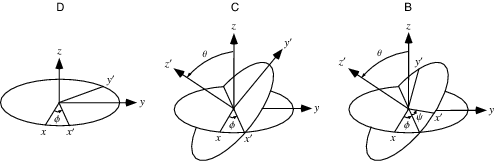\n\nAccording to Euler's rotation theorem, any rotation may be described using three angles. If the rotations are written in terms of rotation matrices D, C, and B, then a general rotation A can be written as \n**A = BCD**\nThe three angles giving the three rotation matrices are called Euler angles. \n\n\n# How to convert Euler Angles to matrix?\nTo build a matrix from a set of euler angles we just multiply a sequence of rotation matrices together\n\nthat's why in centernet baseline kernel and under 3D visualization section we have euler_to_Rot() function which returns dot product of Y,P and R", "votes": null }, { "id": "688773", "postDate": "12/06/2019 04:40:41", "content": "Good job, I'm just thinking about it.👍
", "rawMarkdown": "Good job, I'm just thinking about it.👍", "votes": null }, { "id": "690728", "postDate": "12/09/2019 02:39:34", "content": "I have some question about this dataset. It give (model type, yaw, pitch, roll, x, y, z). how to convert it to quaternion?\nif use scipy library, is R.from_euler('ZXY', [yaw, pitch, roll])?
", "rawMarkdown": "I have some question about this dataset. It give (model type, yaw, pitch, roll, x, y, z). how to convert it to quaternion?\nif use scipy library, is R.from_euler('ZXY', [yaw, pitch, roll])?", "votes": null }, { "id": "690820", "postDate": "12/09/2019 07:59:29", "content": "Dear @xsulu123 i have no idea about this but you might will want to check this link : https://en.wikipedia.org/wiki/Conversion_between_quaternions_and_Euler_angles
", "rawMarkdown": "Dear @xsulu123 i have no idea about this but you might will want to check this link : https://en.wikipedia.org/wiki/Conversion_between_quaternions_and_Euler_angles", "votes": null }, { "id": "690929", "postDate": "12/09/2019 11:08:22", "content": "All right, Thank you~
", "rawMarkdown": "All right, Thank you~", "votes": null } ], "comments": [ { "id": 688773, "author_name": "diegojohnson", "author_url": "", "post_date": "12/06/2019 04:40:41", "content": "Good job, I'm just thinking about it.👍
", "votes": null, "replies": [] }, { "id": 690728, "author_name": "xsulu123", "author_url": "", "post_date": "12/09/2019 02:39:34", "content": "I have some question about this dataset. It give (model type, yaw, pitch, roll, x, y, z). how to convert it to quaternion?\nif use scipy library, is R.from_euler('ZXY', [yaw, pitch, roll])?
", "votes": null, "replies": [ { "id": 690820, "author_name": "mobassir", "author_url": "", "post_date": "12/09/2019 07:59:29", "content": "Dear @xsulu123 i have no idea about this but you might will want to check this link : https://en.wikipedia.org/wiki/Conversion_between_quaternions_and_Euler_angles
", "votes": null, "replies": [] }, { "id": 690929, "author_name": "xsulu123", "author_url": "", "post_date": "12/09/2019 11:08:22", "content": "All right, Thank you~
", "votes": null, "replies": [] } ] } ], "raw_markdown_by_id": { "684334": "if you check the centernet baseline kernel of this competition you will find in 3D Visualization section the author **converted euler angle to rotation matrix**\ni think that not everyone understand the reason behind that well.\n\n\n\n# Euler's rotation theorem\n\n\nAccording to Euler's rotation theorem, any rotation may be described using three angles. If the rotations are written in terms of rotation matrices D, C, and B, then a general rotation A can be written as \n**A = BCD**\nThe three angles giving the three rotation matrices are called Euler angles. \n\n\n# How to convert Euler Angles to matrix?\nTo build a matrix from a set of euler angles we just multiply a sequence of rotation matrices together\n\nthat's why in centernet baseline kernel and under 3D visualization section we have euler_to_Rot() function which returns dot product of Y,P and R", "688773": "Good job, I'm just thinking about it.👍", "690728": "I have some question about this dataset. It give (model type, yaw, pitch, roll, x, y, z). how to convert it to quaternion?\nif use scipy library, is R.from_euler('ZXY', [yaw, pitch, roll])?", "690820": "Dear @xsulu123 i have no idea about this but you might will want to check this link : https://en.wikipedia.org/wiki/Conversion_between_quaternions_and_Euler_angles", "690929": "All right, Thank you~" }, "source": "meta" }