
Thank you to the organizers for the fun competition and everyone who participated.
\nAnd thank you to my teammate ( taksai @tsaito21219 ).
I share our team's solution.
\n

Thank you to my teammate. Let's do it together again!
", "messages": [ { "id": "1510055", "postDate": "09/12/2021 03:40:03", "content": "Thank you to the organizers for the fun competition and everyone who participated.
\nAnd thank you to my teammate ( taksai @tsaito21219 ).
I share our team's solution.
\n
Thank you to my teammate. Let's do it together again!
", "rawMarkdown": "Thank you to the organizers for the fun competition and everyone who participated.\nAnd thank you to my teammate ( taksai @tsaito21219 ).\n\nI share our team's solution.\n\n# summary:\n- LSTM model\n- valid: 2021-05, 2021-06, 2021-07\n- ensemble LSTM:MLP:LightGBM=5:1:1\n\n# 1. validation\n- private-data(2021-08) is in-season, so we use in-season data as validation, and select the month near 2021-08.\n- valid: 2021-05, 2021-06, 2021-07\n- prepared some patterns as training-data while shifting the period. \n- trained 10-fold for each model\n\n[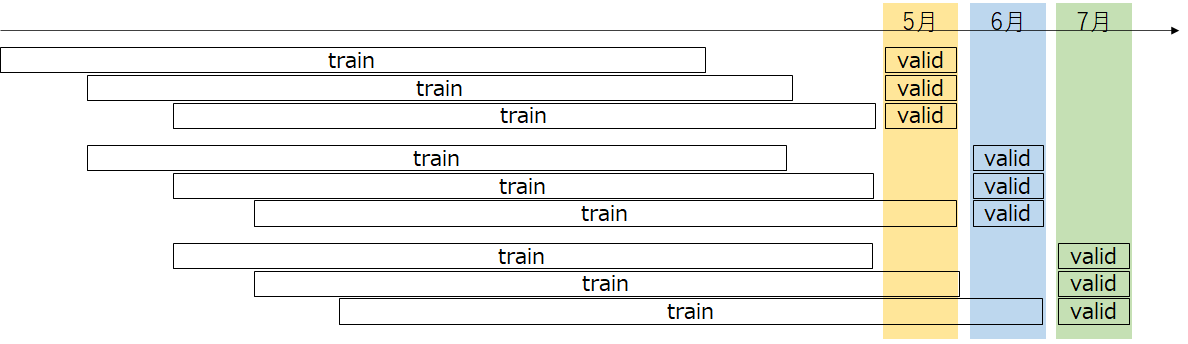](https://postimg.cc/nCds5N1C)\n\n# 2. preprocess data\n- features: total number of 232\n - mean/median/std/min/max of target per playerId last month\n - join each table by key(date/playerId/teamId), use the almost feature of each table\n - use all tables except events.csv\n - not use target-lag-feature\n- didn't use target-lag-feature, because it's risky. However, if spliting the model according to forecast date and use only fixed values, we may have improved the score.\n\n# 3. model\n- LSTM (keras)\n - input: features in forecast-day + past-days(to 5 days ago)\n - output: multi-output (target1, target2, target3, target4)\n - model: Input(6days) > TimeDistributed(Dense) > LSTM > LSTM > Dense(256>128>64>4)\n- other model:\n - MLP (input: features in only forecast-day)\n - GBDT (input: features in only forecast-day)\n\n[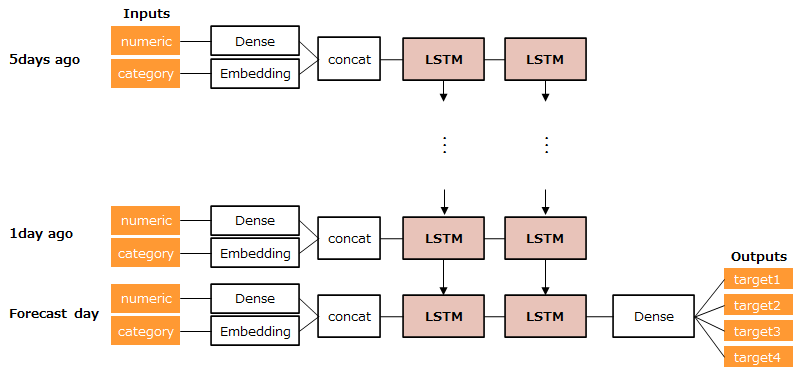](https://postimg.cc/dDwL0JHh)\n\n# 4. ensemble\n- LSTM:MLP:GBDT = 5:1:1\n- score in public LB (evaluation data: 2021-05)\n - LSTM: LB=1.28\n - MLP : LB=1.32\n - GBDT: LB=1.36\n - ensemble: LB=1.26\n\n# 5. measures to avoid submission-errors\n- add a lot of exception handling so that it works even if the table or data is missing.\n- use same function in both training and predicting\n- create dummy data of 2021-08 and 2021-09, and confirmed to work using dummy data on local PC and Kaggle'notebook.\n- use API Emulator ( @nyanpn ). Thank you !\n[API Emulator for debugging your code locally](https://www.kaggle.com/nyanpn/api-emulator-for-debugging-your-code-locally)\n\nThank you to my teammate. Let's do it together again!", "votes": null }, { "id": "1511397", "postDate": "09/13/2021 11:44:25", "content": "Congratulations and well deserved! Using LSTM is a smart idea.
", "rawMarkdown": "Congratulations and well deserved! Using LSTM is a smart idea.", "votes": null }, { "id": "1511816", "postDate": "09/13/2021 17:54:39", "content": "Thank you. Congratulations to you!
\nAPI simulator is very helpful for us. Thanks for sharing.
Congrats!
\nCan you share more information regarding how you created the embeddings for the categorical variables?
", "rawMarkdown": "Congrats! \n\nCan you share more information regarding how you created the embeddings for the categorical variables?", "votes": null }, { "id": "1513769", "postDate": "09/15/2021 11:55:42", "content": "I used Embedding of Keras.
\nlink
For example. when I have 30 numeric variables and 2 categorical variables, process with code like below.
\ninput_x = Input(shape=(32, ))\n\n# numeric\nx_num = input_x[:, :30]\nx_num = Dense(20)(x_num)\n\n# category1\nx_cat1 = input_x[:, 30]\nx_embed1 = Embedding(input_dim=100, output_dim=30)(x_cat1)\n\n# category2\nx_cat2 = input_x[:, 31]\nx_embed2 = Embedding(input_dim=200, output_dim=50)(x_cat2)\n\n# concat\nx = Concatenate()([x_num, x_embed1, x_embed2])\n\nout = Dense(4)(x)\n\nmodel = Model(inputs=input_x, outputs=out)\nprint(model.summary())\nThank you very much!
", "rawMarkdown": "Thank you very much!", "votes": null } ], "comments": [ { "id": 1511397, "author_name": "nyanpn", "author_url": "", "post_date": "09/13/2021 11:44:25", "content": "Congratulations and well deserved! Using LSTM is a smart idea.
", "votes": null, "replies": [ { "id": 1511816, "author_name": "moromoromoro", "author_url": "", "post_date": "09/13/2021 17:54:39", "content": "Thank you. Congratulations to you!
\nAPI simulator is very helpful for us. Thanks for sharing.
Congrats!
\nCan you share more information regarding how you created the embeddings for the categorical variables?
", "votes": null, "replies": [ { "id": 1513769, "author_name": "moromoromoro", "author_url": "", "post_date": "09/15/2021 11:55:42", "content": "I used Embedding of Keras.
\nlink
For example. when I have 30 numeric variables and 2 categorical variables, process with code like below.
\ninput_x = Input(shape=(32, ))\n\n# numeric\nx_num = input_x[:, :30]\nx_num = Dense(20)(x_num)\n\n# category1\nx_cat1 = input_x[:, 30]\nx_embed1 = Embedding(input_dim=100, output_dim=30)(x_cat1)\n\n# category2\nx_cat2 = input_x[:, 31]\nx_embed2 = Embedding(input_dim=200, output_dim=50)(x_cat2)\n\n# concat\nx = Concatenate()([x_num, x_embed1, x_embed2])\n\nout = Dense(4)(x)\n\nmodel = Model(inputs=input_x, outputs=out)\nprint(model.summary())\nThank you very much!
", "votes": null, "replies": [] } ] } ], "raw_markdown_by_id": { "1510055": "Thank you to the organizers for the fun competition and everyone who participated.\nAnd thank you to my teammate ( taksai @tsaito21219 ).\n\nI share our team's solution.\n\n# summary:\n- LSTM model\n- valid: 2021-05, 2021-06, 2021-07\n- ensemble LSTM:MLP:LightGBM=5:1:1\n\n# 1. validation\n- private-data(2021-08) is in-season, so we use in-season data as validation, and select the month near 2021-08.\n- valid: 2021-05, 2021-06, 2021-07\n- prepared some patterns as training-data while shifting the period. \n- trained 10-fold for each model\n\n[](https://postimg.cc/nCds5N1C)\n\n# 2. preprocess data\n- features: total number of 232\n - mean/median/std/min/max of target per playerId last month\n - join each table by key(date/playerId/teamId), use the almost feature of each table\n - use all tables except events.csv\n - not use target-lag-feature\n- didn't use target-lag-feature, because it's risky. However, if spliting the model according to forecast date and use only fixed values, we may have improved the score.\n\n# 3. model\n- LSTM (keras)\n - input: features in forecast-day + past-days(to 5 days ago)\n - output: multi-output (target1, target2, target3, target4)\n - model: Input(6days) > TimeDistributed(Dense) > LSTM > LSTM > Dense(256>128>64>4)\n- other model:\n - MLP (input: features in only forecast-day)\n - GBDT (input: features in only forecast-day)\n\n[](https://postimg.cc/dDwL0JHh)\n\n# 4. ensemble\n- LSTM:MLP:GBDT = 5:1:1\n- score in public LB (evaluation data: 2021-05)\n - LSTM: LB=1.28\n - MLP : LB=1.32\n - GBDT: LB=1.36\n - ensemble: LB=1.26\n\n# 5. measures to avoid submission-errors\n- add a lot of exception handling so that it works even if the table or data is missing.\n- use same function in both training and predicting\n- create dummy data of 2021-08 and 2021-09, and confirmed to work using dummy data on local PC and Kaggle'notebook.\n- use API Emulator ( @nyanpn ). Thank you !\n[API Emulator for debugging your code locally](https://www.kaggle.com/nyanpn/api-emulator-for-debugging-your-code-locally)\n\nThank you to my teammate. Let's do it together again!", "1511397": "Congratulations and well deserved! Using LSTM is a smart idea.", "1511816": "Thank you. Congratulations to you! \nAPI simulator is very helpful for us. Thanks for sharing.", "1513269": "Congrats! \n\nCan you share more information regarding how you created the embeddings for the categorical variables?", "1513769": "I used Embedding of Keras.\n[link](https://keras.io/ja/layers/embeddings/)\n\n1. transform category'name to id (use LabelEncoder)\n2. convert id to vector using Embeding layer\n3. combined with numeric layer \n\nFor example. when I have 30 numeric variables and 2 categorical variables, process with code like below.\n```\ninput_x = Input(shape=(32, ))\n\n# numeric\nx_num = input_x[:, :30]\nx_num = Dense(20)(x_num)\n\n# category1\nx_cat1 = input_x[:, 30]\nx_embed1 = Embedding(input_dim=100, output_dim=30)(x_cat1)\n\n# category2\nx_cat2 = input_x[:, 31]\nx_embed2 = Embedding(input_dim=200, output_dim=50)(x_cat2)\n\n# concat\nx = Concatenate()([x_num, x_embed1, x_embed2])\n\nout = Dense(4)(x)\n\nmodel = Model(inputs=input_x, outputs=out)\nprint(model.summary())\n```", "1514004": "Thank you very much!" }, "source": "meta" }