
Great thanks to Lyft and kaggle team for hosting this competition. Congrats to all the winners. And a special thanks to all my teammates for teaming up!! The time I spent discussing together was very insightful and most enjoyable.
\nOur solution’s point is that we made the custom mask.
\nAgent data one frame away from the same scene is very similar. So, in order to learn efficiently, we created a custom mask so that the data is loaded every N frames. For example, by sampling data every 5 frames, the training data is reduced by a factor of 5, allowing for faster learning.
\nTo make it more efficient, we balanced the data according to the target distance. About 65% of the data had a target distance of less than 6 meters, and they were easy tasks. So in order to efficiently train the difficult data, we downsampled the data below 6 m. This halved the data. In the end, the number of data was roughly 80,000 iterations x 64 batch size.
In addition to CNN, we used LSTM encoder and LSTM decoder.
\nFirst, we trained the model with the target distance balanced mask. Additional learning with the non-balanced mask. We used log10-scaled loss when additional training, because train/validate loss goes up and down with a large margin repeatedly. For two days of model training by using this method, we got a public score under 13, and a private score about 12.
\nhistory_positions more than 10 (Public score around 15, slow convergence)
\nmetalabeling
\nSeq2seq like LSTM decoder
As discussed in this thread, we found that stacking boosted the score, but had no time left integrating the best model to stacking…
\nUntil halfway through, I had mistakenly used satellite_debug as the 3 channel map information instead of semantic_map. Interestingly, this model got a public score of 13.3.
\nI didn’t pursue it further because I realized the mistake, but it seems that satellite maps can score somewhat well in this task. Try it if you like it!!!
Rasterized image data in the form of RGB×T×H×W, then fed them into R2+1D.
\nValidation score was equivalent to resnet18, but the process of rasterizing and the 3D-CNN model were so heavy that the training required twice ~ triple as much time.
We trained Seq2seq model not only with the target agent’s history position, but also with the surrounding vehicle’s history position. Despite no map information, this model got a validation score of 24. We integrated this trained seq2seq model into the trained resnet18 model, and fine-tuned the concat model. Sadly, improvement of the score was marginal.
", "messages": [ { "id": "1100817", "postDate": "12/03/2020 11:26:41", "content": "Great thanks to Lyft and kaggle team for hosting this competition. Congrats to all the winners. And a special thanks to all my teammates for teaming up!! The time I spent discussing together was very insightful and most enjoyable.
\nOur solution’s point is that we made the custom mask.
\nAgent data one frame away from the same scene is very similar. So, in order to learn efficiently, we created a custom mask so that the data is loaded every N frames. For example, by sampling data every 5 frames, the training data is reduced by a factor of 5, allowing for faster learning.
\nTo make it more efficient, we balanced the data according to the target distance. About 65% of the data had a target distance of less than 6 meters, and they were easy tasks. So in order to efficiently train the difficult data, we downsampled the data below 6 m. This halved the data. In the end, the number of data was roughly 80,000 iterations x 64 batch size.
In addition to CNN, we used LSTM encoder and LSTM decoder.
\nFirst, we trained the model with the target distance balanced mask. Additional learning with the non-balanced mask. We used log10-scaled loss when additional training, because train/validate loss goes up and down with a large margin repeatedly. For two days of model training by using this method, we got a public score under 13, and a private score about 12.
\nhistory_positions more than 10 (Public score around 15, slow convergence)
\nmetalabeling
\nSeq2seq like LSTM decoder
As discussed in this thread, we found that stacking boosted the score, but had no time left integrating the best model to stacking…
\nUntil halfway through, I had mistakenly used satellite_debug as the 3 channel map information instead of semantic_map. Interestingly, this model got a public score of 13.3.
\nI didn’t pursue it further because I realized the mistake, but it seems that satellite maps can score somewhat well in this task. Try it if you like it!!!
Rasterized image data in the form of RGB×T×H×W, then fed them into R2+1D.
\nValidation score was equivalent to resnet18, but the process of rasterizing and the 3D-CNN model were so heavy that the training required twice ~ triple as much time.
We trained Seq2seq model not only with the target agent’s history position, but also with the surrounding vehicle’s history position. Despite no map information, this model got a validation score of 24. We integrated this trained seq2seq model into the trained resnet18 model, and fine-tuned the concat model. Sadly, improvement of the score was marginal.
", "rawMarkdown": "Great thanks to Lyft and kaggle team for hosting this competition. Congrats to all the winners. And a special thanks to all my teammates for teaming up!! The time I spent discussing together was very insightful and most enjoyable.\n\n# Create Mask\n\nOur solution’s point is that we made the custom mask.\nAgent data one frame away from the same scene is very similar. So, in order to learn efficiently, we created a custom mask so that the data is loaded every N frames. For example, by sampling data every 5 frames, the training data is reduced by a factor of 5, allowing for faster learning.\nTo make it more efficient, we balanced the data according to the target distance. About 65% of the data had a target distance of less than 6 meters, and they were easy tasks. So in order to efficiently train the difficult data, we downsampled the data below 6 m. This halved the data. In the end, the number of data was roughly 80,000 iterations x 64 batch size.\n\n# Model architecture\n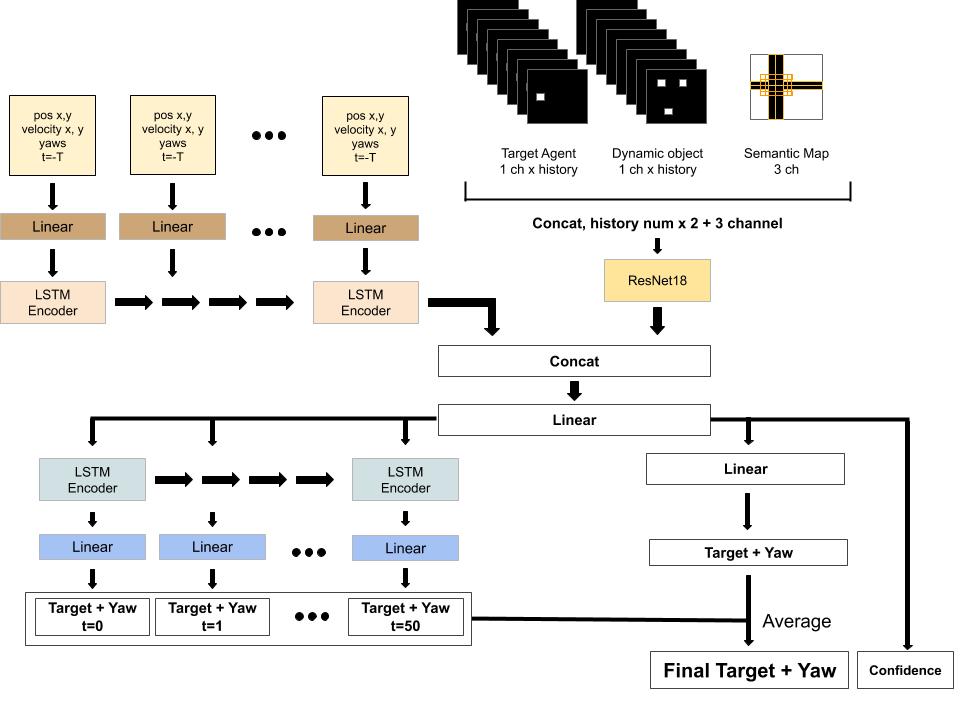\n\nIn addition to CNN, we used LSTM encoder and LSTM decoder.\n- Image size: 300x300\n- Optimizer: Adam\n- Scheduler: Onecyclelr\n- Num history: 10\n- Target: positions + cosine/sine of yaw\n\nFirst, we trained the model with the target distance balanced mask. Additional learning with the non-balanced mask. We used log10-scaled loss when additional training, because train/validate loss goes up and down with a large margin repeatedly. For two days of model training by using this method, we got a public score under 13, and a private score about 12.\n\n\n# Didn’t work\nhistory_positions more than 10 (Public score around 15, slow convergence)\nmetalabeling\nSeq2seq like LSTM decoder\n\n----------\n# Discussion\n\n## Stacking\n\nAs discussed in [this thread](https://www.kaggle.com/c/lyft-motion-prediction-autonomous-vehicles/discussion/199531#1091632), we found that stacking boosted the score, but had no time left integrating the best model to stacking...\n\n## Satellite image\n\nUntil halfway through, I had mistakenly used satellite_debug as the 3 channel map information instead of semantic_map. Interestingly, this model got a public score of 13.3.\nI didn’t pursue it further because I realized the mistake, but it seems that satellite maps can score somewhat well in this task. Try it if you like it!!!\n\n## 3D-CNN(R2+1D)\n\nRasterized image data in the form of RGB×T×H×W, then fed them into R2+1D.\nValidation score was equivalent to resnet18, but the process of rasterizing and the 3D-CNN model were so heavy that the training required twice ~ triple as much time.\n\n## Only sequence model\n\nWe trained Seq2seq model not only with the target agent’s history position, but also with the surrounding vehicle’s history position. Despite no map information, this model got a validation score of 24. We integrated this trained seq2seq model into the trained resnet18 model, and fine-tuned the concat model. Sadly, improvement of the score was marginal.", "votes": null }, { "id": "1103471", "postDate": "12/05/2020 23:45:57", "content": "Thanks for sharing @Inoichan with the summarized figure!
", "rawMarkdown": "Thanks for sharing @Inoichan with the summarized figure!", "votes": null } ], "comments": [ { "id": 1103471, "author_name": "corochann", "author_url": "", "post_date": "12/05/2020 23:45:57", "content": "Thanks for sharing @Inoichan with the summarized figure!
", "votes": null, "replies": [] } ], "raw_markdown_by_id": { "1100817": "Great thanks to Lyft and kaggle team for hosting this competition. Congrats to all the winners. And a special thanks to all my teammates for teaming up!! The time I spent discussing together was very insightful and most enjoyable.\n\n# Create Mask\n\nOur solution’s point is that we made the custom mask.\nAgent data one frame away from the same scene is very similar. So, in order to learn efficiently, we created a custom mask so that the data is loaded every N frames. For example, by sampling data every 5 frames, the training data is reduced by a factor of 5, allowing for faster learning.\nTo make it more efficient, we balanced the data according to the target distance. About 65% of the data had a target distance of less than 6 meters, and they were easy tasks. So in order to efficiently train the difficult data, we downsampled the data below 6 m. This halved the data. In the end, the number of data was roughly 80,000 iterations x 64 batch size.\n\n# Model architecture\n\n\nIn addition to CNN, we used LSTM encoder and LSTM decoder.\n- Image size: 300x300\n- Optimizer: Adam\n- Scheduler: Onecyclelr\n- Num history: 10\n- Target: positions + cosine/sine of yaw\n\nFirst, we trained the model with the target distance balanced mask. Additional learning with the non-balanced mask. We used log10-scaled loss when additional training, because train/validate loss goes up and down with a large margin repeatedly. For two days of model training by using this method, we got a public score under 13, and a private score about 12.\n\n\n# Didn’t work\nhistory_positions more than 10 (Public score around 15, slow convergence)\nmetalabeling\nSeq2seq like LSTM decoder\n\n----------\n# Discussion\n\n## Stacking\n\nAs discussed in [this thread](https://www.kaggle.com/c/lyft-motion-prediction-autonomous-vehicles/discussion/199531#1091632), we found that stacking boosted the score, but had no time left integrating the best model to stacking...\n\n## Satellite image\n\nUntil halfway through, I had mistakenly used satellite_debug as the 3 channel map information instead of semantic_map. Interestingly, this model got a public score of 13.3.\nI didn’t pursue it further because I realized the mistake, but it seems that satellite maps can score somewhat well in this task. Try it if you like it!!!\n\n## 3D-CNN(R2+1D)\n\nRasterized image data in the form of RGB×T×H×W, then fed them into R2+1D.\nValidation score was equivalent to resnet18, but the process of rasterizing and the 3D-CNN model were so heavy that the training required twice ~ triple as much time.\n\n## Only sequence model\n\nWe trained Seq2seq model not only with the target agent’s history position, but also with the surrounding vehicle’s history position. Despite no map information, this model got a validation score of 24. We integrated this trained seq2seq model into the trained resnet18 model, and fine-tuned the concat model. Sadly, improvement of the score was marginal.", "1103471": "Thanks for sharing @Inoichan with the summarized figure!" }, "source": "meta" }