
Thanks to the competition organizers and Kaggle staff for hosting this amazing competition and solid support.
\nThe image matching challenge competition gives us a lot of insight every year.
\nI really enjoyed participating.
Basically, I adopted the ALiked + LightGlue method.
Since the keypoints of ALiked + LightGlue method decreases with image rotation[1], one image was rotated every 90 degrees to search for corresponding points (1st step).
Next, using the keypoints obtained in the 1st step, I corrected the orientation of the two images and performed image matching again (2nd step). Affine transformation using HomographyMatrix is used to correct the image orientation. The reason for this is that the orientation can be corrected without specifying the rotation angle between the images.
In pycolmap's incrementalMapping, this function was implemented under the camera model with \"simple-radial\" and \"simple-pinhole\" settings.
\nTo eliminate randomness in the results, \"simple-radial\" twice and \"simple-pinhole\" once were ran.
\nFrom the results of \"simple-radial\" and \"simple-pinhole\", the largest model was adopted as the submission.
Additionally, in order to complete the above process within 9 hours, the notebook had 2 threads (to process keypoints extraction) and 2 forked processes (to process colmap). I used T4x2 notebook and assigned each GPU to each thread for keypoints extraction.
A conceptual diagram of keypoints extraction is shown below.
\n
Thanks to the competition organizers and Kaggle staff for hosting this amazing competition and solid support.
\nThe image matching challenge competition gives us a lot of insight every year.
\nI really enjoyed participating.
Basically, I adopted the ALiked + LightGlue method.
Since the keypoints of ALiked + LightGlue method decreases with image rotation[1], one image was rotated every 90 degrees to search for corresponding points (1st step).
Next, using the keypoints obtained in the 1st step, I corrected the orientation of the two images and performed image matching again (2nd step). Affine transformation using HomographyMatrix is used to correct the image orientation. The reason for this is that the orientation can be corrected without specifying the rotation angle between the images.
In pycolmap's incrementalMapping, this function was implemented under the camera model with \"simple-radial\" and \"simple-pinhole\" settings.
\nTo eliminate randomness in the results, \"simple-radial\" twice and \"simple-pinhole\" once were ran.
\nFrom the results of \"simple-radial\" and \"simple-pinhole\", the largest model was adopted as the submission.
Additionally, in order to complete the above process within 9 hours, the notebook had 2 threads (to process keypoints extraction) and 2 forked processes (to process colmap). I used T4x2 notebook and assigned each GPU to each thread for keypoints extraction.
A conceptual diagram of keypoints extraction is shown below.
\n
@motono0223 Thank you for your solution. Will you share the code later? I am looking forward to it.
", "rawMarkdown": "motono0223 Thank you for your solution. Will you share the code later? I am looking forward to it.", "votes": null }, { "id": "2855603", "postDate": "06/04/2024 22:16:25", "content": "@monoto0223 Great works!
", "rawMarkdown": "monoto0223 Great works!", "votes": null }, { "id": "2855705", "postDate": "06/05/2024 01:18:29", "content": "nice work. thanks for sharing.
", "rawMarkdown": "nice work. thanks for sharing.", "votes": null }, { "id": "2861623", "postDate": "06/08/2024 09:26:35", "content": "Congrats @motono0223, well deserved! May I know the reason behind using 2 threads (to process keypoints extraction) instead of 2 processes?
", "rawMarkdown": "Congrats @motono0223, well deserved! May I know the reason behind using 2 threads (to process keypoints extraction) instead of 2 processes?", "votes": null } ], "comments": [ { "id": 2854696, "author_name": "", "author_url": "", "post_date": "06/04/2024 12:05:50", "content": "@motono0223 Thank you for your solution. Will you share the code later? I am looking forward to it.
", "votes": null, "replies": [] }, { "id": 2855603, "author_name": "hoangqc", "author_url": "", "post_date": "06/04/2024 22:16:25", "content": "@monoto0223 Great works!
", "votes": null, "replies": [] }, { "id": 2855705, "author_name": "dragonzhang", "author_url": "", "post_date": "06/05/2024 01:18:29", "content": "nice work. thanks for sharing.
", "votes": null, "replies": [] }, { "id": 2861623, "author_name": "huyduong7101", "author_url": "", "post_date": "06/08/2024 09:26:35", "content": "Congrats @motono0223, well deserved! May I know the reason behind using 2 threads (to process keypoints extraction) instead of 2 processes?
", "votes": null, "replies": [] } ], "raw_markdown_by_id": { "2854563": "Thanks to the competition organizers and Kaggle staff for hosting this amazing competition and solid support.\nThe image matching challenge competition gives us a lot of insight every year. \nI really enjoyed participating.\n\n## Overview of 8th place solution\n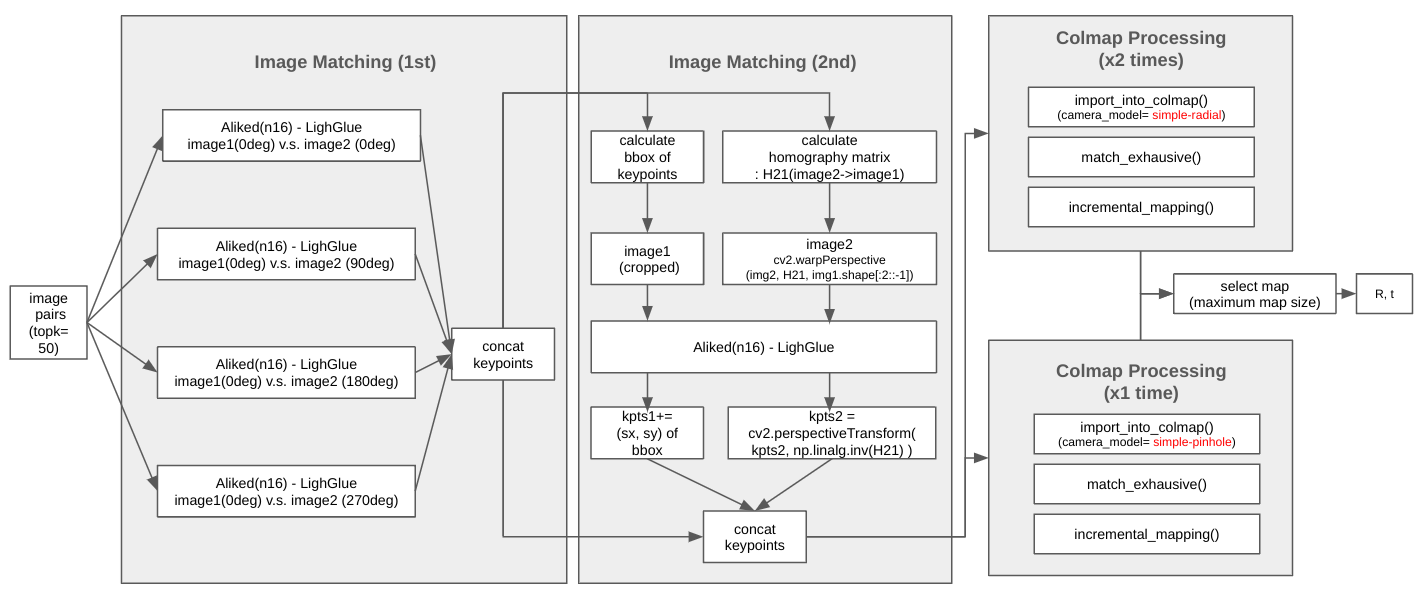\n\n- Basically, I adopted the ALiked + LightGlue method.\n- Since the keypoints of ALiked + LightGlue method decreases with image rotation[1], one image was rotated every 90 degrees to search for corresponding points (1st step).\n- Next, using the keypoints obtained in the 1st step, I corrected the orientation of the two images and performed image matching again (2nd step). Affine transformation using HomographyMatrix is used to correct the image orientation. The reason for this is that the orientation can be corrected without specifying the rotation angle between the images.\n\n- In pycolmap's incrementalMapping, this function was implemented under the camera model with \"simple-radial\" and \"simple-pinhole\" settings. \nTo eliminate randomness in the results, \"simple-radial\" twice and \"simple-pinhole\" once were ran. \nFrom the results of \"simple-radial\" and \"simple-pinhole\", the largest model was adopted as the submission.\n\n- Additionally, in order to complete the above process within 9 hours, the notebook had 2 threads (to process keypoints extraction) and 2 forked processes (to process colmap). I used T4x2 notebook and assigned each GPU to each thread for keypoints extraction.\n\n## Keypoints extraction\nA conceptual diagram of keypoints extraction is shown below.\n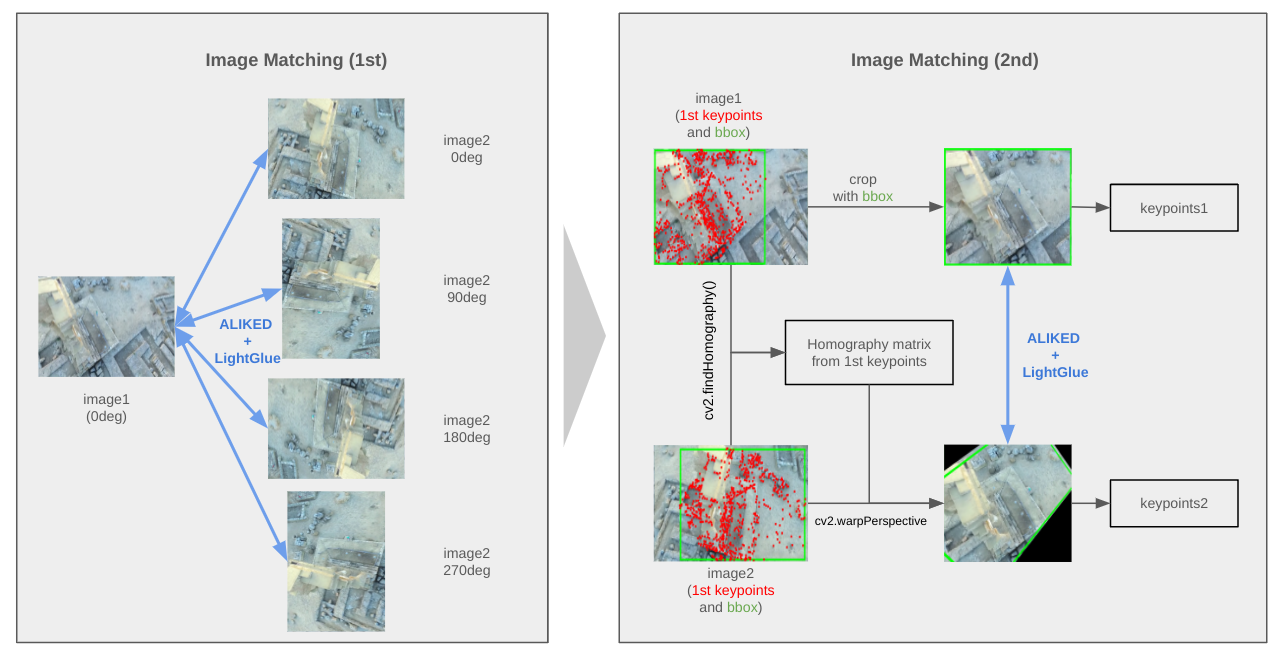\n\n## Reference\n- [1] [https://www.kaggle.com/code/motono0223/rotation-effect-for-image-matching](https://www.kaggle.com/code/motono0223/rotation-effect-for-image-matching)", "2854696": "motono0223 Thank you for your solution. Will you share the code later? I am looking forward to it.", "2855603": "monoto0223 Great works!", "2855705": "nice work. thanks for sharing.", "2861623": "Congrats @motono0223, well deserved! May I know the reason behind using 2 threads (to process keypoints extraction) instead of 2 processes?" }, "source": "meta" }