
Detections will all result from this type of radiation so I thought it would be good to share this, and it's an interesting topic!
\nI have also created a notebook version with some fun things to play around with if you fancy :)
\nhttps://www.kaggle.com/code/kennytanner/cherenkov-light-emission-cone-detection
\nDue to Q.E.D (quantum electrodynamics), the perceived (/measured/effective) speed of light is below c (the speed of light in a vacuum) through the ice. This way it is possible for a high-energy particle to be travelling faster than light propagates.
\nWe quantify this difference with the absolute refractive index, n $$ n= \\frac{c}{v} $$
\nWhere c is the speed of light in a vacuum and v is the speed light travels through the medium.
\nThis is a measured property of the medium, and reflects its optical density. Which is dependent on the chemical composition, temperature, and in truth, the refractive index itself is dependent on the wavelength of light through it as well. But for now there is no need to go into any of that.
\nCherenkov light was actually first observed by Marie Curie (https://www.sciencedirect.com/topics/chemistry/cherenkov-radiation) but later received the name of Pavel Cerenkov, after he and his advisors investigated the source.
\nWhen a charged particle travels through a dielectric medium, at a speed faster than light passes through that medium, then light is emitted.
\nThe electric field of the moving charged particle disrupts electrons of atoms it passes. These disruptions have a knock-on effect, disrupting electrons of other atoms. The sum total changing field results in emitted photons.
\nIt is important to remember this will only occur when the charged particle is travelling faster than the light does. The threshold particle speed for Cherenkov radiation to occur is therefore:
\n$$ u > \\frac{c}{n} $$ Where u is the speed of the particle.
\nWhen this is the case, photons are emitted along the path the particle travels, as it travels. This creates a coherent wavefront bow wave.
\n
https://en.wikipedia.org/wiki/Cherenkov_radiation
\nThe speed the particle travels relative to the light gives the angle of the cone.
\n$$\\theta_{c} = cos^{-1} \\left(\\frac{c}{n \\times u}\\right) = cos^{-1} \\left(\\frac{1}{\\beta \\times n}\\right)$$
\nWith $$ \\beta = \\frac{u}{c} $$
\nSo if the particle travels 80% of the speed of light, using the absolute refractive index of pure ice as 1.31, the Cherenkov angle will be ~0.3 radians.
\nMany particles are decelerated below the speed of the light by their own interactions in the medium. This halts the emission creating a gap between the wavefronts. Projected onto a plane you would see it as a ring but here's and example in from a water detector
\nhttps://physicsopenlab.org/2016/04/24/diy-cherenkov-detector/
\nWhile the Cherenkov light emission is proportional to the energy of the neutrino. It is important to remember that neutrinos (and antineutrinos) are not charged. Therefore the light emission detected will be from the charged particles in the cascades induced by them, not from the neutrinos themselves!
\nThe DOMs (Digital Optical Modules) in IceCube are all facing downwards. The Earth itself is then used as a shield from other sources, reducing the noise and increasing the sensitivity to the target events. And in terms of time, they record photons arriving at an accuracy of 1-2 nanoseconds. Which is less than 0.1% of the time it takes an energetic particle such as a muon to travel across the detector.
\n
https://icecube.wisc.edu/science/icecube/
\nSo, considering we are looking through the Earth what's in the icey detector below. Well nice clear ice, and lots of it!
\nWhile it is some of the most transparent available to this scale, it is not perfect. There is a dusty layer which we can see here in the absorptivity and scattering coeffient and these will effect the refractive index and therefore the Cherenkov angle as well.
\nThe simulated data has been produced to recreate all of these difficulties, as the real observations would.
\nIt appears that the images aren't working here, so I recommend the notebook I've linked below
\nhttps://www.kaggle.com/code/kennytanner/cherenkov-light-emission-cone-detection
\nDetections will all result from this type of radiation so I thought it would be good to share this, and it's an interesting topic!
\nI have also created a notebook version with some fun things to play around with if you fancy :)
\nhttps://www.kaggle.com/code/kennytanner/cherenkov-light-emission-cone-detection
\nDue to Q.E.D (quantum electrodynamics), the perceived (/measured/effective) speed of light is below c (the speed of light in a vacuum) through the ice. This way it is possible for a high-energy particle to be travelling faster than light propagates.
\nWe quantify this difference with the absolute refractive index, n $$ n= \\frac{c}{v} $$
\nWhere c is the speed of light in a vacuum and v is the speed light travels through the medium.
\nThis is a measured property of the medium, and reflects its optical density. Which is dependent on the chemical composition, temperature, and in truth, the refractive index itself is dependent on the wavelength of light through it as well. But for now there is no need to go into any of that.
\nCherenkov light was actually first observed by Marie Curie (https://www.sciencedirect.com/topics/chemistry/cherenkov-radiation) but later received the name of Pavel Cerenkov, after he and his advisors investigated the source.
\nWhen a charged particle travels through a dielectric medium, at a speed faster than light passes through that medium, then light is emitted.
\nThe electric field of the moving charged particle disrupts electrons of atoms it passes. These disruptions have a knock-on effect, disrupting electrons of other atoms. The sum total changing field results in emitted photons.
\nIt is important to remember this will only occur when the charged particle is travelling faster than the light does. The threshold particle speed for Cherenkov radiation to occur is therefore:
\n$$ u > \\frac{c}{n} $$ Where u is the speed of the particle.
\nWhen this is the case, photons are emitted along the path the particle travels, as it travels. This creates a coherent wavefront bow wave.
\n
https://en.wikipedia.org/wiki/Cherenkov_radiation
\nThe speed the particle travels relative to the light gives the angle of the cone.
\n$$\\theta_{c} = cos^{-1} \\left(\\frac{c}{n \\times u}\\right) = cos^{-1} \\left(\\frac{1}{\\beta \\times n}\\right)$$
\nWith $$ \\beta = \\frac{u}{c} $$
\nSo if the particle travels 80% of the speed of light, using the absolute refractive index of pure ice as 1.31, the Cherenkov angle will be ~0.3 radians.
\nMany particles are decelerated below the speed of the light by their own interactions in the medium. This halts the emission creating a gap between the wavefronts. Projected onto a plane you would see it as a ring but here's and example in from a water detector
\nhttps://physicsopenlab.org/2016/04/24/diy-cherenkov-detector/
\nWhile the Cherenkov light emission is proportional to the energy of the neutrino. It is important to remember that neutrinos (and antineutrinos) are not charged. Therefore the light emission detected will be from the charged particles in the cascades induced by them, not from the neutrinos themselves!
\nThe DOMs (Digital Optical Modules) in IceCube are all facing downwards. The Earth itself is then used as a shield from other sources, reducing the noise and increasing the sensitivity to the target events. And in terms of time, they record photons arriving at an accuracy of 1-2 nanoseconds. Which is less than 0.1% of the time it takes an energetic particle such as a muon to travel across the detector.
\n
https://icecube.wisc.edu/science/icecube/
\nSo, considering we are looking through the Earth what's in the icey detector below. Well nice clear ice, and lots of it!
\nWhile it is some of the most transparent available to this scale, it is not perfect. There is a dusty layer which we can see here in the absorptivity and scattering coeffient and these will effect the refractive index and therefore the Cherenkov angle as well.
\nThe simulated data has been produced to recreate all of these difficulties, as the real observations would.
\nIt appears that the images aren't working here, so I recommend the notebook I've linked below
\nhttps://www.kaggle.com/code/kennytanner/cherenkov-light-emission-cone-detection
\nAlso FYI their blue colour is due to the fact that they are high energy and $$ E_{photon}=cf $$
\nWhere f is the frequency of light and the blue end of the visual spectrum is the higher frequency (and energy)
Thank you very much for an excellent explanation!
\nThis video also explains about Cherenkov Light.
\nThe explanation using an analogy is very easy to understand.
\nhttps://www.youtube.com/watch?v=x4Ir6E4IG64
Thanks! And for providing additional resources also!
", "rawMarkdown": "Thanks! And for providing additional resources also!", "votes": null }, { "id": "2118099", "postDate": "01/27/2023 19:04:21", "content": "Great explanations.
\nIf you want your images to work I find either hosting them in a GitHub repo (better long terms solution) or using an image hosting website like imgbb (better short term solution and what I currently use) will work.
\nThanks again for the wonderful content and I’m looking forward to learning more.
", "rawMarkdown": "Great explanations.\n\nIf you want your images to work I find either hosting them in a GitHub repo (better long terms solution) or using an image hosting website like imgbb (better short term solution and what I currently use) will work.\n\nThanks again for the wonderful content and I’m looking forward to learning more.", "votes": null }, { "id": "2118111", "postDate": "01/27/2023 19:20:17", "content": "Yeah, they worked in the notebook but not in the discussion post. Next time I'll have to keep that in mind!
", "rawMarkdown": "Yeah, they worked in the notebook but not in the discussion post. Next time I'll have to keep that in mind!", "votes": null } ], "comments": [ { "id": 2117150, "author_name": "kennytanner", "author_url": "", "post_date": "01/27/2023 04:14:50", "content": "Also FYI their blue colour is due to the fact that they are high energy and $$ E_{photon}=cf $$
\nWhere f is the frequency of light and the blue end of the visual spectrum is the higher frequency (and energy)
Thank you very much for an excellent explanation!
\nThis video also explains about Cherenkov Light.
\nThe explanation using an analogy is very easy to understand.
\nhttps://www.youtube.com/watch?v=x4Ir6E4IG64
Thanks! And for providing additional resources also!
", "votes": null, "replies": [] } ] }, { "id": 2118099, "author_name": "dschettler8845", "author_url": "", "post_date": "01/27/2023 19:04:21", "content": "Great explanations.
\nIf you want your images to work I find either hosting them in a GitHub repo (better long terms solution) or using an image hosting website like imgbb (better short term solution and what I currently use) will work.
\nThanks again for the wonderful content and I’m looking forward to learning more.
", "votes": null, "replies": [ { "id": 2118111, "author_name": "kennytanner", "author_url": "", "post_date": "01/27/2023 19:20:17", "content": "Yeah, they worked in the notebook but not in the discussion post. Next time I'll have to keep that in mind!
", "votes": null, "replies": [] } ] } ], "raw_markdown_by_id": { "2117142": "*Detections will all result from this type of radiation so I thought it would be good to share this, and it's an interesting topic!*\n\n*I have also created a notebook version with some fun things to play around with if you fancy :)*\n\nhttps://www.kaggle.com/code/kennytanner/cherenkov-light-emission-cone-detection\n\nDue to Q.E.D (quantum electrodynamics), the perceived (/measured/effective) speed of light is below c (the speed of light in a vacuum) through the ice. This way it is possible for a high-energy particle to be travelling faster than light propagates.\n\nWe quantify this difference with the absolute refractive index, n $$ n= \\frac{c}{v} $$\n\nWhere c is the speed of light in a vacuum and v is the speed light travels through the medium.\n\nThis is a measured property of the medium, and reflects its optical density. Which is dependent on the chemical composition, temperature, and in truth, the refractive index itself is dependent on the wavelength of light through it as well. But for now there is no need to go into any of that.\n\nCherenkov light was actually first observed by Marie Curie (https://www.sciencedirect.com/topics/chemistry/cherenkov-radiation) but later received the name of Pavel Cerenkov, after he and his advisors investigated the source.\n\nWhen a charged particle travels through a dielectric medium, at a speed faster than light passes through that medium, then light is emitted.\n\nThe electric field of the moving charged particle disrupts electrons of atoms it passes. These disruptions have a knock-on effect, disrupting electrons of other atoms. The sum total changing field results in emitted photons.\n\nIt is important to remember this will only occur when the charged particle is travelling faster than the light does. The threshold particle speed for Cherenkov radiation to occur is therefore:\n\n$$ u > \\frac{c}{n} $$ Where u is the speed of the particle.\n\nWhen this is the case, photons are emitted along the path the particle travels, as it travels. This creates a coherent wavefront bow wave.\n\n\n\nhttps://en.wikipedia.org/wiki/Cherenkov_radiation\n\nThe speed the particle travels relative to the light gives the angle of the cone.\n\n$$\\theta_{c} = cos^{-1} \\left(\\frac{c}{n \\times u}\\right) = cos^{-1} \\left(\\frac{1}{\\beta \\times n}\\right)$$\n\nWith $$ \\beta = \\frac{u}{c} $$ \n\nSo if the particle travels 80% of the speed of light, using the absolute refractive index of pure ice as 1.31, the Cherenkov angle will be ~0.3 radians.\n\nMany particles are decelerated below the speed of the light by their own interactions in the medium. This halts the emission creating a gap between the wavefronts. Projected onto a plane you would see it as a ring but here's and example in from a water detector\n\n\n\nhttps://physicsopenlab.org/2016/04/24/diy-cherenkov-detector/\n\nWhile the Cherenkov light emission is proportional to the energy of the neutrino. It is important to remember that neutrinos (and antineutrinos) are not charged. Therefore **the light emission detected will be from the charged particles in the cascades induced by them, not from the neutrinos themselves**!\n\nThe DOMs (Digital Optical Modules) in IceCube are all facing downwards. The Earth itself is then used as a shield from other sources, reducing the noise and increasing the sensitivity to the target events. And in terms of time, they record photons arriving at an accuracy of 1-2 nanoseconds. Which is less than 0.1% of the time it takes an energetic particle such as a muon to travel across the detector.\n\n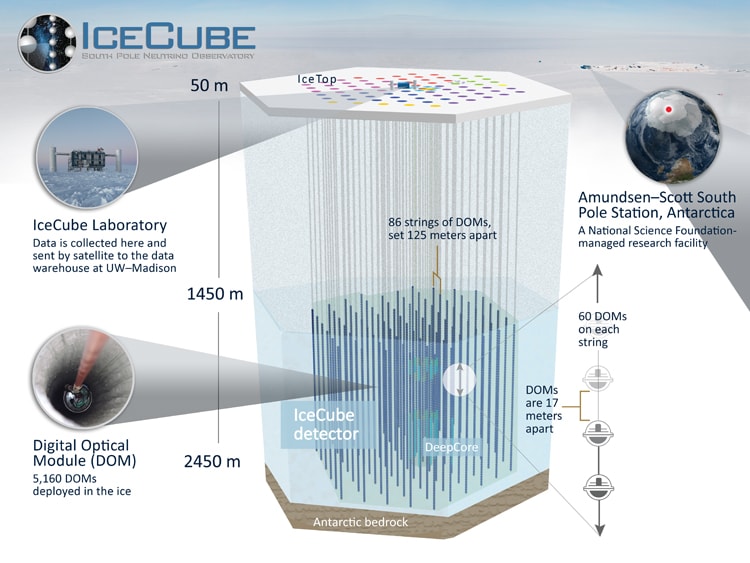\n\nhttps://icecube.wisc.edu/science/icecube/\n\nSo, considering we are looking through the Earth what's in the icey detector below. Well nice clear ice, and lots of it!\n\nWhile it is some of the most transparent available to this scale, it is not perfect. There is a dusty layer which we can see here in the absorptivity and scattering coeffient and these will effect the refractive index and therefore the Cherenkov angle as well.\n\nThe simulated data has been produced to recreate all of these difficulties, as the real observations would.\n\n\n\n**It appears that the images aren't working here, so I recommend the notebook I've linked below**\n\nhttps://www.kaggle.com/code/kennytanner/cherenkov-light-emission-cone-detection\n\n#### Best of luck everybody! \n#### Let's detect the most massive events with the tiniest and sneakiest of messengers.", "2117150": "Also FYI their blue colour is due to the fact that they are high energy and $$ E_{photon}=cf $$ \nWhere f is the frequency of light and the blue end of the visual spectrum is the higher frequency (and energy)", "2117214": "Thank you very much for an excellent explanation!\nThis video also explains about Cherenkov Light.\nThe explanation using an analogy is very easy to understand.\n[https://www.youtube.com/watch?v=x4Ir6E4IG64](url)", "2117861": "Thanks! And for providing additional resources also!", "2118099": "Great explanations.\n\nIf you want your images to work I find either hosting them in a GitHub repo (better long terms solution) or using an image hosting website like imgbb (better short term solution and what I currently use) will work.\n\nThanks again for the wonderful content and I’m looking forward to learning more.", "2118111": "Yeah, they worked in the notebook but not in the discussion post. Next time I'll have to keep that in mind!" }, "source": "meta" }