
The competition organizers provide a great illustration of the measured charges and the ground-truth direction. Can we know what sample/event was used and how to properly draw the line based only based on a direction?
\n
my attend is in: https://www.kaggle.com/code/jirkaborovec/icecube-neutrino-eda-3d-interactive-viewer
\n
The competition organizers provide a great illustration of the measured charges and the ground-truth direction. Can we know what sample/event was used and how to properly draw the line based only based on a direction?
\n
my attend is in: https://www.kaggle.com/code/jirkaborovec/icecube-neutrino-eda-3d-interactive-viewer
\n
Bumping the thread.
\nI'm also curious about that illustration, which event_id that plot represents.
\nIt would be helpful to validate whether our plotting code is already correct or not.
Or even better if the organizer can provide us with a code that being used to generate that plot.
\nPersonally, I have confusion why that red-line plot doesn't originate from (0, 0, 0).
", "rawMarkdown": "Bumping the thread.\nI'm also curious about that illustration, which event_id that plot represents.\nIt would be helpful to validate whether our plotting code is already correct or not.\n\nOr even better if the organizer can provide us with a code that being used to generate that plot.\n\nPersonally, I have confusion why that red-line plot doesn't originate from (0, 0, 0).", "votes": null }, { "id": "2111251", "postDate": "01/22/2023 18:23:50", "content": "From what I can see there are around ~900 possible train events that could match that image. This assumes rounding is done with string formatting (similar to the provided plot notebook).
\nThat being said there are other things you can do as well (more than 40 pulses in non-aux, etc.).
\nI'll let you know if I find it! :)
", "rawMarkdown": "From what I can see there are around ~900 possible train events that could match that image. This assumes rounding is done with string formatting (similar to the provided plot notebook). \n* I arrived at this number by writing a function to events within a threshold range to a particular (azimuth, zenith) value. \n* I then filtered this based on the requirement that both values would have to round to the plot title values.\n* Doing this I arrived at the ~900 event number. I'm plotting some randomly now hoping to just be able to pluck it out...\n\nThat being said there are other things you can do as well (more than 40 pulses in non-aux, etc.).\n\nI'll let you know if I find it! :)", "votes": null }, { "id": "2111282", "postDate": "01/22/2023 18:49:46", "content": "The line does not pass through the origin since it is not just a direction- it is also drawn in the correct position over the pulses it is based on. If we knew what event it is, we still would not be able to replicate it exactly since we are provided only with the direction of the vector and not its position in space. To replicate it is to find the algorithm they used to calculate the angles.
", "rawMarkdown": "The line does not pass through the origin since it is not just a direction- it is also drawn in the correct position over the pulses it is based on. If we knew what event it is, we still would not be able to replicate it exactly since we are provided only with the direction of the vector and not its position in space. To replicate it is to find the algorithm they used to calculate the angles.", "votes": null }, { "id": "2111289", "postDate": "01/22/2023 18:57:22", "content": "I went through every one of the 900 plots that had more than 40 pulses in the non-aux and didn't find the shared display plot image.
\nFor fun, here are some similar events (origin, charge, timing, position) I've found that share the same azimuth and zenith as the sample image:
\n


We wouldn't be able to replicate it perfectly (red line and all), but the charges, time, and position should all be the same?
", "rawMarkdown": "We wouldn't be able to replicate it perfectly (red line and all), but the charges, time, and position should all be the same?", "votes": null }, { "id": "2111335", "postDate": "01/22/2023 19:45:12", "content": "Well, yes. I guess you could scrap some information about the connection between charges/times and the pulses. However, since it's only one example, I would say that it would probably be more misleading than helpful…what would be really helpful is if they share their algorithm for calculating the angles, lol. (maybe they even shared it already on some paper, and we just need to find it…)
", "rawMarkdown": "Well, yes. I guess you could scrap some information about the connection between charges/times and the pulses. However, since it's only one example, I would say that it would probably be more misleading than helpful...what would be really helpful is if they share their algorithm for calculating the angles, lol. (maybe they even shared it already on some paper, and we just need to find it...)", "votes": null }, { "id": "2111542", "postDate": "01/23/2023 00:47:16", "content": "This data is all synthetic. For the episode in question, I think we can safely assume, they picked the neutrino's direction and energy randomly (according to some distribution). Then they ran it through their (highly stochastic) 'forward model' to create an example of what the sensor reports might look like were such a neutrino to pass through the cube. Those simulated sensor reports are what we get as the 'episode'.
\nOur task is to create an 'inverse model' - given the (simulated) sensor reports, estimate what the neutrino's direction of travel must have been. I'm sure the organizers have their own inverse models, but that's not how they generated the ground truth for this contest.
", "rawMarkdown": "This data is all synthetic. For the episode in question, I think we can safely assume, they picked the neutrino's direction and energy randomly (according to some distribution). Then they ran it through their (highly stochastic) 'forward model' to create an example of what the sensor reports might look like were such a neutrino to pass through the cube. Those simulated sensor reports are what we get as the 'episode'.\n\nOur task is to create an 'inverse model' - given the (simulated) sensor reports, estimate what the neutrino's direction of travel must have been. I'm sure the organizers have their own inverse models, but that's not how they generated the ground truth for this contest.", "votes": null }, { "id": "2111859", "postDate": "01/23/2023 09:06:22", "content": "@glazed is exactly right! Thanks for the nice explanation
", "rawMarkdown": "glazed is exactly right! Thanks for the nice explanation", "votes": null }, { "id": "2111871", "postDate": "01/23/2023 09:15:43", "content": "It is possible the event from the illustration is in the test data, or in some other junk of the data that is not used in this competition, because - believe it or not - we actually downsized the full dataset as it was >> 100 GB.
\nI think the plots above look very good and there is no reason to think that you are doing anything wrong.
\nSo I think there is probably not much value to further try to dig out the exact event used in the illustration image, it really was just one random example out of hundreds of millions of events, the plots above are just as good.
", "rawMarkdown": "It is possible the event from the illustration is in the test data, or in some other junk of the data that is not used in this competition, because - believe it or not - we actually downsized the full dataset as it was >> 100 GB.\n\nI think the plots above look very good and there is no reason to think that you are doing anything wrong.\n\nSo I think there is probably not much value to further try to dig out the _exact_ event used in the illustration image, it really was just one random example out of hundreds of millions of events, the plots above are just as good.", "votes": null }, { "id": "2111895", "postDate": "01/23/2023 09:32:35", "content": "So what are the event's IDs from your illustration? :)
", "rawMarkdown": "So what are the event's IDs from your illustration? :)", "votes": null }, { "id": "2112207", "postDate": "01/23/2023 13:23:44", "content": "Me or the host? I can provide mine shortly if you want.
", "rawMarkdown": "Me or the host? I can provide mine shortly if you want.", "votes": null } ], "comments": [ { "id": 2110822, "author_name": "thariqnugrohotomo", "author_url": "", "post_date": "01/22/2023 12:59:36", "content": "Bumping the thread.
\nI'm also curious about that illustration, which event_id that plot represents.
\nIt would be helpful to validate whether our plotting code is already correct or not.
Or even better if the organizer can provide us with a code that being used to generate that plot.
\nPersonally, I have confusion why that red-line plot doesn't originate from (0, 0, 0).
", "votes": null, "replies": [ { "id": 2111282, "author_name": "shlomoron", "author_url": "", "post_date": "01/22/2023 18:49:46", "content": "The line does not pass through the origin since it is not just a direction- it is also drawn in the correct position over the pulses it is based on. If we knew what event it is, we still would not be able to replicate it exactly since we are provided only with the direction of the vector and not its position in space. To replicate it is to find the algorithm they used to calculate the angles.
", "votes": null, "replies": [ { "id": 2111290, "author_name": "dschettler8845", "author_url": "", "post_date": "01/22/2023 18:58:29", "content": "We wouldn't be able to replicate it perfectly (red line and all), but the charges, time, and position should all be the same?
", "votes": null, "replies": [ { "id": 2111335, "author_name": "shlomoron", "author_url": "", "post_date": "01/22/2023 19:45:12", "content": "Well, yes. I guess you could scrap some information about the connection between charges/times and the pulses. However, since it's only one example, I would say that it would probably be more misleading than helpful…what would be really helpful is if they share their algorithm for calculating the angles, lol. (maybe they even shared it already on some paper, and we just need to find it…)
", "votes": null, "replies": [ { "id": 2111542, "author_name": "glazed", "author_url": "", "post_date": "01/23/2023 00:47:16", "content": "This data is all synthetic. For the episode in question, I think we can safely assume, they picked the neutrino's direction and energy randomly (according to some distribution). Then they ran it through their (highly stochastic) 'forward model' to create an example of what the sensor reports might look like were such a neutrino to pass through the cube. Those simulated sensor reports are what we get as the 'episode'.
\nOur task is to create an 'inverse model' - given the (simulated) sensor reports, estimate what the neutrino's direction of travel must have been. I'm sure the organizers have their own inverse models, but that's not how they generated the ground truth for this contest.
", "votes": null, "replies": [ { "id": 2111859, "author_name": "pellerphys", "author_url": "", "post_date": "01/23/2023 09:06:22", "content": "@glazed is exactly right! Thanks for the nice explanation
", "votes": null, "replies": [] } ] } ] } ] } ] } ] }, { "id": 2111251, "author_name": "dschettler8845", "author_url": "", "post_date": "01/22/2023 18:23:50", "content": "From what I can see there are around ~900 possible train events that could match that image. This assumes rounding is done with string formatting (similar to the provided plot notebook).
\nThat being said there are other things you can do as well (more than 40 pulses in non-aux, etc.).
\nI'll let you know if I find it! :)
", "votes": null, "replies": [ { "id": 2111289, "author_name": "dschettler8845", "author_url": "", "post_date": "01/22/2023 18:57:22", "content": "I went through every one of the 900 plots that had more than 40 pulses in the non-aux and didn't find the shared display plot image.
\nFor fun, here are some similar events (origin, charge, timing, position) I've found that share the same azimuth and zenith as the sample image:
\n
It is possible the event from the illustration is in the test data, or in some other junk of the data that is not used in this competition, because - believe it or not - we actually downsized the full dataset as it was >> 100 GB.
\nI think the plots above look very good and there is no reason to think that you are doing anything wrong.
\nSo I think there is probably not much value to further try to dig out the exact event used in the illustration image, it really was just one random example out of hundreds of millions of events, the plots above are just as good.
", "votes": null, "replies": [] }, { "id": 2111895, "author_name": "jirkaborovec", "author_url": "", "post_date": "01/23/2023 09:32:35", "content": "So what are the event's IDs from your illustration? :)
", "votes": null, "replies": [ { "id": 2112207, "author_name": "dschettler8845", "author_url": "", "post_date": "01/23/2023 13:23:44", "content": "Me or the host? I can provide mine shortly if you want.
", "votes": null, "replies": [] } ] } ] } ] } ], "raw_markdown_by_id": { "2109658": "The competition organizers provide a great illustration of the measured charges and the ground-truth direction. Can we know what sample/event was used and how to properly draw the line based only based on a direction?\n\n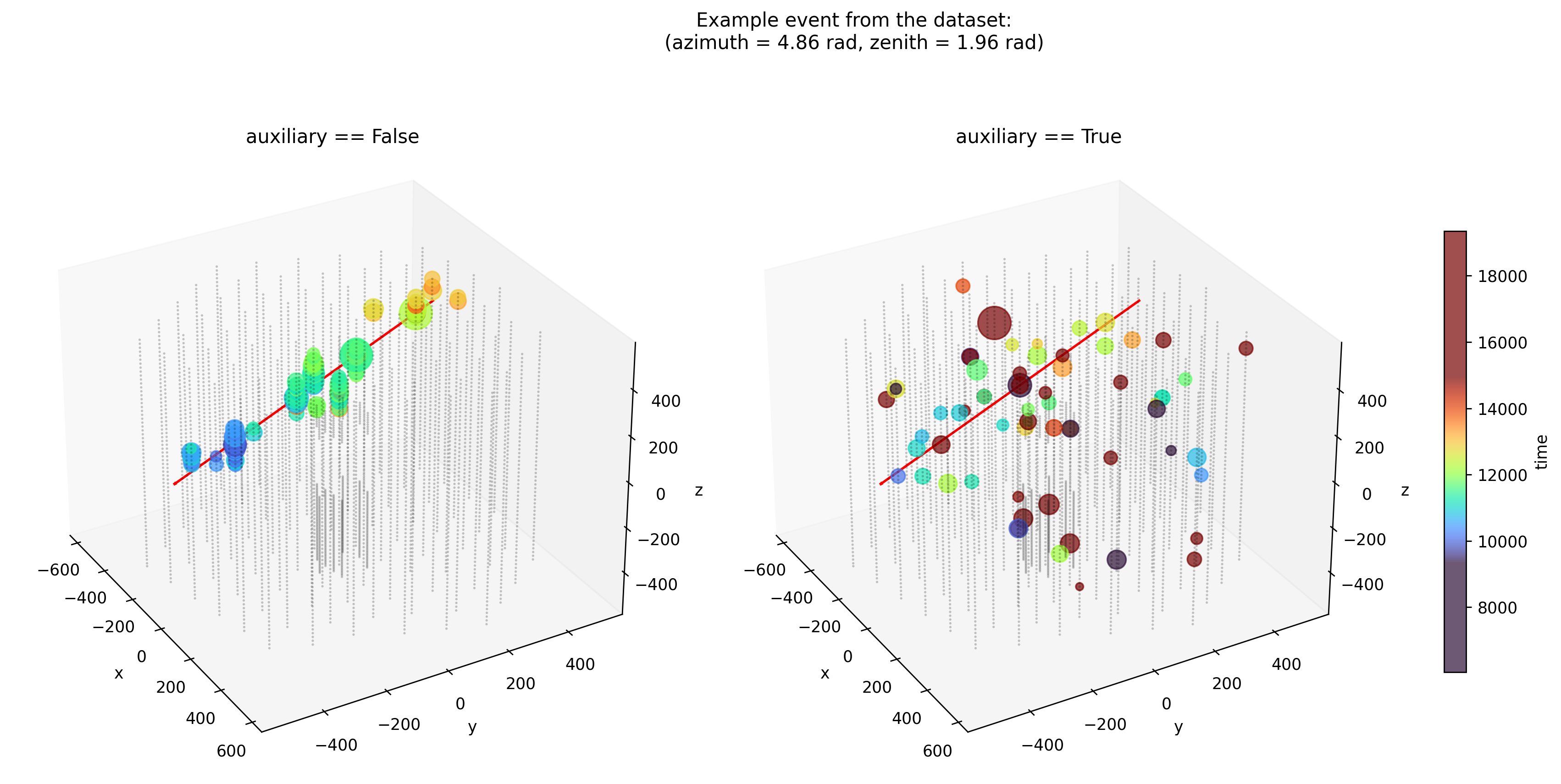\n\nmy attend is in: https://www.kaggle.com/code/jirkaborovec/icecube-neutrino-eda-3d-interactive-viewer\n\n[](https://postimg.cc/Vr2ZL1tc)", "2110822": "Bumping the thread.\nI'm also curious about that illustration, which event_id that plot represents.\nIt would be helpful to validate whether our plotting code is already correct or not.\n\nOr even better if the organizer can provide us with a code that being used to generate that plot.\n\nPersonally, I have confusion why that red-line plot doesn't originate from (0, 0, 0).", "2111251": "From what I can see there are around ~900 possible train events that could match that image. This assumes rounding is done with string formatting (similar to the provided plot notebook). \n* I arrived at this number by writing a function to events within a threshold range to a particular (azimuth, zenith) value. \n* I then filtered this based on the requirement that both values would have to round to the plot title values.\n* Doing this I arrived at the ~900 event number. I'm plotting some randomly now hoping to just be able to pluck it out...\n\nThat being said there are other things you can do as well (more than 40 pulses in non-aux, etc.).\n\nI'll let you know if I find it! :)", "2111282": "The line does not pass through the origin since it is not just a direction- it is also drawn in the correct position over the pulses it is based on. If we knew what event it is, we still would not be able to replicate it exactly since we are provided only with the direction of the vector and not its position in space. To replicate it is to find the algorithm they used to calculate the angles.", "2111289": "**I went through every one of the 900 plots that had more than 40 pulses in the non-aux and didn't find the shared display plot image.** \n* I'm pretty sure it's in the test data or something is wonky. \n* You can see all the plots I made here with the logic: **https://www.kaggle.com/code/dschettler8845/ndi-let-s-learn-together-eli5-and-eda**\n\n---\n\n\n**For fun**, here are some similar events (origin, charge, timing, position) I've found that share the same azimuth and zenith as the sample image:\n\n\n\n\n\n\n\n", "2111290": "We wouldn't be able to replicate it perfectly (red line and all), but the charges, time, and position should all be the same?", "2111335": "Well, yes. I guess you could scrap some information about the connection between charges/times and the pulses. However, since it's only one example, I would say that it would probably be more misleading than helpful...what would be really helpful is if they share their algorithm for calculating the angles, lol. (maybe they even shared it already on some paper, and we just need to find it...)", "2111542": "This data is all synthetic. For the episode in question, I think we can safely assume, they picked the neutrino's direction and energy randomly (according to some distribution). Then they ran it through their (highly stochastic) 'forward model' to create an example of what the sensor reports might look like were such a neutrino to pass through the cube. Those simulated sensor reports are what we get as the 'episode'.\n\nOur task is to create an 'inverse model' - given the (simulated) sensor reports, estimate what the neutrino's direction of travel must have been. I'm sure the organizers have their own inverse models, but that's not how they generated the ground truth for this contest.", "2111859": "glazed is exactly right! Thanks for the nice explanation", "2111871": "It is possible the event from the illustration is in the test data, or in some other junk of the data that is not used in this competition, because - believe it or not - we actually downsized the full dataset as it was >> 100 GB.\n\nI think the plots above look very good and there is no reason to think that you are doing anything wrong.\n\nSo I think there is probably not much value to further try to dig out the _exact_ event used in the illustration image, it really was just one random example out of hundreds of millions of events, the plots above are just as good.", "2111895": "So what are the event's IDs from your illustration? :)", "2112207": "Me or the host? I can provide mine shortly if you want." }, "source": "meta" }