
As per the description, the [azimuth/zenith] angle is in the radians of the neutrino. A value between 0 and 2*pi for the azimuth and 0 and pi for the zenith. The target columns. Not provided for the test set. The direction vector represented by zenith and azimuth points to where the neutrino came from.
\n
I follow computation of
\nx = cos(azimuth) * sin(zenith)\ny = sin(azimuth) * sin(zenith)\nz = cos(zenith)\n
but I have a hard time getting the line from [-x, -y, -z] to [x, y, z] aligned with observations, also it seems that most of the events are coming from about 90 degrees zenith and most of the vent seems to occur coming from the top down to in z-axis direction from +z to -z.
\nDoes it mean that the zenith has a 90-degree offset?
\nUPDATE: created a 3D point cloud fitting: https://www.kaggle.com/code/jirkaborovec/icecube-neutrino-fitting-3d-point-cloud
", "messages": [ { "id": "2109397", "postDate": "01/21/2023 11:36:59", "content": "As per the description, the [azimuth/zenith] angle is in the radians of the neutrino. A value between 0 and 2*pi for the azimuth and 0 and pi for the zenith. The target columns. Not provided for the test set. The direction vector represented by zenith and azimuth points to where the neutrino came from.
\n
I follow computation of
\nx = cos(azimuth) * sin(zenith)\ny = sin(azimuth) * sin(zenith)\nz = cos(zenith)\n
but I have a hard time getting the line from [-x, -y, -z] to [x, y, z] aligned with observations, also it seems that most of the events are coming from about 90 degrees zenith and most of the vent seems to occur coming from the top down to in z-axis direction from +z to -z.
\nDoes it mean that the zenith has a 90-degree offset?
\nUPDATE: created a 3D point cloud fitting: https://www.kaggle.com/code/jirkaborovec/icecube-neutrino-fitting-3d-point-cloud
", "rawMarkdown": "As per the description, the [azimuth/zenith] angle is in the radians of the neutrino. A value between 0 and 2*pi for the azimuth and 0 and pi for the zenith. The target columns. Not provided for the test set. The direction vector represented by zenith and azimuth points to where the neutrino came from.\n\n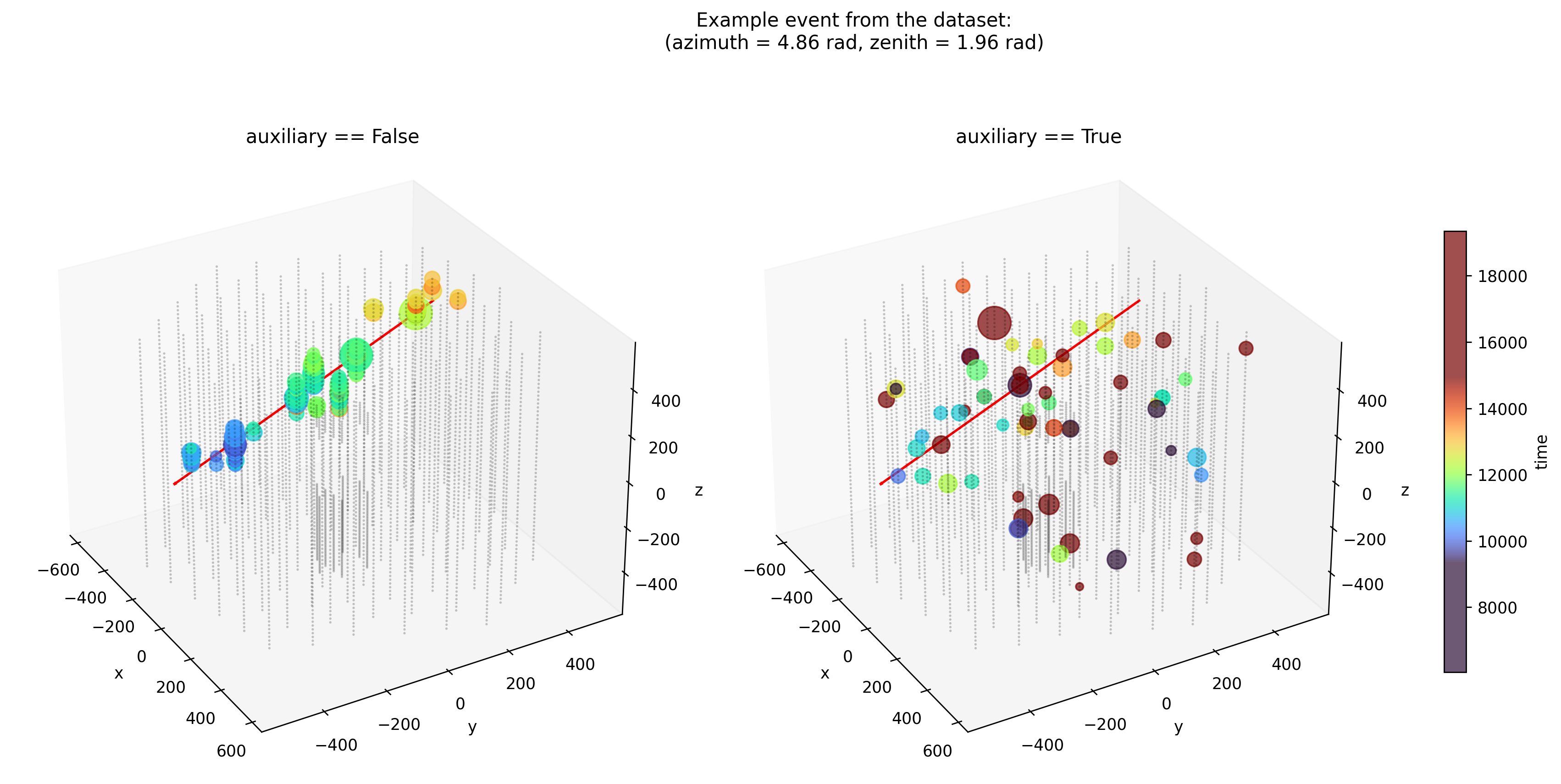\n\nI follow computation of\n\n```python\nx = cos(azimuth) * sin(zenith)\ny = sin(azimuth) * sin(zenith)\nz = cos(zenith)\n```\n\n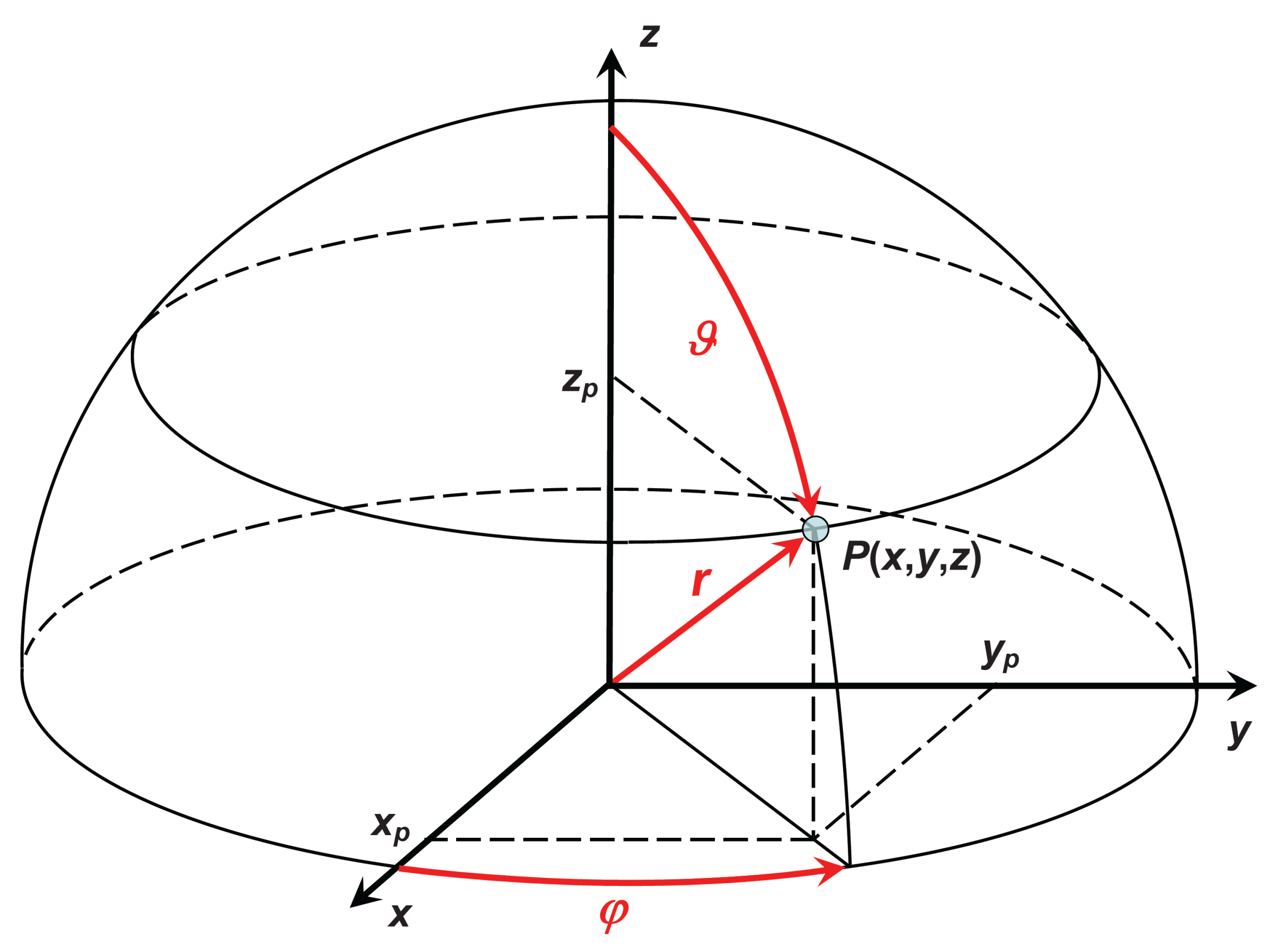\n\nbut I have a hard time getting the line from [-x, -y, -z] to [x, y, z] aligned with observations, also it seems that most of the events are coming from about 90 degrees zenith and most of the vent seems to occur coming from the top down to in z-axis direction from +z to -z.\n\nDoes it mean that the zenith has a 90-degree offset?\n\nUPDATE: created a 3D point cloud fitting: https://www.kaggle.com/code/jirkaborovec/icecube-neutrino-fitting-3d-point-cloud", "votes": null }, { "id": "2109438", "postDate": "01/21/2023 12:03:04", "content": "Also it would be great to know what event is on the illustration so we can replicate it 🤠
", "rawMarkdown": "Also it would be great to know what event is on the illustration so we can replicate it 🤠", "votes": null }, { "id": "2110620", "postDate": "01/22/2023 10:12:41", "content": "Isn't it 1583 from batch 1 ?
", "rawMarkdown": "Isn't it 1583 from batch 1 ?", "votes": null }, { "id": "2110827", "postDate": "01/22/2023 13:03:36", "content": "How do you conclude that?
\nNote that in the title of the illustration, it's mentioning about the value of azimuth and zenith. But 1583 that you mentioned is too far from those values.
", "rawMarkdown": "How do you conclude that?\n\nNote that in the title of the illustration, it's mentioning about the value of azimuth and zenith. But 1583 that you mentioned is too far from those values.", "votes": null }, { "id": "2110864", "postDate": "01/22/2023 13:48:05", "content": "based on the histogram, there can be about 60k events with very similar azimuth/zenith
\n
see: https://www.kaggle.com/code/jirkaborovec/icecube-neutrino-eda-3d-interactive-viewer
", "rawMarkdown": "based on the histogram, there can be about 60k events with very similar azimuth/zenith\n\n[](https://postimg.cc/9zQq7J3g)\n\nsee: https://www.kaggle.com/code/jirkaborovec/icecube-neutrino-eda-3d-interactive-viewer", "votes": null }, { "id": "2110907", "postDate": "01/22/2023 14:26:40", "content": "As mentioned elsewhere, unfortunately, I cannot give you the exact event_id from the illustration plot, as the dataset has been scrambled by kaggle.^
\nAlso, we don't provide you with any x,y,z coordinates of the neutrino interaction, only its direction. So when you plot the direction vector naturally it will simply sit at the origin and does not show you where the neutrino or its interaction product went through the detector, but only the direction.
", "rawMarkdown": "As mentioned elsewhere, unfortunately, I cannot give you the exact event_id from the illustration plot, as the dataset has been scrambled by kaggle.^\n\nAlso, we don't provide you with any x,y,z coordinates of the neutrino interaction, only its direction. So when you plot the direction vector naturally it will simply sit at the origin and does not show you _where_ the neutrino or its interaction product went through the detector, but only the direction.", "votes": null }, { "id": "2110989", "postDate": "01/22/2023 15:06:17", "content": "That was a question, not a conclusion.
\nI was asking about that number because @jirkaborovec has visualized that one and looked similar. So I asked if that's the one or not:)
The red lines in your plots seem to correlate nicely with the data - there's just an offset required to allow them to match up.
\nAs @pellerphys mentioned, we are not given the coordinates of the interaction - we are missing the c from y = mx + c and only given the components to derive m.
", "rawMarkdown": "The red lines in your plots seem to correlate nicely with the data - there's just an offset required to allow them to match up.\n\nAs @pellerphys mentioned, we are not given the coordinates of the interaction - we are missing the c from y = mx + c and only given the components to derive m.", "votes": null }, { "id": "2111281", "postDate": "01/22/2023 18:49:08", "content": "\nYour point about no positional information may be worth putting into the data section of the competition. It seems to be a point of confusion and many Kagglers may miss this detail if it's buried in a comment. Unless this detail is already in the data section and I just missed it…
", "rawMarkdown": "pellerphys \n\nYour point about no positional information may be worth putting into the data section of the competition. It seems to be a point of confusion and many Kagglers may miss this detail if it's buried in a comment. Unless this detail is already in the data section and I just missed it...", "votes": null }, { "id": "2111291", "postDate": "01/22/2023 19:00:13", "content": "Good suggestion, i will do that
", "rawMarkdown": "Good suggestion, i will do that", "votes": null }, { "id": "2116737", "postDate": "01/26/2023 17:20:05", "content": "Unfortunately, the illustration is the one provided by the organizers, so the question holds where is the origin…
", "rawMarkdown": "Unfortunately, the illustration is the one provided by the organizers, so the question holds where is the origin...", "votes": null }, { "id": "2116778", "postDate": "01/26/2023 18:06:09", "content": "Ok, I made just plotting of all values of azimuth/zenith within a given range… in particular for zenith, it seems a bit contra-intuitive that training data also includes data from pi/2 to pi, which means that some neutrinos come from the bottom/earth?
https://www.kaggle.com/jirkaborovec/icecube-visualize-azimuth-zenith
", "rawMarkdown": "Ok, I made just plotting of all values of azimuth/zenith within a given range... in particular for zenith, it seems a bit contra-intuitive that training data also includes data from `pi/2` to `pi`, which means that some neutrinos come from the bottom/earth? \n\nhttps://www.kaggle.com/jirkaborovec/icecube-visualize-azimuth-zenith", "votes": null }, { "id": "2117871", "postDate": "01/27/2023 15:52:37", "content": "zenith from Earth:
\nTo my limited understanding, there are billions or trillions of neutrinos passing through Earth all the time. Individually, the chance of collision is low, so it is hard to detect and can indeed be coming from any angle.
", "rawMarkdown": "zenith from Earth:\n\nTo my limited understanding, there are billions or trillions of neutrinos passing through Earth all the time. Individually, the chance of collision is low, so it is hard to detect and can indeed be coming from any angle.", "votes": null }, { "id": "2117888", "postDate": "01/27/2023 16:04:55", "content": "Yes. It's actually better to detect neutrino's coming from the bottom/earth. There's far less noise. If we look up we get lots of 'noise' and cosmic rays that are filtered out if we instead look into the Earth. Hope that makes sense. Here's a pic if that helps.
\n
The caption is: IceCube sees both cosmic rays and neutrinos from the Southern-Hemisphere sky. Earth blocks cosmic rays from the Northern Hemisphere, so IceCube sees only muons made by those mysterious, high-energy neutrinos from the north.
\nCheers!
", "rawMarkdown": "Yes. It's actually better to detect neutrino's coming from the bottom/earth. There's far less noise. If we look up we get lots of 'noise' and cosmic rays that are filtered out if we instead look into the Earth. Hope that makes sense. Here's a pic if that helps.\n\n\n\nThe caption is: ***IceCube sees both cosmic rays and neutrinos from the Southern-Hemisphere sky. Earth blocks cosmic rays from the Northern Hemisphere, so IceCube sees only muons made by those mysterious, high-energy neutrinos from the north.***\n* The website I pulled it from is here (I found it really helpful): https://whyfiles.org/2012/chasing-neutrinos-at-the-south-pole\n\nCheers!", "votes": null }, { "id": "2118185", "postDate": "01/27/2023 20:36:58", "content": "WAAY off-topic, but my dad was a premier GPS scientist and, in his spare time, an astrophysicist hobbyist (he was a proponent of a modified Lorentz ether theory). I googled my dad's name and neutrinos the other day, and didn't see anything from him, but I did happen to see an ether-related theory that speculated that, essentially, neutrinos limited interactions based on density could cause 'ether wind' (akin to air pressure rushing in to fill a lower pressure space) that in turn causes gravity.
\nIt's not, of course, a generally accepted idea, but my personal belief/takeaway is that when it comes to the speed of light, neutrinos, gravity, and similar things: we are very limited in how we can study it. The frame of reference problem (re speed of light and even gravity), and the 'invisible' problem, and other such challenges. Much has been done to work around those limitations, but there's a lot that's difficult to be definitive about, other than what currently best matches the observed evidence.
\nIceCube is exciting precisely because it can help add to that body of observed evidence. (Though I'm sad to be working only on the simulated data, oh well.)
", "rawMarkdown": "WAAY off-topic, but my dad was a premier GPS scientist and, in his spare time, an astrophysicist hobbyist (he was a proponent of a modified [Lorentz ether theory](https://en.wikipedia.org/wiki/Lorentz_ether_theory)). I googled my dad's name and neutrinos the other day, and didn't see anything from him, but I did happen to see an ether-related theory that speculated that, essentially, neutrinos limited interactions based on density could cause 'ether wind' (akin to air pressure rushing in to fill a lower pressure space) that in turn causes gravity.\n\nIt's not, of course, a generally accepted idea, but my personal belief/takeaway is that when it comes to the speed of light, neutrinos, gravity, and similar things: we are very limited in how we can study it. The frame of reference problem (re speed of light and even gravity), and the 'invisible' problem, and other such challenges. Much has been done to work around those limitations, but there's a lot that's difficult to be definitive about, other than what currently best matches the observed evidence.\n\nIceCube is exciting precisely because it can help add to that body of observed evidence. (Though I'm sad to be working only on the simulated data, oh well.)", "votes": null }, { "id": "2129619", "postDate": "02/04/2023 18:51:29", "content": "The clearest answer I found came from the Competition Host on this thread.
\n\n", "rawMarkdown": "The clearest answer I found came from the Competition Host on [this thread](https://www.kaggle.com/competitions/icecube-neutrinos-in-deep-ice/discussion/381648).\n\n>\"*all parallel paths will have identical zenith and azimuth values*\"", "votes": null }, { "id": "2129876", "postDate": "02/05/2023 01:06:03", "content": "\"all parallel paths will have identical zenith and azimuth values\"
\n
that is nature for parallel lines; I would surprised if if this wont be true :D
", "rawMarkdown": "that is nature for parallel lines; I would surprised if if this wont be true :D", "votes": null } ], "comments": [ { "id": 2109438, "author_name": "jirkaborovec", "author_url": "", "post_date": "01/21/2023 12:03:04", "content": "Also it would be great to know what event is on the illustration so we can replicate it 🤠
", "votes": null, "replies": [ { "id": 2110620, "author_name": "nofreewill", "author_url": "", "post_date": "01/22/2023 10:12:41", "content": "Isn't it 1583 from batch 1 ?
", "votes": null, "replies": [ { "id": 2110827, "author_name": "thariqnugrohotomo", "author_url": "", "post_date": "01/22/2023 13:03:36", "content": "How do you conclude that?
\nNote that in the title of the illustration, it's mentioning about the value of azimuth and zenith. But 1583 that you mentioned is too far from those values.
", "votes": null, "replies": [ { "id": 2110989, "author_name": "nofreewill", "author_url": "", "post_date": "01/22/2023 15:06:17", "content": "That was a question, not a conclusion.
\nI was asking about that number because @jirkaborovec has visualized that one and looked similar. So I asked if that's the one or not:)
based on the histogram, there can be about 60k events with very similar azimuth/zenith
\n
see: https://www.kaggle.com/code/jirkaborovec/icecube-neutrino-eda-3d-interactive-viewer
", "votes": null, "replies": [ { "id": 2110907, "author_name": "pellerphys", "author_url": "", "post_date": "01/22/2023 14:26:40", "content": "As mentioned elsewhere, unfortunately, I cannot give you the exact event_id from the illustration plot, as the dataset has been scrambled by kaggle.^
\nAlso, we don't provide you with any x,y,z coordinates of the neutrino interaction, only its direction. So when you plot the direction vector naturally it will simply sit at the origin and does not show you where the neutrino or its interaction product went through the detector, but only the direction.
", "votes": null, "replies": [ { "id": 2111281, "author_name": "dschettler8845", "author_url": "", "post_date": "01/22/2023 18:49:08", "content": "\nYour point about no positional information may be worth putting into the data section of the competition. It seems to be a point of confusion and many Kagglers may miss this detail if it's buried in a comment. Unless this detail is already in the data section and I just missed it…
", "votes": null, "replies": [ { "id": 2111291, "author_name": "pellerphys", "author_url": "", "post_date": "01/22/2023 19:00:13", "content": "Good suggestion, i will do that
", "votes": null, "replies": [] } ] } ] } ] } ] } ] }, { "id": 2111157, "author_name": "anjum48", "author_url": "", "post_date": "01/22/2023 16:30:53", "content": "The red lines in your plots seem to correlate nicely with the data - there's just an offset required to allow them to match up.
\nAs @pellerphys mentioned, we are not given the coordinates of the interaction - we are missing the c from y = mx + c and only given the components to derive m.
", "votes": null, "replies": [ { "id": 2116737, "author_name": "jirkaborovec", "author_url": "", "post_date": "01/26/2023 17:20:05", "content": "Unfortunately, the illustration is the one provided by the organizers, so the question holds where is the origin…
", "votes": null, "replies": [] } ] }, { "id": 2116778, "author_name": "jirkaborovec", "author_url": "", "post_date": "01/26/2023 18:06:09", "content": "Ok, I made just plotting of all values of azimuth/zenith within a given range… in particular for zenith, it seems a bit contra-intuitive that training data also includes data from pi/2 to pi, which means that some neutrinos come from the bottom/earth?
https://www.kaggle.com/jirkaborovec/icecube-visualize-azimuth-zenith
", "votes": null, "replies": [ { "id": 2117871, "author_name": "roberthatch", "author_url": "", "post_date": "01/27/2023 15:52:37", "content": "zenith from Earth:
\nTo my limited understanding, there are billions or trillions of neutrinos passing through Earth all the time. Individually, the chance of collision is low, so it is hard to detect and can indeed be coming from any angle.
", "votes": null, "replies": [] }, { "id": 2117888, "author_name": "dschettler8845", "author_url": "", "post_date": "01/27/2023 16:04:55", "content": "Yes. It's actually better to detect neutrino's coming from the bottom/earth. There's far less noise. If we look up we get lots of 'noise' and cosmic rays that are filtered out if we instead look into the Earth. Hope that makes sense. Here's a pic if that helps.
\n
The caption is: IceCube sees both cosmic rays and neutrinos from the Southern-Hemisphere sky. Earth blocks cosmic rays from the Northern Hemisphere, so IceCube sees only muons made by those mysterious, high-energy neutrinos from the north.
\nCheers!
", "votes": null, "replies": [ { "id": 2118185, "author_name": "roberthatch", "author_url": "", "post_date": "01/27/2023 20:36:58", "content": "WAAY off-topic, but my dad was a premier GPS scientist and, in his spare time, an astrophysicist hobbyist (he was a proponent of a modified Lorentz ether theory). I googled my dad's name and neutrinos the other day, and didn't see anything from him, but I did happen to see an ether-related theory that speculated that, essentially, neutrinos limited interactions based on density could cause 'ether wind' (akin to air pressure rushing in to fill a lower pressure space) that in turn causes gravity.
\nIt's not, of course, a generally accepted idea, but my personal belief/takeaway is that when it comes to the speed of light, neutrinos, gravity, and similar things: we are very limited in how we can study it. The frame of reference problem (re speed of light and even gravity), and the 'invisible' problem, and other such challenges. Much has been done to work around those limitations, but there's a lot that's difficult to be definitive about, other than what currently best matches the observed evidence.
\nIceCube is exciting precisely because it can help add to that body of observed evidence. (Though I'm sad to be working only on the simulated data, oh well.)
", "votes": null, "replies": [] } ] } ] }, { "id": 2129619, "author_name": "michaelbarrett", "author_url": "", "post_date": "02/04/2023 18:51:29", "content": "The clearest answer I found came from the Competition Host on this thread.
\n\n", "votes": null, "replies": [ { "id": 2129876, "author_name": "jirkaborovec", "author_url": "", "post_date": "02/05/2023 01:06:03", "content": "\"all parallel paths will have identical zenith and azimuth values\"
\n
that is nature for parallel lines; I would surprised if if this wont be true :D
", "votes": null, "replies": [] } ] } ], "raw_markdown_by_id": { "2109397": "As per the description, the [azimuth/zenith] angle is in the radians of the neutrino. A value between 0 and 2*pi for the azimuth and 0 and pi for the zenith. The target columns. Not provided for the test set. The direction vector represented by zenith and azimuth points to where the neutrino came from.\n\n\n\nI follow computation of\n\n```python\nx = cos(azimuth) * sin(zenith)\ny = sin(azimuth) * sin(zenith)\nz = cos(zenith)\n```\n\n\n\nbut I have a hard time getting the line from [-x, -y, -z] to [x, y, z] aligned with observations, also it seems that most of the events are coming from about 90 degrees zenith and most of the vent seems to occur coming from the top down to in z-axis direction from +z to -z.\n\nDoes it mean that the zenith has a 90-degree offset?\n\nUPDATE: created a 3D point cloud fitting: https://www.kaggle.com/code/jirkaborovec/icecube-neutrino-fitting-3d-point-cloud", "2109438": "Also it would be great to know what event is on the illustration so we can replicate it 🤠", "2110620": "Isn't it 1583 from batch 1 ?", "2110827": "How do you conclude that?\n\nNote that in the title of the illustration, it's mentioning about the value of azimuth and zenith. But 1583 that you mentioned is too far from those values.", "2110864": "based on the histogram, there can be about 60k events with very similar azimuth/zenith\n\n[](https://postimg.cc/9zQq7J3g)\n\nsee: https://www.kaggle.com/code/jirkaborovec/icecube-neutrino-eda-3d-interactive-viewer", "2110907": "As mentioned elsewhere, unfortunately, I cannot give you the exact event_id from the illustration plot, as the dataset has been scrambled by kaggle.^\n\nAlso, we don't provide you with any x,y,z coordinates of the neutrino interaction, only its direction. So when you plot the direction vector naturally it will simply sit at the origin and does not show you _where_ the neutrino or its interaction product went through the detector, but only the direction.", "2110989": "That was a question, not a conclusion.\nI was asking about that number because @jirkaborovec has visualized that one and looked similar. So I asked if that's the one or not:)", "2111157": "The red lines in your plots seem to correlate nicely with the data - there's just an offset required to allow them to match up.\n\nAs @pellerphys mentioned, we are not given the coordinates of the interaction - we are missing the c from y = mx + c and only given the components to derive m.", "2111281": "pellerphys \n\nYour point about no positional information may be worth putting into the data section of the competition. It seems to be a point of confusion and many Kagglers may miss this detail if it's buried in a comment. Unless this detail is already in the data section and I just missed it...", "2111291": "Good suggestion, i will do that", "2116737": "Unfortunately, the illustration is the one provided by the organizers, so the question holds where is the origin...", "2116778": "Ok, I made just plotting of all values of azimuth/zenith within a given range... in particular for zenith, it seems a bit contra-intuitive that training data also includes data from `pi/2` to `pi`, which means that some neutrinos come from the bottom/earth? \n\nhttps://www.kaggle.com/jirkaborovec/icecube-visualize-azimuth-zenith", "2117871": "zenith from Earth:\n\nTo my limited understanding, there are billions or trillions of neutrinos passing through Earth all the time. Individually, the chance of collision is low, so it is hard to detect and can indeed be coming from any angle.", "2117888": "Yes. It's actually better to detect neutrino's coming from the bottom/earth. There's far less noise. If we look up we get lots of 'noise' and cosmic rays that are filtered out if we instead look into the Earth. Hope that makes sense. Here's a pic if that helps.\n\n\n\nThe caption is: ***IceCube sees both cosmic rays and neutrinos from the Southern-Hemisphere sky. Earth blocks cosmic rays from the Northern Hemisphere, so IceCube sees only muons made by those mysterious, high-energy neutrinos from the north.***\n* The website I pulled it from is here (I found it really helpful): https://whyfiles.org/2012/chasing-neutrinos-at-the-south-pole\n\nCheers!", "2118185": "WAAY off-topic, but my dad was a premier GPS scientist and, in his spare time, an astrophysicist hobbyist (he was a proponent of a modified [Lorentz ether theory](https://en.wikipedia.org/wiki/Lorentz_ether_theory)). I googled my dad's name and neutrinos the other day, and didn't see anything from him, but I did happen to see an ether-related theory that speculated that, essentially, neutrinos limited interactions based on density could cause 'ether wind' (akin to air pressure rushing in to fill a lower pressure space) that in turn causes gravity.\n\nIt's not, of course, a generally accepted idea, but my personal belief/takeaway is that when it comes to the speed of light, neutrinos, gravity, and similar things: we are very limited in how we can study it. The frame of reference problem (re speed of light and even gravity), and the 'invisible' problem, and other such challenges. Much has been done to work around those limitations, but there's a lot that's difficult to be definitive about, other than what currently best matches the observed evidence.\n\nIceCube is exciting precisely because it can help add to that body of observed evidence. (Though I'm sad to be working only on the simulated data, oh well.)", "2129619": "The clearest answer I found came from the Competition Host on [this thread](https://www.kaggle.com/competitions/icecube-neutrinos-in-deep-ice/discussion/381648).\n\n>\"*all parallel paths will have identical zenith and azimuth values*\"", "2129876": "that is nature for parallel lines; I would surprised if if this wont be true :D" }, "source": "meta" }