\n

Hi everyone,
\nI'd like to share some insights I gather searching on internet that might be helpful to better understand what you should expect when dealing with cassava lead diseases.
In the competition you'll find 4 types of disease:
\nAt first, angular, water-soaked spots occur on the leaves which are restricted by the veins; the spots are more clearly seen on the lower leaf surface. The spots expand rapidly, join together, especially along the margins of the leaves, and turn brown with yellow borders (in picture, on the left). Droplets of a creamy-white ooze occur at the centre of the spots; later, they turn yellow.
\nStem infections block the flow of water and food and the leaves above wilt, die and fall, and branches die back (in picture, on the right).[1]
Main characteristics to leverage: angular spots, brown spots with yellow borders, yellow leaves, leaves wilting
\n
Symptoms of cassava brown streak disease appear as patches of yellow areas mixed with normal green colour. The characteristic yellow or necrotic vein banding may enlarge and coalesce to form a large yellow patches.
\nThe infected leaves do not become distorted in shape as occurs with leaves infected by Cassava mosaic disease.[2]
Main characteristics to leverage: yellow spots
\n
Young leaves are puckered with faint to distinct yellow spots (in picture, on the left), green patterns (mosaics), and twisted margins (in picture, on the right). Occasionally, plants become severely stunted.[3]
\nMain characteristics to leverage: yellow patterns, irregular patches of yellow and green, leaf margins distortion, stunted
\n
Cassava Mosaic Disease is characterized by sever mosaic symptoms on leaves, with affected leaved showing mottling and light-green, yellow or white spots. Discoloration, malformation and puckering of the leaf blade occur.[4]
\nMain characteristics to leverage: severe shape distortion, mosaic patterns
\n
At least two classes share the same patterns (CGM and CMD) in terms of spots and shape distortion under some degree. Yellow spots are another common patter across all classes.
\nHope this could help!
\nReferences
\n[1]http://www.pestnet.org/fact_sheets/cassava_bacterial_blight_173.htm
\n[2]http://www.fao.org/3/CA2940EN/ca2940en.pdf
\n[3]http://www.pestnet.org/fact_sheets/v6/cassava_green_mottle_068.htm
\n[4]https://www.easybiologyclass.com/mosaic-disease-of-tapioca-symptoms-and-control-measures/
Hi everyone,
\nI'd like to share some insights I gather searching on internet that might be helpful to better understand what you should expect when dealing with cassava lead diseases.
In the competition you'll find 4 types of disease:
\nAt first, angular, water-soaked spots occur on the leaves which are restricted by the veins; the spots are more clearly seen on the lower leaf surface. The spots expand rapidly, join together, especially along the margins of the leaves, and turn brown with yellow borders (in picture, on the left). Droplets of a creamy-white ooze occur at the centre of the spots; later, they turn yellow.
\nStem infections block the flow of water and food and the leaves above wilt, die and fall, and branches die back (in picture, on the right).[1]
Main characteristics to leverage: angular spots, brown spots with yellow borders, yellow leaves, leaves wilting
\n
Symptoms of cassava brown streak disease appear as patches of yellow areas mixed with normal green colour. The characteristic yellow or necrotic vein banding may enlarge and coalesce to form a large yellow patches.
\nThe infected leaves do not become distorted in shape as occurs with leaves infected by Cassava mosaic disease.[2]
Main characteristics to leverage: yellow spots
\n
Young leaves are puckered with faint to distinct yellow spots (in picture, on the left), green patterns (mosaics), and twisted margins (in picture, on the right). Occasionally, plants become severely stunted.[3]
\nMain characteristics to leverage: yellow patterns, irregular patches of yellow and green, leaf margins distortion, stunted
\n
Cassava Mosaic Disease is characterized by sever mosaic symptoms on leaves, with affected leaved showing mottling and light-green, yellow or white spots. Discoloration, malformation and puckering of the leaf blade occur.[4]
\nMain characteristics to leverage: severe shape distortion, mosaic patterns
\n
At least two classes share the same patterns (CGM and CMD) in terms of spots and shape distortion under some degree. Yellow spots are another common patter across all classes.
\nHope this could help!
\nReferences
\n[1]http://www.pestnet.org/fact_sheets/cassava_bacterial_blight_173.htm
\n[2]http://www.fao.org/3/CA2940EN/ca2940en.pdf
\n[3]http://www.pestnet.org/fact_sheets/v6/cassava_green_mottle_068.htm
\n[4]https://www.easybiologyclass.com/mosaic-disease-of-tapioca-symptoms-and-control-measures/
Thanks for sharing!
", "rawMarkdown": "Thanks for sharing!", "votes": null }, { "id": "1098011", "postDate": "12/01/2020 11:53:50", "content": "Hope it helps!
", "rawMarkdown": "Hope it helps!", "votes": null }, { "id": "1104075", "postDate": "12/06/2020 15:26:38", "content": "I hope it helped you!
", "rawMarkdown": "I hope it helped you!", "votes": null }, { "id": "1104899", "postDate": "12/07/2020 10:46:00", "content": "Thanks for sharing, 👍
", "rawMarkdown": "Thanks for sharing, 👍", "votes": null }, { "id": "1106554", "postDate": "12/08/2020 23:17:55", "content": "Thanks for sharing!
", "rawMarkdown": "Thanks for sharing!", "votes": null }, { "id": "1110609", "postDate": "12/12/2020 22:52:45", "content": "Hope it helped
", "rawMarkdown": "Hope it helped", "votes": null }, { "id": "1110610", "postDate": "12/12/2020 22:53:11", "content": "Glad you found it useful
", "rawMarkdown": "Glad you found it useful", "votes": null }, { "id": "1120870", "postDate": "12/21/2020 07:00:21", "content": "It was very informative! Thanks for sharing!
", "rawMarkdown": "It was very informative! Thanks for sharing!", "votes": null }, { "id": "1133749", "postDate": "12/31/2020 13:43:10", "content": "Thanks for sharing! Maybe it can be true challenge to optimize images and models for classify each diseases. Actually I can't tell differecne between healthy leaves and CGM leaves.
", "rawMarkdown": "Thanks for sharing! Maybe it can be true challenge to optimize images and models for classify each diseases. Actually I can't tell differecne between healthy leaves and CGM leaves.", "votes": null }, { "id": "1135087", "postDate": "01/01/2021 21:55:13", "content": "It has also been reported that the dataset is noisy, so be careful with the choice of your loss function!
", "rawMarkdown": "It has also been reported that the dataset is noisy, so be careful with the choice of your loss function!", "votes": null }, { "id": "1135387", "postDate": "01/02/2021 08:00:33", "content": "Thanks for your sharing!
", "rawMarkdown": "Thanks for your sharing!", "votes": null } ], "comments": [ { "id": 1097866, "author_name": "snaker", "author_url": "", "post_date": "12/01/2020 10:03:24", "content": "Thanks for sharing!
", "votes": null, "replies": [ { "id": 1098011, "author_name": "jacoporepossi", "author_url": "", "post_date": "12/01/2020 11:53:50", "content": "Hope it helps!
", "votes": null, "replies": [] } ] }, { "id": 1104899, "author_name": "shanmukh05", "author_url": "", "post_date": "12/07/2020 10:46:00", "content": "Thanks for sharing, 👍
", "votes": null, "replies": [ { "id": 1110610, "author_name": "jacoporepossi", "author_url": "", "post_date": "12/12/2020 22:53:11", "content": "Glad you found it useful
", "votes": null, "replies": [] } ] }, { "id": 1106554, "author_name": "azhura", "author_url": "", "post_date": "12/08/2020 23:17:55", "content": "Thanks for sharing!
", "votes": null, "replies": [ { "id": 1110609, "author_name": "jacoporepossi", "author_url": "", "post_date": "12/12/2020 22:52:45", "content": "Hope it helped
", "votes": null, "replies": [] } ] }, { "id": 1120870, "author_name": "chaejihan", "author_url": "", "post_date": "12/21/2020 07:00:21", "content": "It was very informative! Thanks for sharing!
", "votes": null, "replies": [] }, { "id": 1133749, "author_name": "vkehfdl1", "author_url": "", "post_date": "12/31/2020 13:43:10", "content": "Thanks for sharing! Maybe it can be true challenge to optimize images and models for classify each diseases. Actually I can't tell differecne between healthy leaves and CGM leaves.
", "votes": null, "replies": [ { "id": 1135087, "author_name": "jacoporepossi", "author_url": "", "post_date": "01/01/2021 21:55:13", "content": "It has also been reported that the dataset is noisy, so be careful with the choice of your loss function!
", "votes": null, "replies": [] } ] }, { "id": 1135387, "author_name": "fuckvenkatraman", "author_url": "", "post_date": "01/02/2021 08:00:33", "content": "Thanks for your sharing!
", "votes": null, "replies": [] }, { "id": 1104075, "author_name": "jacoporepossi", "author_url": "", "post_date": "12/06/2020 15:26:38", "content": "I hope it helped you!
", "votes": null, "replies": [] } ], "raw_markdown_by_id": { "1084333": "Hi everyone,\nI'd like to share some insights I gather searching on internet that might be helpful to better understand what you should expect when dealing with cassava lead diseases.\n\nIn the competition you'll find **4 types** of disease: \n\n- Cassava Bacterial Blight (CBB)\n- Cassava Brown Streak Disease (CBSD)\n- Cassava Green Mottle (CGM)\n- Cassava Mosaic Disease (CMD)\n\n\n## **Cassava Bacterial Blight (CBB)**\nAt first, angular, water-soaked spots occur on the leaves which are restricted by the veins; the spots are more clearly seen on the lower leaf surface. The spots expand rapidly, join together, especially along the margins of the leaves, and turn brown with yellow borders (in picture, on the left). Droplets of a creamy-white ooze occur at the centre of the spots; later, they turn yellow.\nStem infections block the flow of water and food and the leaves above wilt, die and fall, and branches die back (in picture, on the right).[1]\n\nMain characteristics to leverage: **angular spots, brown spots with yellow borders, yellow leaves, leaves wilting**\n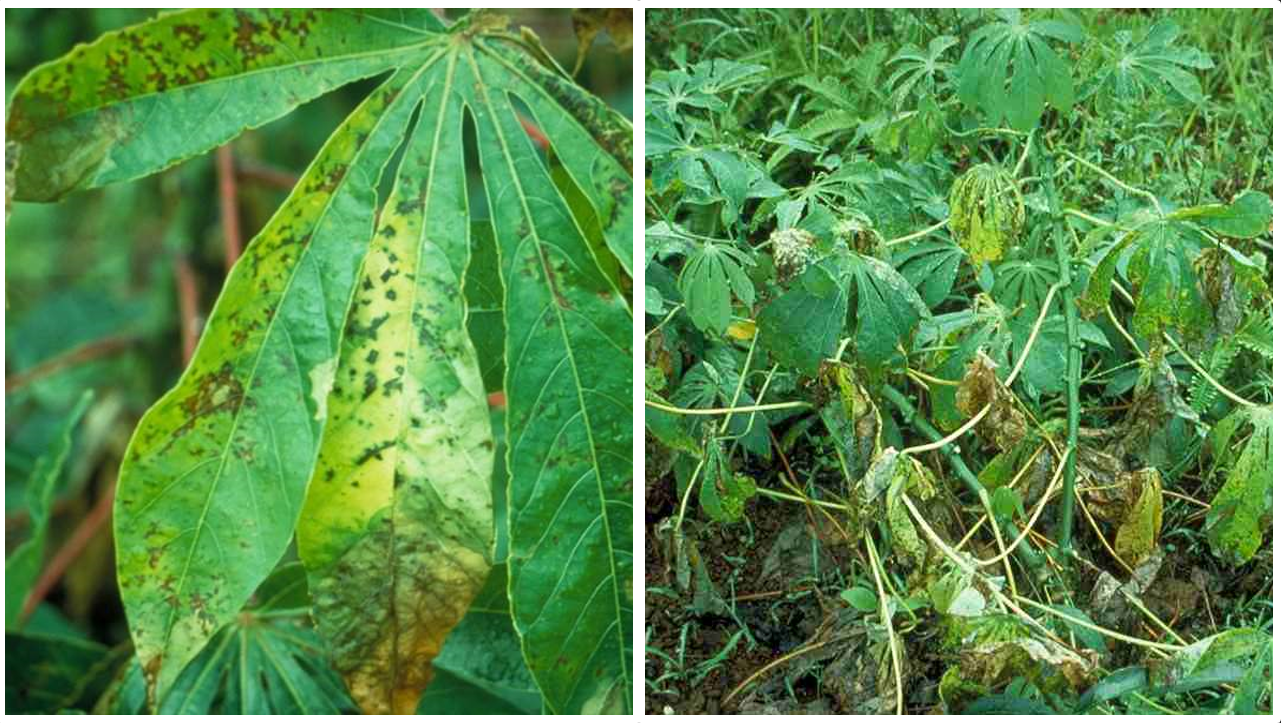\n\n##**Cassava Brown Streak Disease (CBSD)**\nSymptoms of cassava brown streak disease appear as patches of yellow areas mixed with normal green colour. The characteristic yellow or necrotic vein banding may enlarge and coalesce to form a large yellow patches.\nThe infected leaves **do not become distorted in shape as occurs with leaves infected by Cassava mosaic disease**.[2]\n\nMain characteristics to leverage: **yellow spots**\n\n\n\n##**Cassava Green Mottle (CGM)**\nYoung leaves are puckered with faint to distinct yellow spots (in picture, on the left), green patterns (mosaics), and twisted margins (in picture, on the right). Occasionally, plants become severely stunted.[3]\n\nMain characteristics to leverage: **yellow patterns, irregular patches of yellow and green, leaf margins distortion, stunted**\n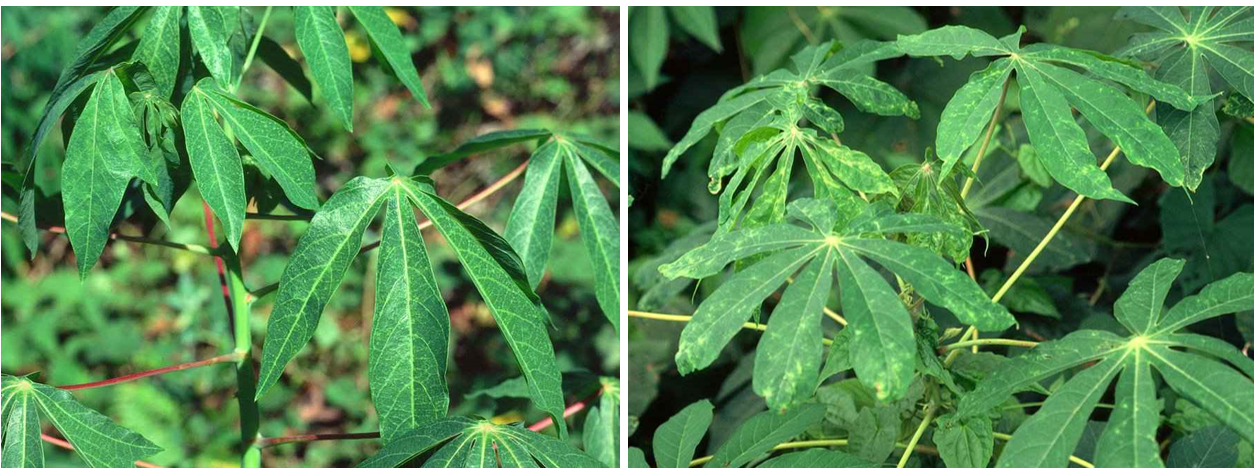\n\n\n##**Cassava Mosaic Disease (CMD)**\nCassava Mosaic Disease is characterized by sever mosaic symptoms on leaves, with affected leaved showing mottling and light-green, yellow or white spots. Discoloration, malformation and puckering of the leaf blade occur.[4]\n\nMain characteristics to leverage: **severe shape distortion, mosaic patterns**\n\n\n\nAt least two classes share the same patterns (CGM and CMD) in terms of spots and shape distortion under some degree. Yellow spots are another common patter across all classes.\n\nHope this could help!\n\n**References**\n[1][http://www.pestnet.org/fact_sheets/cassava_bacterial_blight_173.htm](url)\n[2][http://www.fao.org/3/CA2940EN/ca2940en.pdf](url)\n[3][http://www.pestnet.org/fact_sheets/v6/cassava_green_mottle_068.htm](url)\n[4][https://www.easybiologyclass.com/mosaic-disease-of-tapioca-symptoms-and-control-measures/](url)", "1097866": "Thanks for sharing!", "1098011": "Hope it helps!", "1104075": "I hope it helped you!", "1104899": "Thanks for sharing, 👍", "1106554": "Thanks for sharing!", "1110609": "Hope it helped", "1110610": "Glad you found it useful", "1120870": "It was very informative! Thanks for sharing!", "1133749": "Thanks for sharing! Maybe it can be true challenge to optimize images and models for classify each diseases. Actually I can't tell differecne between healthy leaves and CGM leaves.", "1135087": "It has also been reported that the dataset is noisy, so be careful with the choice of your loss function!", "1135387": "Thanks for your sharing!" }, "source": "meta" }