
\nFigure 11 from 2 - full size
The first question that I had after getting acquainted with the InChI notation – how exactly is the numbering of atoms performed? (and this question has already been asked on the forum)
\nAfter studying some resources, there was a certain understanding, which I want to describe in a short summary.
\nA couple of comments: 1) this is an incomplete description of the algorithm; 2) I am not a specialist in chemistry. Therefore, if there are any amendments and additions, please write in the comments
\n\nThe main layer of the InChI ID consists of 3 sublayers that are separated \"/\":
\n
\n 1) The chemical formula is represented according to Hill convention, that is, beginning with carbon atoms, then hydrogens, then all other elements in alphabetical order
\n 2) Sublayer of the structure (prefix \"/c\") - enumeration of canonical numbers in the chain of connected atoms (branches are indicated in parentheses)
\n 3) This layer prefixed with ‘/h’ lists the bonds between the atoms in the structure, partitioned into as many as three sublayers. The first sublayer represents all bonds other than those to non-bridging H-atoms, the second sublayer represents bonds of all immobile H-atoms, and the third sublayer provides locations of any mobile H-atoms. (whatever that means)
In this topic, I will focus on point 2 and the atom numbering algorithm.
\nIn the notebook 1, I showed several examples with images of simple molecules
\nEach molecule is displayed in 3 different forms: standard form; with atom numbers and with the number of hydrogen atoms for each atom of the basic structure.
\nFor the drawings, I use the techniques for the rdkit found in 3
\nAnd the numbering algorithm itself is taken from 2 - Canonicalization.
The list of possible numbers for the atoms depends on the chemical formula.
\nFor example, we have the formula \"C4H9Cl\". So the atoms \"C\" have numbers 1-4, and \"Cl\" – 5.
Description of the algorithm
\n
\nFigure 11 from 2 - full size
An iterative process is described (the steps are shown in the figure) using the example of the C4H9Cl molecule (2-chlorobutane)
\nStep A - hydrogenless constitution
\n1) The skeletal atoms are labelled with numerical \"colors\" in the following order of precedence.
\nOrdering number of chemical element in the sequence: carbon, other atoms in alphabetic order, bridging hydrogen.
\nIn case of C4H9Cl all C will be given color 1, Cl will be given 2.
\n(See 'a' on Figure)
Determine the number of bonds for each atom.
\nIn 2-chlorobutane CH3CH2CH(Cl)CH3 these are (in curly brackets): C{1}C{2}C{3}(Cl{1})C{1};
\nThe resultant \"ordered lists of colors\" presented in order of the atoms in the semi-structural formula CH3CH2CH(Cl)CH3 are: C: (1, 1); C: (1, 2); C: (1, 3); Cl: (2, 1); C (1, 1)
\n(See 'b' on Figure)
2) Atoms are assigned new colors according to lexicographical comparison of the \"color lists\", in ascending order.
\nFor example, (1,1) < (1,2) < (2,1); (1, 2) < (1, 2, 1)
C: 1, 1 = > 2;
\nC: 1, 2 = > 3
\nC: 1, 3 = > 4
\nCl: 2, 1 = > 5
\nC 1, 1 = > 2
(See 'c' on Figure)
\nNotice that each color is equal to the number of atoms that have this or smaller color
\n3) Atoms are assigned new \"ordered lists of colors\": the first in the list is the color of the atom, the rest are sorted in ascending order colors of other atoms, connected to this atom
\nC: 2, 3
\nC: 3, 2, 3 (It seems to me that there is an error in the description and it should be '3, 2, 4'?)
\nC: 4, 2, 3, 5
\nCl: 5, 4
\nC 2, 4
(See 'd' on Figure)
\n4) Atoms are assigned new colors according to lexicographical comparison of the \"color lists\", in ascending order
\nC: 2, 3 = > 1
\nC: 3, 2, 3 = > 3
\nC: 4, 2, 3, 5 = > 4
\nCl: 5, 4 = > 5
\nC 2, 4 = > 2
(See 'e' on Figure)
\n5) Steps 3–4 are repeated until all new colors are different or no more changes occur (for 2-chlorobutane the colors - canonical numbers - have already been found)
\n…
there is a continuation of the algorithm: 6) … -9) and then Step B - Step D (I skip it … see 2)
\n=
\nAccordingly, then we just go in order, starting with the number 1 and write down the canonical numbers of the atoms, the bonds are denoted by the \"-\" sign.
\nAs a result, we get the \"/c \" sublayer for the InChI ID
Encoding of branches
\nIt turns out that branches (and loops) are encoded using parentheses: \"(\"–the beginning of the branch; \")\" – end of the branch.
\nFor the cycle, the number of the atom that we start with is also repeated at the end.
\nFor example - 000afb9f46bb.png from train:
\nInChI=1S/C11H17ClN2/c1-8(9(6-13)7-14)10-4-2-3-5-11(10)12/h2-5,8-9H,6-7,13-14H2,1H3 (see 1)
\nHere, atom 10 is repeated twice - at the beginning of the cycle and at the end as a branch.
So far, for me, the key question of the contest is how to get the 'canonical numbers' of atoms?
\nDo this algorithmically or using machine learning?
Links
\n1 – Code with several examples of simple molecules
\nhttps://www.kaggle.com/sapr3s/inchi-samples
2 – InChI, the IUPAC International Chemical Identifier
\nhttps://jcheminf.biomedcentral.com/articles/10.1186/s13321-015-0068-4
3 – RDKit Cookbook
\nhttp://www.rdkit.org/docs/Cookbook.html
The first question that I had after getting acquainted with the InChI notation – how exactly is the numbering of atoms performed? (and this question has already been asked on the forum)
\nAfter studying some resources, there was a certain understanding, which I want to describe in a short summary.
\nA couple of comments: 1) this is an incomplete description of the algorithm; 2) I am not a specialist in chemistry. Therefore, if there are any amendments and additions, please write in the comments
\n\nThe main layer of the InChI ID consists of 3 sublayers that are separated \"/\":
\n
\n 1) The chemical formula is represented according to Hill convention, that is, beginning with carbon atoms, then hydrogens, then all other elements in alphabetical order
\n 2) Sublayer of the structure (prefix \"/c\") - enumeration of canonical numbers in the chain of connected atoms (branches are indicated in parentheses)
\n 3) This layer prefixed with ‘/h’ lists the bonds between the atoms in the structure, partitioned into as many as three sublayers. The first sublayer represents all bonds other than those to non-bridging H-atoms, the second sublayer represents bonds of all immobile H-atoms, and the third sublayer provides locations of any mobile H-atoms. (whatever that means)
In this topic, I will focus on point 2 and the atom numbering algorithm.
\nIn the notebook 1, I showed several examples with images of simple molecules
\nEach molecule is displayed in 3 different forms: standard form; with atom numbers and with the number of hydrogen atoms for each atom of the basic structure.
\nFor the drawings, I use the techniques for the rdkit found in 3
\nAnd the numbering algorithm itself is taken from 2 - Canonicalization.
The list of possible numbers for the atoms depends on the chemical formula.
\nFor example, we have the formula \"C4H9Cl\". So the atoms \"C\" have numbers 1-4, and \"Cl\" – 5.
Description of the algorithm
\n
\nFigure 11 from 2 - full size
An iterative process is described (the steps are shown in the figure) using the example of the C4H9Cl molecule (2-chlorobutane)
\nStep A - hydrogenless constitution
\n1) The skeletal atoms are labelled with numerical \"colors\" in the following order of precedence.
\nOrdering number of chemical element in the sequence: carbon, other atoms in alphabetic order, bridging hydrogen.
\nIn case of C4H9Cl all C will be given color 1, Cl will be given 2.
\n(See 'a' on Figure)
Determine the number of bonds for each atom.
\nIn 2-chlorobutane CH3CH2CH(Cl)CH3 these are (in curly brackets): C{1}C{2}C{3}(Cl{1})C{1};
\nThe resultant \"ordered lists of colors\" presented in order of the atoms in the semi-structural formula CH3CH2CH(Cl)CH3 are: C: (1, 1); C: (1, 2); C: (1, 3); Cl: (2, 1); C (1, 1)
\n(See 'b' on Figure)
2) Atoms are assigned new colors according to lexicographical comparison of the \"color lists\", in ascending order.
\nFor example, (1,1) < (1,2) < (2,1); (1, 2) < (1, 2, 1)
C: 1, 1 = > 2;
\nC: 1, 2 = > 3
\nC: 1, 3 = > 4
\nCl: 2, 1 = > 5
\nC 1, 1 = > 2
(See 'c' on Figure)
\nNotice that each color is equal to the number of atoms that have this or smaller color
\n3) Atoms are assigned new \"ordered lists of colors\": the first in the list is the color of the atom, the rest are sorted in ascending order colors of other atoms, connected to this atom
\nC: 2, 3
\nC: 3, 2, 3 (It seems to me that there is an error in the description and it should be '3, 2, 4'?)
\nC: 4, 2, 3, 5
\nCl: 5, 4
\nC 2, 4
(See 'd' on Figure)
\n4) Atoms are assigned new colors according to lexicographical comparison of the \"color lists\", in ascending order
\nC: 2, 3 = > 1
\nC: 3, 2, 3 = > 3
\nC: 4, 2, 3, 5 = > 4
\nCl: 5, 4 = > 5
\nC 2, 4 = > 2
(See 'e' on Figure)
\n5) Steps 3–4 are repeated until all new colors are different or no more changes occur (for 2-chlorobutane the colors - canonical numbers - have already been found)
\n…
there is a continuation of the algorithm: 6) … -9) and then Step B - Step D (I skip it … see 2)
\n=
\nAccordingly, then we just go in order, starting with the number 1 and write down the canonical numbers of the atoms, the bonds are denoted by the \"-\" sign.
\nAs a result, we get the \"/c \" sublayer for the InChI ID
Encoding of branches
\nIt turns out that branches (and loops) are encoded using parentheses: \"(\"–the beginning of the branch; \")\" – end of the branch.
\nFor the cycle, the number of the atom that we start with is also repeated at the end.
\nFor example - 000afb9f46bb.png from train:
\nInChI=1S/C11H17ClN2/c1-8(9(6-13)7-14)10-4-2-3-5-11(10)12/h2-5,8-9H,6-7,13-14H2,1H3 (see 1)
\nHere, atom 10 is repeated twice - at the beginning of the cycle and at the end as a branch.
So far, for me, the key question of the contest is how to get the 'canonical numbers' of atoms?
\nDo this algorithmically or using machine learning?
Links
\n1 – Code with several examples of simple molecules
\nhttps://www.kaggle.com/sapr3s/inchi-samples
2 – InChI, the IUPAC International Chemical Identifier
\nhttps://jcheminf.biomedcentral.com/articles/10.1186/s13321-015-0068-4
3 – RDKit Cookbook
\nhttp://www.rdkit.org/docs/Cookbook.html
Thanks a lot, I was wondering exactly about that and had just opened the JCheminf paper from Heller et al. (2015).
\nHere the competion hosts give some insight into how it could be done. If I understood correctly they suggest to use an intermediate representation that can be converted algorithmically to a valid InChI.
\"that can be converted algorithmically to a valid InChI\"
\nThe question is what is this algorithm precisely and is it already implemented somewhere ?
\nHow do they came up with the InChI in the training set ?
Implemented, of course. For example, in RDKit :
\nfrom rdkit import Chem\nmol = Chem.MolFromInchi(inchi)\n# ...\nrestored_inchi = Chem.MolToInchi(mol )\n'mol' is an object from which you can get atoms (mol.GetAtoms()) or bonds (mol.GetBonds())
", "rawMarkdown": "Implemented, of course. For example, in RDKit :\n```\nfrom rdkit import Chem\nmol = Chem.MolFromInchi(inchi)\n# ...\nrestored_inchi = Chem.MolToInchi(mol )\n\n```\n'mol' is an object from which you can get atoms (*mol.GetAtoms()*) or bonds (*mol.GetBonds()*)", "votes": null }, { "id": "1245420", "postDate": "03/19/2021 19:11:28", "content": "Thanks Pavel for the code !
\nI checked training InChIs with rdkit and following code :
from rdkit import Chem\nfrom tqdm.notebook import tqdm\nimport pandas as pd\n\ndf = pd.read_csv(\"train_labels.csv\")\nnot_equal = []\n\nfor inchi in tqdm(df.InChI):\n mol = Chem.MolFromInchi(inchi)\n inchi2 = Chem.MolToInchi(mol)\n if inchi != inchi2:\n not_equal.append((inchi, inchi2))\n\nprint(len(not_equal)/len(df)*100) # this prints 0.008173022470833305\nI found that there is only 0.008% of the training InChIs with conversion error (inchi != inchi2).
\nSo rdkit InChI implementation and training InChIs agree very well which is reassuring.
Thank for explaining this! I have cracked my head trying to understand this.
", "rawMarkdown": "Thank for explaining this! I have cracked my head trying to understand this.", "votes": null }, { "id": "1255888", "postDate": "03/29/2021 10:13:41", "content": "I found on 100 000 random InChIs that by predicting only the 3 first parts of InChI (formula, connections and hydrogens), the average levenstein is 2.86.
\nIt means that the best possible leaderboard score with a model predicting only the molecular graph (formula, connections and hydrogens) is 2.86.
\nFor details, here is the code I use on the 100 000 InChIs :
from Levenshtein import distance\ninchi_trunc = \"/\".join(inchi.split(\"/\", maxsplit=4)[:4])\nlevenstein = distance(inchi_trunc, inchi)\n@sapr3s - thank you for the exhaustive explanation. Since no-one else mentioned it, I'll note that a mobile hydrogen is attached to different atoms in different tautomers.
", "rawMarkdown": "sapr3s - thank you for the exhaustive explanation. Since no-one else mentioned it, I'll note that a mobile hydrogen is attached to different atoms in different tautomers.", "votes": null }, { "id": "1256630", "postDate": "03/30/2021 05:16:05", "content": "Perhaps a model such as a binary classifier can be used for the remaining InChI string.
\nMulti-step approach after /c and /h layers:
\n-> then predict the /b string and append-> then predict the /t string and appendThis should hopefully reduce Levenshtein distance below 2.0 or even below 1.0!
", "rawMarkdown": "Perhaps a model such as a [binary classifier](https://www.kaggle.com/c/bms-molecular-translation/discussion/229168) can be used for the remaining InChI string.\n\nMulti-step approach after /c and /h layers:\n- Predict whether /b layer should be present `->` then predict the /b string and append\n- Predict whether /t layer should be present `->` then predict the /t string and append\n- Predict whether /m0 or /m1 or /s1 layer should be present and append these short strings at the end\n\nThis should hopefully reduce Levenshtein distance below 2.0 or even below 1.0!", "votes": null } ], "comments": [ { "id": 1232481, "author_name": "michaelwolff", "author_url": "", "post_date": "03/09/2021 19:33:48", "content": "Thanks a lot, I was wondering exactly about that and had just opened the JCheminf paper from Heller et al. (2015).
\nHere the competion hosts give some insight into how it could be done. If I understood correctly they suggest to use an intermediate representation that can be converted algorithmically to a valid InChI.
\"that can be converted algorithmically to a valid InChI\"
\nThe question is what is this algorithm precisely and is it already implemented somewhere ?
\nHow do they came up with the InChI in the training set ?
Implemented, of course. For example, in RDKit :
\nfrom rdkit import Chem\nmol = Chem.MolFromInchi(inchi)\n# ...\nrestored_inchi = Chem.MolToInchi(mol )\n'mol' is an object from which you can get atoms (mol.GetAtoms()) or bonds (mol.GetBonds())
", "votes": null, "replies": [] }, { "id": 1245420, "author_name": "datanewb", "author_url": "", "post_date": "03/19/2021 19:11:28", "content": "Thanks Pavel for the code !
\nI checked training InChIs with rdkit and following code :
from rdkit import Chem\nfrom tqdm.notebook import tqdm\nimport pandas as pd\n\ndf = pd.read_csv(\"train_labels.csv\")\nnot_equal = []\n\nfor inchi in tqdm(df.InChI):\n mol = Chem.MolFromInchi(inchi)\n inchi2 = Chem.MolToInchi(mol)\n if inchi != inchi2:\n not_equal.append((inchi, inchi2))\n\nprint(len(not_equal)/len(df)*100) # this prints 0.008173022470833305\nI found that there is only 0.008% of the training InChIs with conversion error (inchi != inchi2).
\nSo rdkit InChI implementation and training InChIs agree very well which is reassuring.
Thank for explaining this! I have cracked my head trying to understand this.
", "votes": null, "replies": [] }, { "id": 1255888, "author_name": "datanewb", "author_url": "", "post_date": "03/29/2021 10:13:41", "content": "I found on 100 000 random InChIs that by predicting only the 3 first parts of InChI (formula, connections and hydrogens), the average levenstein is 2.86.
\nIt means that the best possible leaderboard score with a model predicting only the molecular graph (formula, connections and hydrogens) is 2.86.
\nFor details, here is the code I use on the 100 000 InChIs :
from Levenshtein import distance\ninchi_trunc = \"/\".join(inchi.split(\"/\", maxsplit=4)[:4])\nlevenstein = distance(inchi_trunc, inchi)\nPerhaps a model such as a binary classifier can be used for the remaining InChI string.
\nMulti-step approach after /c and /h layers:
\n-> then predict the /b string and append-> then predict the /t string and appendThis should hopefully reduce Levenshtein distance below 2.0 or even below 1.0!
", "votes": null, "replies": [] } ] }, { "id": 1256394, "author_name": "jbomitchell", "author_url": "", "post_date": "03/29/2021 20:34:40", "content": "@sapr3s - thank you for the exhaustive explanation. Since no-one else mentioned it, I'll note that a mobile hydrogen is attached to different atoms in different tautomers.
", "votes": null, "replies": [] } ], "raw_markdown_by_id": { "1230519": "The first question that I had after getting acquainted with the InChI notation – how exactly is the numbering of atoms performed? (and this question has already been asked on the [forum](https://www.kaggle.com/c/bms-molecular-translation/discussion/223503))\n\nAfter studying some resources, there was a certain understanding, which I want to describe in a short summary.\nA couple of comments: 1) this is an **incomplete** description of the algorithm; 2) I am not a specialist in chemistry. Therefore, if there are any amendments and additions, please write in the comments\n\n\n> The main layer of the InChI ID consists of 3 sublayers that are separated \"/\":\n1) The chemical formula is represented according to Hill convention, that is, beginning with carbon atoms, then hydrogens, then all other elements in alphabetical order\n2) Sublayer of the structure (prefix \"/c\") - enumeration of **canonical numbers** in the chain of connected atoms (branches are indicated in parentheses)\n3) This layer prefixed with ‘/h’ lists the bonds between the atoms in the structure, partitioned into as many as three sublayers. The first sublayer represents all bonds other than those to non-bridging H-atoms, the second sublayer represents bonds of all immobile H-atoms, and the third sublayer provides locations of any mobile H-atoms. (*whatever that means*)\n\n\nIn this topic, I will focus on **point 2** and the atom numbering algorithm.\nIn the notebook [1](https://www.kaggle.com/sapr3s/inchi-samples), I showed several examples with images of simple molecules\nEach molecule is displayed in 3 different forms: standard form; with atom numbers and with the number of hydrogen atoms for each atom of the basic structure.\nFor the drawings, I use the techniques for the rdkit found in [3](http://www.rdkit.org/docs/Cookbook.html)\nAnd the numbering algorithm itself is taken from [2](https://jcheminf.biomedcentral.com/articles/10.1186/s13321-015-0068-4) - **Canonicalization**.\n\nThe list of possible numbers for the atoms depends on the chemical formula.\nFor example, we have the formula \"C4H9Cl\". So the atoms \"C\" have numbers 1-4, and \"Cl\" – 5.\n\n**Description of the algorithm**\n\n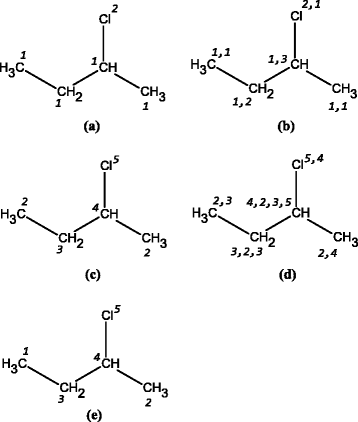\nFigure 11 from [2](https://jcheminf.biomedcentral.com/articles/10.1186/s13321-015-0068-4) - [full size](https://jcheminf.biomedcentral.com/articles/10.1186/s13321-015-0068-4/figures/11)\n\nAn iterative process is described (the steps are shown in the figure) using the example of the C4H9Cl molecule (2-chlorobutane) \n\n**Step A - hydrogenless constitution**\n\n1) The skeletal atoms are labelled with numerical \"colors\" in the following order of precedence.\n- Ordering number of chemical element in the sequence: carbon, other atoms in alphabetic order, bridging hydrogen.\nIn case of C4H9Cl all C will be given color 1, Cl will be given 2.\n(See 'a' on Figure)\n\n- Determine the number of bonds for each atom. \nIn 2-chlorobutane CH3CH2CH(Cl)CH3 these are (in curly brackets): C{1}C{2}C{3}(Cl{1})C{1};\nThe resultant \"ordered lists of colors\" presented in order of the atoms in the semi-structural formula CH3CH2CH(Cl)CH3 are: C: (1, 1); C: (1, 2); C: (1, 3); Cl: (2, 1); C (1, 1)\n(See 'b' on Figure)\n\n2) Atoms are assigned new colors according to lexicographical comparison of the \"color lists\", in ascending order.\nFor example, (1,1) < (1,2) < (2,1); (1, 2) < (1, 2, 1)\n\nC: 1, 1 = > 2;\nC: 1, 2 = > 3\nC: 1, 3 = > 4\nCl: 2, 1 = > 5\nC 1, 1 = > 2\n\n(See 'c' on Figure)\n\nNotice that each color is equal to the number of atoms that have this or smaller color\n\n3) Atoms are assigned new \"ordered lists of colors\": the first in the list is the color of the atom, the rest are sorted in ascending order colors of other atoms, connected to this atom\n\nC: 2, 3\nC: 3, 2, 3 (*It seems to me that there is an error in the description and it should be '3, 2, 4'?*)\nC: 4, 2, 3, 5\nCl: 5, 4\nC 2, 4\n\n(See 'd' on Figure)\n\n4) Atoms are assigned new colors according to lexicographical comparison of the \"color lists\", in ascending order\nC: 2, 3 = > 1\nC: 3, 2, 3 = > 3\nC: 4, 2, 3, 5 = > 4\nCl: 5, 4 = > 5\nC 2, 4 = > 2\n\n(See 'e' on Figure)\n\n5) Steps 3–4 are repeated until all new colors are different or no more changes occur (for 2-chlorobutane the colors - canonical numbers - have already been found)\n...\n\nthere is a continuation of the algorithm: 6) ... -9) and then Step B - Step D (**I skip it** ... see [2](https://jcheminf.biomedcentral.com/articles/10.1186/s13321-015-0068-4))\n\n=\nAccordingly, then we just go in order, starting with the number 1 and write down the canonical numbers of the atoms, the bonds are denoted by the \"-\" sign.\nAs a result, we get the \"/c \" sublayer for the InChI ID\n\n**Encoding of branches**\n\nIt turns out that branches (and loops) are encoded using parentheses: \"(\"–the beginning of the branch; \")\" – end of the branch.\nFor the cycle, the number of the atom that we start with is also repeated at the end.\nFor example - 000afb9f46bb.png from train:\nInChI=1S/C11H17ClN2/c1-8(9(6-13)7-14)10-4-2-3-5-11(10)12/h2-5,8-9H,6-7,13-14H2,1H3 (see [1](https://www.kaggle.com/sapr3s/inchi-samples))\nHere, atom 10 is repeated twice - at the beginning of the cycle and at the end as a branch.\n\nSo far, for me, the key question of the contest is how to get the 'canonical numbers' of atoms? \nDo this algorithmically or using machine learning?\n\n**Links**\n1 – Code with several examples of simple molecules\nhttps://www.kaggle.com/sapr3s/inchi-samples\n\n2 – InChI, the IUPAC International Chemical Identifier \nhttps://jcheminf.biomedcentral.com/articles/10.1186/s13321-015-0068-4\n\n3 – RDKit Cookbook\nhttp://www.rdkit.org/docs/Cookbook.html", "1232481": "Thanks a lot, I was wondering exactly about that and had just opened the JCheminf paper from Heller et al. (2015).\n[Here](https://www.kaggle.com/c/bms-molecular-translation/discussion/224394) the competion hosts give some insight into how it could be done. If I understood correctly they suggest to use an intermediate representation that can be converted algorithmically to a valid InChI.", "1244273": "\"that can be converted algorithmically to a valid InChI\"\nThe question is what is this algorithm precisely and is it already implemented somewhere ?\nHow do they came up with the InChI in the training set ?", "1244551": "Implemented, of course. For example, in RDKit :\n```\nfrom rdkit import Chem\nmol = Chem.MolFromInchi(inchi)\n# ...\nrestored_inchi = Chem.MolToInchi(mol )\n\n```\n'mol' is an object from which you can get atoms (*mol.GetAtoms()*) or bonds (*mol.GetBonds()*)", "1245420": "Thanks Pavel for the code !\nI checked training InChIs with rdkit and following code :\n```python\nfrom rdkit import Chem\nfrom tqdm.notebook import tqdm\nimport pandas as pd\n\ndf = pd.read_csv(\"train_labels.csv\")\nnot_equal = []\n\nfor inchi in tqdm(df.InChI):\n mol = Chem.MolFromInchi(inchi)\n inchi2 = Chem.MolToInchi(mol)\n if inchi != inchi2:\n not_equal.append((inchi, inchi2))\n\nprint(len(not_equal)/len(df)*100) # this prints 0.008173022470833305\n```\nI found that there is only **0.008%** of the training InChIs with conversion error (inchi != inchi2).\nSo rdkit InChI implementation and training InChIs agree very well which is reassuring.", "1247580": "Thank for explaining this! I have cracked my head trying to understand this.", "1255888": "I found on 100 000 random InChIs that by predicting only the 3 first parts of InChI (formula, connections and hydrogens), the average levenstein is **2.86**.\n**It means that the best possible leaderboard score with a model predicting only the molecular graph (formula, connections and hydrogens) is 2.86.**\nFor details, here is the code I use on the 100 000 InChIs :\n```python\nfrom Levenshtein import distance\ninchi_trunc = \"/\".join(inchi.split(\"/\", maxsplit=4)[:4])\nlevenstein = distance(inchi_trunc, inchi)\n```", "1256394": "sapr3s - thank you for the exhaustive explanation. Since no-one else mentioned it, I'll note that a mobile hydrogen is attached to different atoms in different tautomers.", "1256630": "Perhaps a model such as a [binary classifier](https://www.kaggle.com/c/bms-molecular-translation/discussion/229168) can be used for the remaining InChI string.\n\nMulti-step approach after /c and /h layers:\n- Predict whether /b layer should be present `->` then predict the /b string and append\n- Predict whether /t layer should be present `->` then predict the /t string and append\n- Predict whether /m0 or /m1 or /s1 layer should be present and append these short strings at the end\n\nThis should hopefully reduce Levenshtein distance below 2.0 or even below 1.0!" }, "source": "meta" }