\n

I would like to thank the hosts for this unique challenge. Congratulations to my teammate @canalici and to all competitors. It was indeed a very educative competition in the audio domain. Many thanks to @hidehisaarai1213 guidance through competition, and @doanquanvietnamca for GRU-SED and Dmytro Karabash for ideas.
\nModels have trained in both original and extended datasets. Augmentations applied in both waveform and mel-spectrogram level.
\nI have modified the SED model (PANN’s) and replace its inefficient backbone with a noisy-Efficientnet and further experimented with GRU’s, LSTM’s, and with Transformers for temporal modeling. We had a CNN backbone -> a GRU layer -> and attention layer in the final model.
\nTo ensemble different solutions, I have removed the attention layer for each model, kept pre-trained weights of the extracted part, and re-trained an attention layer from features extracted from 3 different models listed above.
\n
For validation, we have hand-labeled no-calls into gt_birdclef2020_validation_data and excluded irrelevant species, which provided a chance to test the algorithm in the wild.
\nPre-trained models proven self to be leverage in many knowledge transfer tasks. It is tough not to over-fit our classifier, especially in this competition, where we had a few audio clips with very noisy labels. Hidehisa Arai pointed out PANN’s(one of the largest pre-trained models in the audio domain) for this issue, their CNN backbone was less potent than lighter alternatives. We have used a firm CNN backbone to overcome this issue, pre-trained on a large corpus of images (Noisy Student, Efficientnet). However, it is possible to extract mel-spectrogram encoder/decoder parts from very famous text-to-speech, speech conversation (Tacotron, Glow TTS…) algorithms that trained on a relatively larger corpus. It could be beneficial to adapt successfully pre-trained models from the Audio domain, fine-tuning it with all the bird data we have, then applying a noisy-student training scheme.
", "messages": [ { "id": "1012650", "postDate": "09/16/2020 07:54:28", "content": "I would like to thank the hosts for this unique challenge. Congratulations to my teammate @canalici and to all competitors. It was indeed a very educative competition in the audio domain. Many thanks to @hidehisaarai1213 guidance through competition, and @doanquanvietnamca for GRU-SED and Dmytro Karabash for ideas.
\nModels have trained in both original and extended datasets. Augmentations applied in both waveform and mel-spectrogram level.
\nI have modified the SED model (PANN’s) and replace its inefficient backbone with a noisy-Efficientnet and further experimented with GRU’s, LSTM’s, and with Transformers for temporal modeling. We had a CNN backbone -> a GRU layer -> and attention layer in the final model.
\nTo ensemble different solutions, I have removed the attention layer for each model, kept pre-trained weights of the extracted part, and re-trained an attention layer from features extracted from 3 different models listed above.
\n
For validation, we have hand-labeled no-calls into gt_birdclef2020_validation_data and excluded irrelevant species, which provided a chance to test the algorithm in the wild.
\nPre-trained models proven self to be leverage in many knowledge transfer tasks. It is tough not to over-fit our classifier, especially in this competition, where we had a few audio clips with very noisy labels. Hidehisa Arai pointed out PANN’s(one of the largest pre-trained models in the audio domain) for this issue, their CNN backbone was less potent than lighter alternatives. We have used a firm CNN backbone to overcome this issue, pre-trained on a large corpus of images (Noisy Student, Efficientnet). However, it is possible to extract mel-spectrogram encoder/decoder parts from very famous text-to-speech, speech conversation (Tacotron, Glow TTS…) algorithms that trained on a relatively larger corpus. It could be beneficial to adapt successfully pre-trained models from the Audio domain, fine-tuning it with all the bird data we have, then applying a noisy-student training scheme.
", "rawMarkdown": "I would like to thank the hosts for this unique challenge. Congratulations to my teammate @canalici and to all competitors. It was indeed a very educative competition in the audio domain. Many thanks to @hidehisaarai1213 guidance through competition, and @doanquanvietnamca for GRU-SED and Dmytro Karabash for ideas.\n\n##Data Augmentation\nModels have trained in both original and extended datasets. Augmentations applied in both waveform and mel-spectrogram level.\n\n- Gaussian Noise\n- SpecAug\n\n##Modeling\nI have modified the SED model (PANN’s) and replace its inefficient backbone with a noisy-Efficientnet and further experimented with GRU’s, LSTM’s, and with Transformers for temporal modeling. We had a CNN backbone -> a GRU layer -> and attention layer in the final model. \n\n- EfficientNet-B4 (Noisy Student) \n- EfficientNet-B7 (Noisy Student)\n- EfficientNet-B7 (Noisy Student)\n\nTo ensemble different solutions, I have removed the attention layer for each model, kept pre-trained weights of the extracted part, and re-trained an attention layer from features extracted from 3 different models listed above.\n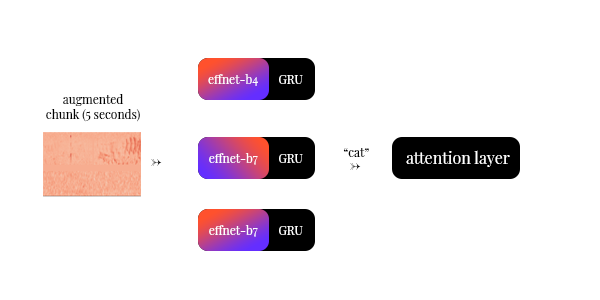\n\n##Training\n- Batch size of 32 for B4, and 8 for B7 models (single GPU)\n- No mixup :( \n- BCELoss \n- AdamW with Cosine Anneal\n- 5 seconds of audio clips (501, 64) (scaling mel_bins into 224, 300 would really have helped, but very expensive)\n- Pre-training on primary labels, fine tuning with secondary labels\n\nFor validation, we have hand-labeled no-calls into gt_birdclef2020_validation_data and excluded irrelevant species, which provided a chance to test the algorithm in the wild. \n \n \n###Possible further work\nPre-trained models proven self to be leverage in many knowledge transfer tasks. It is tough not to over-fit our classifier, especially in this competition, where we had a few audio clips with very noisy labels. Hidehisa Arai pointed out PANN’s(one of the largest pre-trained models in the audio domain) for this issue, their CNN backbone was less potent than lighter alternatives. We have used a firm CNN backbone to overcome this issue, pre-trained on a large corpus of images (Noisy Student, Efficientnet). However, it is possible to extract mel-spectrogram encoder/decoder parts from very famous text-to-speech, speech conversation (Tacotron, Glow TTS...) algorithms that trained on a relatively larger corpus. It could be beneficial to adapt successfully pre-trained models from the Audio domain, fine-tuning it with all the bird data we have, then applying a noisy-student training scheme.", "votes": null }, { "id": "1012677", "postDate": "09/16/2020 08:11:03", "content": "thanks so much! any reason for choosing Noisy Student as the pre-trained weight instead of the original one?
\nIs it by experiment CV/LB result?
The reason I would say is extended pre-training corpus and smarter optimization. You can review this table for comparison.
\n
My original plan was to stack noisy effnet-l2 models, though I couldn't do it on single GPU 😅
", "rawMarkdown": "The reason I would say is extended pre-training corpus and smarter optimization. You can review this table for comparison. \n\n\nMy original plan was to stack noisy effnet-l2 models, though I couldn't do it on single GPU 😅", "votes": null }, { "id": "1012734", "postDate": "09/16/2020 08:59:57", "content": "Thank you for sharing your solution, congratulation👍
", "rawMarkdown": "Thank you for sharing your solution, congratulation👍", "votes": null }, { "id": "1012751", "postDate": "09/16/2020 09:14:32", "content": "Congrats on the solution and result! From your picture it looks like GRU was better than LSTM or Transformer head. Do you confirm?
", "rawMarkdown": "Congrats on the solution and result! From your picture it looks like GRU was better than LSTM or Transformer head. Do you confirm?", "votes": null }, { "id": "1012756", "postDate": "09/16/2020 09:17:12", "content": "Congrats on result and thanks for sharing summary of solution @realsleim
", "rawMarkdown": "Congrats on result and thanks for sharing summary of solution @realsleim", "votes": null }, { "id": "1012762", "postDate": "09/16/2020 09:21:56", "content": "Although I had comparative scores on local validation, GRU outperformed it on LB. My idea was to handling longer sequences with Linformer (self-attention with linear complexity). I think it's my bad and with better initilization and better optimization, it could outperform GRU or LSTM with a large margin, yet sadly I didn't have time to test all ideas :( Thank you very much for the kind comment.
", "rawMarkdown": "Although I had comparative scores on local validation, GRU outperformed it on LB. My idea was to handling longer sequences with Linformer (self-attention with linear complexity). I think it's my bad and with better initilization and better optimization, it could outperform GRU or LSTM with a large margin, yet sadly I didn't have time to test all ideas :( Thank you very much for the kind comment.", "votes": null }, { "id": "1012957", "postDate": "09/16/2020 12:20:30", "content": "@realsleim congratulations for your 1st gold medal and well organised models report, is it a model dashboard. Curious to see your code organisation. is any plans to share your code ?
", "rawMarkdown": "realsleim congratulations for your 1st gold medal and well organised models report, is it a model dashboard. Curious to see your code organisation. is any plans to share your code ?", "votes": null }, { "id": "1012968", "postDate": "09/16/2020 12:31:01", "content": "Thank you very much. Unfortunately, I don't know what is \"model dashboard\" 😅 I am planning to share the code.
", "rawMarkdown": "Thank you very much. Unfortunately, I don't know what is \"model dashboard\" 😅 I am planning to share the code.", "votes": null }, { "id": "1012981", "postDate": "09/16/2020 12:41:42", "content": "the way you organised your results is a model dashboard i mean. Will wait for your code :)
", "rawMarkdown": "the way you organised your results is a model dashboard i mean. Will wait for your code :)", "votes": null } ], "comments": [ { "id": 1012677, "author_name": "fiyeroleung", "author_url": "", "post_date": "09/16/2020 08:11:03", "content": "thanks so much! any reason for choosing Noisy Student as the pre-trained weight instead of the original one?
\nIs it by experiment CV/LB result?
The reason I would say is extended pre-training corpus and smarter optimization. You can review this table for comparison.
\n
My original plan was to stack noisy effnet-l2 models, though I couldn't do it on single GPU 😅
", "votes": null, "replies": [] }, { "id": 1012957, "author_name": "seshurajup", "author_url": "", "post_date": "09/16/2020 12:20:30", "content": "@realsleim congratulations for your 1st gold medal and well organised models report, is it a model dashboard. Curious to see your code organisation. is any plans to share your code ?
", "votes": null, "replies": [] }, { "id": 1012968, "author_name": "realsleim", "author_url": "", "post_date": "09/16/2020 12:31:01", "content": "Thank you very much. Unfortunately, I don't know what is \"model dashboard\" 😅 I am planning to share the code.
", "votes": null, "replies": [] }, { "id": 1012981, "author_name": "seshurajup", "author_url": "", "post_date": "09/16/2020 12:41:42", "content": "the way you organised your results is a model dashboard i mean. Will wait for your code :)
", "votes": null, "replies": [] } ] }, { "id": 1012734, "author_name": "", "author_url": "", "post_date": "09/16/2020 08:59:57", "content": "Thank you for sharing your solution, congratulation👍
", "votes": null, "replies": [] }, { "id": 1012751, "author_name": "cpmpml", "author_url": "", "post_date": "09/16/2020 09:14:32", "content": "Congrats on the solution and result! From your picture it looks like GRU was better than LSTM or Transformer head. Do you confirm?
", "votes": null, "replies": [ { "id": 1012762, "author_name": "realsleim", "author_url": "", "post_date": "09/16/2020 09:21:56", "content": "Although I had comparative scores on local validation, GRU outperformed it on LB. My idea was to handling longer sequences with Linformer (self-attention with linear complexity). I think it's my bad and with better initilization and better optimization, it could outperform GRU or LSTM with a large margin, yet sadly I didn't have time to test all ideas :( Thank you very much for the kind comment.
", "votes": null, "replies": [] } ] }, { "id": 1012756, "author_name": "duykhanh99", "author_url": "", "post_date": "09/16/2020 09:17:12", "content": "Congrats on result and thanks for sharing summary of solution @realsleim
", "votes": null, "replies": [] } ], "raw_markdown_by_id": { "1012650": "I would like to thank the hosts for this unique challenge. Congratulations to my teammate @canalici and to all competitors. It was indeed a very educative competition in the audio domain. Many thanks to @hidehisaarai1213 guidance through competition, and @doanquanvietnamca for GRU-SED and Dmytro Karabash for ideas.\n\n##Data Augmentation\nModels have trained in both original and extended datasets. Augmentations applied in both waveform and mel-spectrogram level.\n\n- Gaussian Noise\n- SpecAug\n\n##Modeling\nI have modified the SED model (PANN’s) and replace its inefficient backbone with a noisy-Efficientnet and further experimented with GRU’s, LSTM’s, and with Transformers for temporal modeling. We had a CNN backbone -> a GRU layer -> and attention layer in the final model. \n\n- EfficientNet-B4 (Noisy Student) \n- EfficientNet-B7 (Noisy Student)\n- EfficientNet-B7 (Noisy Student)\n\nTo ensemble different solutions, I have removed the attention layer for each model, kept pre-trained weights of the extracted part, and re-trained an attention layer from features extracted from 3 different models listed above.\n\n\n##Training\n- Batch size of 32 for B4, and 8 for B7 models (single GPU)\n- No mixup :( \n- BCELoss \n- AdamW with Cosine Anneal\n- 5 seconds of audio clips (501, 64) (scaling mel_bins into 224, 300 would really have helped, but very expensive)\n- Pre-training on primary labels, fine tuning with secondary labels\n\nFor validation, we have hand-labeled no-calls into gt_birdclef2020_validation_data and excluded irrelevant species, which provided a chance to test the algorithm in the wild. \n \n \n###Possible further work\nPre-trained models proven self to be leverage in many knowledge transfer tasks. It is tough not to over-fit our classifier, especially in this competition, where we had a few audio clips with very noisy labels. Hidehisa Arai pointed out PANN’s(one of the largest pre-trained models in the audio domain) for this issue, their CNN backbone was less potent than lighter alternatives. We have used a firm CNN backbone to overcome this issue, pre-trained on a large corpus of images (Noisy Student, Efficientnet). However, it is possible to extract mel-spectrogram encoder/decoder parts from very famous text-to-speech, speech conversation (Tacotron, Glow TTS...) algorithms that trained on a relatively larger corpus. It could be beneficial to adapt successfully pre-trained models from the Audio domain, fine-tuning it with all the bird data we have, then applying a noisy-student training scheme.", "1012677": "thanks so much! any reason for choosing Noisy Student as the pre-trained weight instead of the original one?\nIs it by experiment CV/LB result?", "1012690": "The reason I would say is extended pre-training corpus and smarter optimization. You can review this table for comparison. \n\n\nMy original plan was to stack noisy effnet-l2 models, though I couldn't do it on single GPU 😅", "1012734": "Thank you for sharing your solution, congratulation👍", "1012751": "Congrats on the solution and result! From your picture it looks like GRU was better than LSTM or Transformer head. Do you confirm?", "1012756": "Congrats on result and thanks for sharing summary of solution @realsleim", "1012762": "Although I had comparative scores on local validation, GRU outperformed it on LB. My idea was to handling longer sequences with Linformer (self-attention with linear complexity). I think it's my bad and with better initilization and better optimization, it could outperform GRU or LSTM with a large margin, yet sadly I didn't have time to test all ideas :( Thank you very much for the kind comment.", "1012957": "realsleim congratulations for your 1st gold medal and well organised models report, is it a model dashboard. Curious to see your code organisation. is any plans to share your code ?", "1012968": "Thank you very much. Unfortunately, I don't know what is \"model dashboard\" 😅 I am planning to share the code.", "1012981": "the way you organised your results is a model dashboard i mean. Will wait for your code :)" }, "source": "meta" }