{"metadata":{"kernelspec":{"language":"python","display_name":"Python 3","name":"python3"},"language_info":{"pygments_lexer":"ipython3","nbconvert_exporter":"python","version":"3.6.4","file_extension":".py","codemirror_mode":{"name":"ipython","version":3},"name":"python","mimetype":"text/x-python"}},"nbformat_minor":4,"nbformat":4,"cells":[{"cell_type":"markdown","source":"## Update","metadata":{}},{"cell_type":"markdown","source":"### Version note\n\nv3: \n\n* Training procedure didn't use pretrained weight. Changed to use pretrained weight.\n* Add link to original paper.","metadata":{}},{"cell_type":"markdown","source":"## About\n\nIn this notebook, I will introduce Sound Event Detection (SED) task and model fit for that task, and I will show how to train SED model with only *weak* annotation.\n\n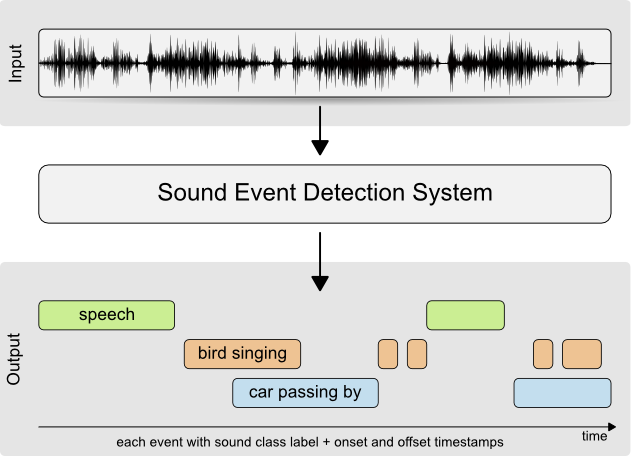\n\nIn SED task, we need to detect sound events from continuous (long) audio clip, and provide prediction of *what sound event exists from when to when*. Therefore our prediction for SED task should look like this.\n\n|clip_id|onset|offset|event|\n|---|---|---|---|\n|audio_001|0.952|1.87|car|\n|audio_001|3.82|6.75|speech|\n|audio_001|5.32|9.28|alarm|\n\n
\n\nSED task is different from the tasks in past audio competitions in kaggle. The task in [Freesound Audio Tagging 2019](https://www.kaggle.com/c/freesound-audio-tagging-2019) or [Freesound General-Purpose Audio Tagging Challenge](https://www.kaggle.com/c/freesound-audio-tagging) is Audio Tagging, which we'll need to provide clip level prediction, and the task in [TensorFlow Speech Recognition Challenge](https://www.kaggle.com/c/tensorflow-speech-recognition-challenge) is Speech Recognition, so what we need to predict is which speech command is in that audio clip (which is in a sense similar to Audio Tagging task, because we only need to provide clip level prediction).\n\nIn this competition, what we need to provide is 5sec chunk level prediction for `site_1` and `site_2` data, and clip level prediction for `site_3` data. Chunk level prediction can be treated as audio tagging task if we treat each chunk as short audio clip, but we can also use SED approach.\n\nClip:指一段很长的语音\n\nChunk 和 Segment都是指 Clip中的一小段","metadata":{}},{"cell_type":"markdown","source":"## Model for SED task\n\nHow can we provide prediction with `onset` and `offset` time information? To do this, models for SED task output *segment-wise* prediction instead of outputting aggregated prediction for a clip, which is usually used for Audio Tagging model.\n\nHow can we output *segment-wise* prediction? The idea is simple. Assume we use 2D CNN based model which takes log-melspectrogram as input and extract features using CNN feature extractor, and do classification with the feature map which is the output of CNN.\n\nThe output of CNN feature extractor still contains information about frequency and time(it should be 4 dimensional: (batch size, channels, frequency, time)), so if we aggregate it only in frequency axis, we can preserve time information on that feature map. That feature map has information about which time segment has what sound event.\n\nNow that I've introduced the basic idea, let's look into a SED model with some code. In this notebook, I'll use (Weakly-supervised) SED model provided by [PANNs repository](https://github.com/qiuqiangkong/audioset_tagging_cnn/). The model here is pretrained with [AudioSet](https://research.google.com/audioset/), which is an ImageNet counterpart in audio field.\n\n[PANNs paper](https://arxiv.org/abs/1912.10211)","metadata":{}},{"cell_type":"code","source":"import cv2\nimport audioread\nimport logging\nimport os\nimport random\nimport time\nimport warnings\n\nimport librosa\nimport librosa.display as display\nimport numpy as np\nimport pandas as pd\nimport soundfile as sf\nimport torch\nimport torch.nn as nn\nimport torch.nn.functional as F\nimport torch.optim as optim\nimport torch.utils.data as data\n\nfrom contextlib import contextmanager\nfrom IPython.display import Audio\nfrom pathlib import Path\nfrom typing import Optional, List\n\nfrom catalyst.dl import SupervisedRunner, State, CallbackOrder, Callback, CheckpointCallback\nfrom fastprogress import progress_bar\nfrom sklearn.model_selection import StratifiedKFold\nfrom sklearn.metrics import f1_score, average_precision_score","metadata":{"_kg_hide-input":true,"trusted":true},"execution_count":null,"outputs":[]},{"cell_type":"code","source":"def set_seed(seed: int = 42):\n random.seed(seed)\n np.random.seed(seed)\n os.environ[\"PYTHONHASHSEED\"] = str(seed)\n torch.manual_seed(seed)\n torch.cuda.manual_seed(seed) # type: ignore\n torch.backends.cudnn.deterministic = True # type: ignore\n torch.backends.cudnn.benchmark = True # type: ignore\n \n \ndef get_logger(out_file=None):\n logger = logging.getLogger()\n formatter = logging.Formatter(\"%(asctime)s - %(levelname)s - %(message)s\")\n logger.handlers = []\n logger.setLevel(logging.INFO)\n\n handler = logging.StreamHandler()\n handler.setFormatter(formatter)\n handler.setLevel(logging.INFO)\n logger.addHandler(handler)\n\n if out_file is not None:\n fh = logging.FileHandler(out_file)\n fh.setFormatter(formatter)\n fh.setLevel(logging.INFO)\n logger.addHandler(fh)\n logger.info(\"logger set up\")\n return logger\n \n \n@contextmanager\ndef timer(name: str, logger: Optional[logging.Logger] = None):\n t0 = time.time()\n msg = f\"[{name}] start\"\n if logger is None:\n print(msg)\n else:\n logger.info(msg)\n yield\n\n msg = f\"[{name}] done in {time.time() - t0:.2f} s\"\n if logger is None:\n print(msg)\n else:\n logger.info(msg)\n \n \nset_seed(1213)","metadata":{"_uuid":"8f2839f25d086af736a60e9eeb907d3b93b6e0e5","_cell_guid":"b1076dfc-b9ad-4769-8c92-a6c4dae69d19","_kg_hide-input":true,"trusted":true},"execution_count":null,"outputs":[]},{"cell_type":"code","source":"ROOT = Path.cwd().parent\nINPUT_ROOT = ROOT / \"input\"\nRAW_DATA = INPUT_ROOT / \"birdsong-recognition\"\nTRAIN_AUDIO_DIR = RAW_DATA / \"train_audio\"\nTRAIN_RESAMPLED_AUDIO_DIRS = [\n INPUT_ROOT / \"birdsong-resampled-train-audio-{:0>2}\".format(i) for i in range(5)\n]\nTEST_AUDIO_DIR = RAW_DATA / \"test_audio\"","metadata":{"_uuid":"d629ff2d2480ee46fbb7e2d37f6b5fab8052498a","_cell_guid":"79c7e3d0-c299-4dcb-8224-4455121ee9b0","_kg_hide-input":true,"trusted":true},"execution_count":null,"outputs":[]},{"cell_type":"code","source":"train = pd.read_csv(TRAIN_RESAMPLED_AUDIO_DIRS[0] / \"train_mod.csv\")\n\nif not TEST_AUDIO_DIR.exists():\n TEST_AUDIO_DIR = INPUT_ROOT / \"birdcall-check\" / \"test_audio\"\n test = pd.read_csv(INPUT_ROOT / \"birdcall-check\" / \"test.csv\")\nelse:\n test = pd.read_csv(RAW_DATA / \"test.csv\")","metadata":{"_kg_hide-input":true,"trusted":true},"execution_count":null,"outputs":[]},{"cell_type":"markdown","source":"### torchlibrosa\n\n\nIn PANNs, `torchlibrosa`, a PyTorch based implementation are used to replace some of the `librosa`'s functions. Here I use some functions of `torchlibrosa`.\n\nRef: https://github.com/qiuqiangkong/torchlibrosa","metadata":{}},{"cell_type":"markdown","source":"#### LICENSE\n\n```\nISC License\nCopyright (c) 2013--2017, librosa development team.\n\nPermission to use, copy, modify, and/or distribute this software for any purpose with or without fee is hereby granted, provided that the above copyright notice and this permission notice appear in all copies.\n\nTHE SOFTWARE IS PROVIDED \"AS IS\" AND THE AUTHOR DISCLAIMS ALL WARRANTIES WITH REGARD TO THIS SOFTWARE INCLUDING ALL IMPLIED WARRANTIES OF MERCHANTABILITY AND FITNESS. IN NO EVENT SHALL THE AUTHOR BE LIABLE FOR ANY SPECIAL, DIRECT, INDIRECT, OR CONSEQUENTIAL DAMAGES OR ANY DAMAGES WHATSOEVER RESULTING FROM LOSS OF USE, DATA OR PROFITS, WHETHER IN AN ACTION OF CONTRACT, NEGLIGENCE OR OTHER TORTIOUS ACTION, ARISING OUT OF OR IN CONNECTION WITH THE USE OR PERFORMANCE OF THIS SOFTWARE.\n```","metadata":{}},{"cell_type":"code","source":"class DFTBase(nn.Module):\n def __init__(self):\n \"\"\"Base class for DFT and IDFT matrix\"\"\"\n super(DFTBase, self).__init__()\n\n def dft_matrix(self, n):\n (x, y) = np.meshgrid(np.arange(n), np.arange(n))\n omega = np.exp(-2 * np.pi * 1j / n)\n W = np.power(omega, x * y)\n return W\n\n def idft_matrix(self, n):\n (x, y) = np.meshgrid(np.arange(n), np.arange(n))\n omega = np.exp(2 * np.pi * 1j / n)\n W = np.power(omega, x * y)\n return W\n \n \nclass STFT(DFTBase):\n def __init__(self, n_fft=2048, hop_length=None, win_length=None, \n window='hann', center=True, pad_mode='reflect', freeze_parameters=True):\n \"\"\"Implementation of STFT with Conv1d. The function has the same output \n of librosa.core.stft\n \"\"\"\n super(STFT, self).__init__()\n\n assert pad_mode in ['constant', 'reflect']\n\n self.n_fft = n_fft\n self.center = center\n self.pad_mode = pad_mode\n\n # By default, use the entire frame\n if win_length is None:\n win_length = n_fft\n\n # Set the default hop, if it's not already specified\n if hop_length is None:\n hop_length = int(win_length // 4)\n\n fft_window = librosa.filters.get_window(window, win_length, fftbins=True)\n\n # Pad the window out to n_fft size\n fft_window = librosa.util.pad_center(fft_window, n_fft)\n\n # DFT & IDFT matrix\n self.W = self.dft_matrix(n_fft)\n\n out_channels = n_fft // 2 + 1\n\n self.conv_real = nn.Conv1d(in_channels=1, out_channels=out_channels, \n kernel_size=n_fft, stride=hop_length, padding=0, dilation=1, \n groups=1, bias=False)\n\n self.conv_imag = nn.Conv1d(in_channels=1, out_channels=out_channels, \n kernel_size=n_fft, stride=hop_length, padding=0, dilation=1, \n groups=1, bias=False)\n\n self.conv_real.weight.data = torch.Tensor(\n np.real(self.W[:, 0 : out_channels] * fft_window[:, None]).T)[:, None, :]\n # (n_fft // 2 + 1, 1, n_fft)\n\n self.conv_imag.weight.data = torch.Tensor(\n np.imag(self.W[:, 0 : out_channels] * fft_window[:, None]).T)[:, None, :]\n # (n_fft // 2 + 1, 1, n_fft)\n\n if freeze_parameters:\n for param in self.parameters():\n param.requires_grad = False\n\n def forward(self, input):\n \"\"\"input: (batch_size, data_length)\n Returns:\n real: (batch_size, n_fft // 2 + 1, time_steps)\n imag: (batch_size, n_fft // 2 + 1, time_steps)\n \"\"\"\n\n x = input[:, None, :] # (batch_size, channels_num, data_length)\n\n if self.center:\n x = F.pad(x, pad=(self.n_fft // 2, self.n_fft // 2), mode=self.pad_mode)\n\n real = self.conv_real(x)\n imag = self.conv_imag(x)\n # (batch_size, n_fft // 2 + 1, time_steps)\n\n real = real[:, None, :, :].transpose(2, 3)\n imag = imag[:, None, :, :].transpose(2, 3)\n # (batch_size, 1, time_steps, n_fft // 2 + 1)\n\n return real, imag\n \n \nclass Spectrogram(nn.Module):\n def __init__(self, n_fft=2048, hop_length=None, win_length=None, \n window='hann', center=True, pad_mode='reflect', power=2.0, \n freeze_parameters=True):\n \"\"\"Calculate spectrogram using pytorch. The STFT is implemented with \n Conv1d. The function has the same output of librosa.core.stft\n \"\"\"\n super(Spectrogram, self).__init__()\n\n self.power = power\n\n self.stft = STFT(n_fft=n_fft, hop_length=hop_length, \n win_length=win_length, window=window, center=center, \n pad_mode=pad_mode, freeze_parameters=True)\n\n def forward(self, input):\n \"\"\"input: (batch_size, 1, time_steps, n_fft // 2 + 1)\n Returns:\n spectrogram: (batch_size, 1, time_steps, n_fft // 2 + 1)\n \"\"\"\n\n (real, imag) = self.stft.forward(input)\n # (batch_size, n_fft // 2 + 1, time_steps)\n\n spectrogram = real ** 2 + imag ** 2\n\n if self.power == 2.0:\n pass\n else:\n spectrogram = spectrogram ** (power / 2.0)\n\n return spectrogram\n\n \nclass LogmelFilterBank(nn.Module):\n def __init__(self, sr=32000, n_fft=2048, n_mels=64, fmin=50, fmax=14000, is_log=True, \n ref=1.0, amin=1e-10, top_db=80.0, freeze_parameters=True):\n \"\"\"Calculate logmel spectrogram using pytorch. The mel filter bank is \n the pytorch implementation of as librosa.filters.mel \n \"\"\"\n super(LogmelFilterBank, self).__init__()\n\n self.is_log = is_log\n self.ref = ref\n self.amin = amin\n self.top_db = top_db\n\n self.melW = librosa.filters.mel(sr=sr, n_fft=n_fft, n_mels=n_mels,\n fmin=fmin, fmax=fmax).T\n # (n_fft // 2 + 1, mel_bins)\n\n self.melW = nn.Parameter(torch.Tensor(self.melW))\n\n if freeze_parameters:\n for param in self.parameters():\n param.requires_grad = False\n\n def forward(self, input):\n \"\"\"input: (batch_size, channels, time_steps)\n \n Output: (batch_size, time_steps, mel_bins)\n \"\"\"\n\n # Mel spectrogram\n mel_spectrogram = torch.matmul(input, self.melW)\n\n # Logmel spectrogram\n if self.is_log:\n output = self.power_to_db(mel_spectrogram)\n else:\n output = mel_spectrogram\n\n return output\n\n\n def power_to_db(self, input):\n \"\"\"Power to db, this function is the pytorch implementation of \n librosa.core.power_to_lb\n \"\"\"\n ref_value = self.ref\n log_spec = 10.0 * torch.log10(torch.clamp(input, min=self.amin, max=np.inf))\n log_spec -= 10.0 * np.log10(np.maximum(self.amin, ref_value))\n\n if self.top_db is not None:\n if self.top_db < 0:\n raise ParameterError('top_db must be non-negative')\n log_spec = torch.clamp(log_spec, min=log_spec.max().item() - self.top_db, max=np.inf)\n\n return log_spec","metadata":{"_kg_hide-input":true,"trusted":true},"execution_count":null,"outputs":[]},{"cell_type":"code","source":"class DropStripes(nn.Module):\n def __init__(self, dim, drop_width, stripes_num):\n #在[0, drop_width]的频带范围里,随机选取stripes_num个频带置零\n \"\"\"Drop stripes. \n Args:\n dim: int, dimension along which to drop\n drop_width: int, maximum width of stripes to drop\n stripes_num: int, how many stripes to drop\n \"\"\"\n super(DropStripes, self).__init__()\n\n assert dim in [2, 3] # dim 2: time; dim 3: frequency\n\n self.dim = dim\n self.drop_width = drop_width\n self.stripes_num = stripes_num\n\n def forward(self, input):\n \"\"\"input: (batch_size, channels, time_steps, freq_bins)\"\"\"\n\n assert input.ndimension() == 4\n\n if self.training is False:\n return input\n\n else:\n batch_size = input.shape[0]\n total_width = input.shape[self.dim]#总频带数\n\n for n in range(batch_size):#对每一个batch,进行\n self.transform_slice(input[n], total_width)\n\n return input\n\n\n def transform_slice(self, e, total_width):\n \"\"\"e: (channels, time_steps, freq_bins)\"\"\"\n\n for _ in range(self.stripes_num):\n distance = torch.randint(low=0, high=self.drop_width, size=(1,))[0]\n bgn = torch.randint(low=0, high=total_width - distance, size=(1,))[0]\n\n if self.dim == 2:\n e[:, bgn : bgn + distance, :] = 0\n elif self.dim == 3:\n e[:, :, bgn : bgn + distance] = 0\n\n\nclass SpecAugmentation(nn.Module):\n def __init__(self, time_drop_width, time_stripes_num, freq_drop_width, \n freq_stripes_num):\n \"\"\"Spec augmetation. \n [ref] Park, D.S., Chan, W., Zhang, Y., Chiu, C.C., Zoph, B., Cubuk, E.D. \n and Le, Q.V., 2019. Specaugment: A simple data augmentation method \n for automatic speech recognition. arXiv preprint arXiv:1904.08779.\n Args:\n time_drop_width: int,64\n time_stripes_num: int,2\n freq_drop_width: int,8\n freq_stripes_num: int,2\n \"\"\"\n #输入维度为(batch_size, channel, time,fre)\n super(SpecAugmentation, self).__init__()\n #在[0, time_drop_width]的帧数里,随机选取time_stripes_num帧置零\n self.time_dropper = DropStripes(dim=2, drop_width=time_drop_width, \n stripes_num=time_stripes_num)\n #在[0, freq_drop_width]的频带范围里,随机选取freq_stripes_num个频带置零\n self.freq_dropper = DropStripes(dim=3, drop_width=freq_drop_width, \n stripes_num=freq_stripes_num)\n\n def forward(self, input):\n x = self.time_dropper(input)\n x = self.freq_dropper(x)\n return x","metadata":{"_kg_hide-input":true,"trusted":true},"execution_count":null,"outputs":[]},{"cell_type":"markdown","source":"### audioset_tagging_cnn\n\nI also use `Cnn14_DecisionLevelAtt` model from [PANNs models](https://github.com/qiuqiangkong/audioset_tagging_cnn/blob/master/pytorch/models.py), which is a SED model.","metadata":{}},{"cell_type":"markdown","source":"#### LICENSE\n\n```\nThe MIT License\n \nCopyright (c) 2010-2017 Google, Inc. http://angularjs.org\n\nPermission is hereby granted, free of charge, to any person obtaining a copy\nof this software and associated documentation files (the \"Software\"), to deal\nin the Software without restriction, including without limitation the rights\nto use, copy, modify, merge, publish, distribute, sublicense, and/or sell\ncopies of the Software, and to permit persons to whom the Software is\nfurnished to do so, subject to the following conditions:\n\nThe above copyright notice and this permission notice shall be included in\nall copies or substantial portions of the Software.\n\nTHE SOFTWARE IS PROVIDED \"AS IS\", WITHOUT WARRANTY OF ANY KIND, EXPRESS OR\nIMPLIED, INCLUDING BUT NOT LIMITED TO THE WARRANTIES OF MERCHANTABILITY,\nFITNESS FOR A PARTICULAR PURPOSE AND NONINFRINGEMENT. IN NO EVENT SHALL THE\nAUTHORS OR COPYRIGHT HOLDERS BE LIABLE FOR ANY CLAIM, DAMAGES OR OTHER\nLIABILITY, WHETHER IN AN ACTION OF CONTRACT, TORT OR OTHERWISE, ARISING FROM,\nOUT OF OR IN CONNECTION WITH THE SOFTWARE OR THE USE OR OTHER DEALINGS IN\nTHE SOFTWARE.\n```","metadata":{}},{"cell_type":"markdown","source":"### Building blocks","metadata":{}},{"cell_type":"code","source":"def init_layer(layer):\n nn.init.xavier_uniform_(layer.weight)\n\n if hasattr(layer, \"bias\"):\n if layer.bias is not None:\n layer.bias.data.fill_(0.)\n\n\ndef init_bn(bn):\n bn.bias.data.fill_(0.)\n bn.weight.data.fill_(1.0)\n\n\ndef interpolate(x: torch.Tensor, ratio: int):\n \"\"\"Interpolate data in time domain. This is used to compensate the\n resolution reduction in downsampling of a CNN.\n\n Args:\n x: (batch_size, time_steps, classes_num)\n ratio: int, ratio to interpolate\n Returns:\n upsampled: (batch_size, time_steps * ratio, classes_num)\n \"\"\"\n (batch_size, time_steps, classes_num) = x.shape\n upsampled = x[:, :, None, :].repeat(1, 1, ratio, 1)\n upsampled = upsampled.reshape(batch_size, time_steps * ratio, classes_num)\n return upsampled\n\n\ndef pad_framewise_output(framewise_output: torch.Tensor, frames_num: int):\n \"\"\"Pad framewise_output to the same length as input frames. The pad value\n is the same as the value of the last frame.\n Args:\n framewise_output: (batch_size, frames_num, classes_num)\n frames_num: int, number of frames to pad\n Outputs:\n output: (batch_size, frames_num, classes_num)\n \"\"\"\n pad = framewise_output[:, -1:, :].repeat(#framewise_output[:, -1:, :] shape(batch_size,1,classes_num)\n 1, frames_num - framewise_output.shape[1], 1)#repeat的三个参数,第一个参数表示的是复制后的通道数,第二个参数表示的是复制后的行数,第三个参数表示复制后的列数。\n \"\"\"tensor for padding\"\"\" #pad shape(batch_size,frames_num - framewise_output.shape[1],classes_num)\n\n output = torch.cat((framewise_output, pad), dim=1)\n \"\"\"(batch_size, frames_num, classes_num)\"\"\"\n\n return output\n\n\nclass ConvBlock(nn.Module):\n #ConvBlock由两个卷积层和一个pooling层组成,每过一次ConvBlock大小减少一半\n def __init__(self, in_channels: int, out_channels: int):\n super().__init__()\n\n self.conv1 = nn.Conv2d(\n in_channels=in_channels,\n out_channels=out_channels,\n kernel_size=(3, 3),\n stride=(1, 1),\n padding=(1, 1),\n bias=False)\n\n self.conv2 = nn.Conv2d(\n in_channels=out_channels,\n out_channels=out_channels,\n kernel_size=(3, 3),\n stride=(1, 1),\n padding=(1, 1),\n bias=False)\n\n self.bn1 = nn.BatchNorm2d(out_channels)\n self.bn2 = nn.BatchNorm2d(out_channels)\n\n self.init_weight()\n\n def init_weight(self):\n init_layer(self.conv1)\n init_layer(self.conv2)\n init_bn(self.bn1)\n init_bn(self.bn2)\n\n def forward(self, input, pool_size=(2, 2), pool_type='avg'):\n\n x = input\n x = F.relu_(self.bn1(self.conv1(x)))\n x = F.relu_(self.bn2(self.conv2(x)))\n if pool_type == 'max':\n x = F.max_pool2d(x, kernel_size=pool_size)\n elif pool_type == 'avg':\n x = F.avg_pool2d(x, kernel_size=pool_size)\n elif pool_type == 'avg+max':\n x1 = F.avg_pool2d(x, kernel_size=pool_size)\n x2 = F.max_pool2d(x, kernel_size=pool_size)\n x = x1 + x2\n else:\n raise Exception('Incorrect argument!')\n\n return x\n\n\nclass AttBlock(nn.Module):\n #输入经过卷积后的Mel谱,其在时间维被降采样到15帧,频率维被Pooling成0,但是通道数增加到2048。Input shape (batch size, channel = 2048 ,time = 15)\n def __init__(self,\n in_features: int,#输入维度\n out_features: int,#输出维度:分类类别\n activation=\"linear\",\n temperature=1.0):\n super().__init__()\n\n self.activation = activation\n self.temperature = temperature\n self.att = nn.Conv1d(\n in_channels=in_features,\n out_channels=out_features,\n kernel_size=1,\n stride=1,\n padding=0,\n bias=True)\n self.cla = nn.Conv1d( #clip level attention\n in_channels=in_features,\n out_channels=out_features,\n kernel_size=1,\n stride=1,\n padding=0,\n bias=True)\n\n self.bn_att = nn.BatchNorm1d(out_features)\n self.init_weights()\n\n def init_weights(self):\n init_layer(self.att)\n init_layer(self.cla)\n init_bn(self.bn_att)\n\n def forward(self, x):\n # x: (n_samples, n_in, n_time)\n #计算每一个segment的attention score\n norm_att = torch.softmax(torch.clamp(self.att(x), -10, 10), dim=-1)#att(x) 维度:(batch size, 类别数,time(帧数) = 15)\n #对每一帧进行预测即\n cla = self.nonlinear_transform(self.cla(x))#输出维度:(batch size, 类别数,time = 15)\n #将每个segment乘以其对应的attention score得到结合所有帧(clip)的最终输出\n x = torch.sum(norm_att * cla, dim=2) #输出维度:(batch size, 类别数)\n return x, norm_att, cla\n\n def nonlinear_transform(self, x):\n if self.activation == 'linear':\n return x\n elif self.activation == 'sigmoid':\n return torch.sigmoid(x)","metadata":{"trusted":true},"execution_count":null,"outputs":[]},{"cell_type":"code","source":"class PANNsCNN14Att(nn.Module):\n def __init__(self, sample_rate: int, window_size: int, hop_size: int,\n mel_bins: int, fmin: int, fmax: int, classes_num: int):\n super().__init__()\n\n window = 'hann'\n center = True\n pad_mode = 'reflect'\n ref = 1.0\n amin = 1e-10\n top_db = None\n self.interpolate_ratio = 32 # Downsampled ratio\n\n # Spectrogram extractor\n self.spectrogram_extractor = Spectrogram(\n n_fft=window_size,\n hop_length=hop_size,\n win_length=window_size,\n window=window,\n center=center,\n pad_mode=pad_mode,\n freeze_parameters=True)\n\n # Logmel feature extractor\n self.logmel_extractor = LogmelFilterBank(\n sr=sample_rate,\n n_fft=window_size,\n n_mels=mel_bins,\n fmin=fmin,\n fmax=fmax,\n ref=ref,\n amin=amin,\n top_db=top_db,\n freeze_parameters=True)\n\n # Spec augmenter\n self.spec_augmenter = SpecAugmentation(\n time_drop_width=64,\n time_stripes_num=2,\n freq_drop_width=8,\n freq_stripes_num=2)\n\n self.bn0 = nn.BatchNorm2d(mel_bins)#mel_bins为待处理的通道数\n #ConvBlock由两个卷积层和一个pooling层组成,每过一次ConvBlock大小减少一半\n self.conv_block1 = ConvBlock(in_channels=1, out_channels=64)\n self.conv_block2 = ConvBlock(in_channels=64, out_channels=128)\n self.conv_block3 = ConvBlock(in_channels=128, out_channels=256)\n self.conv_block4 = ConvBlock(in_channels=256, out_channels=512)\n self.conv_block5 = ConvBlock(in_channels=512, out_channels=1024)\n self.conv_block6 = ConvBlock(in_channels=1024, out_channels=2048)\n\n self.fc1 = nn.Linear(2048, 2048, bias=True)\n self.att_block = AttBlock(2048, classes_num, activation='sigmoid')\n\n self.init_weight()\n\n def init_weight(self):\n init_bn(self.bn0)\n init_layer(self.fc1)\n \n def cnn_feature_extractor(self, x):\n #由6个conv_block1组成,时频图大小减少为原来的32倍。\n x = self.conv_block1(x, pool_size=(2, 2), pool_type='avg')\n x = F.dropout(x, p=0.2, training=self.training)\n x = self.conv_block2(x, pool_size=(2, 2), pool_type='avg')\n x = F.dropout(x, p=0.2, training=self.training)\n x = self.conv_block3(x, pool_size=(2, 2), pool_type='avg')\n x = F.dropout(x, p=0.2, training=self.training)\n x = self.conv_block4(x, pool_size=(2, 2), pool_type='avg')\n x = F.dropout(x, p=0.2, training=self.training)\n x = self.conv_block5(x, pool_size=(2, 2), pool_type='avg')\n x = F.dropout(x, p=0.2, training=self.training)\n x = self.conv_block6(x, pool_size=(1, 1), pool_type='avg')\n x = F.dropout(x, p=0.2, training=self.training)\n return x\n \n def preprocess(self, input, mixup_lambda=None):\n # t1 = time.time(),提取梅尔谱\n x = self.spectrogram_extractor(input) # (batch_size, 1, time_steps = 501, freq_bins = 64)\n x = self.logmel_extractor(x) # (batch_size, 1, time_steps = 501, mel_bins = 64)\n\n frames_num = x.shape[2] #帧数\n #对所有样本的沿着频带进行batch_norm\n x = x.transpose(1, 3)#torch中输入张量维度为(batch_size,channel_size,height,width),所以这里变换维度\n x = self.bn0(x)\n x = x.transpose(1, 3)#变回原来的维度\n\n if self.training:\n #在训练时进行频谱增强,随机掩蔽掉一些帧与频带\n x = self.spec_augmenter(x)\n\n # Mixup on spectrogram\n if self.training and mixup_lambda is not None:\n x = do_mixup(x, mixup_lambda)\n return x, frames_num\n \n\n def forward(self, input, mixup_lambda=None):\n \"\"\"\n Input: 长度为5s * sample_rate的样本 (batch_size, data_length)\"\"\"\n #预处理包括提取Mel谱和数据增强,frames_num帧数 = 501\n x, frames_num = self.preprocess(input, mixup_lambda=mixup_lambda)\n\n # Input shape (batch size, channels = 1, time = 501, frequency = 64)\n x = self.cnn_feature_extractor(x)\n print(x.shape)\n # Input shape (batch size, channels = 2048, time = 15, frequency = 2)\n \n # Aggregate in frequency axis,output shape[batch size, channels = 2048, 15]\n x = torch.mean(x, dim=3)\n \n #pooling后维度保持不变还是[batch size, channels = 2048, 15]\n x1 = F.max_pool1d(x, kernel_size=3, stride=1, padding=1)\n x2 = F.avg_pool1d(x, kernel_size=3, stride=1, padding=1)\n x = x1 + x2\n\n x = F.dropout(x, p=0.5, training=self.training)\n x = x.transpose(1, 2)\n #此时帧数已经被压缩成了15帧\n #Input shape (batch size, time = 15 ,channel = 2048)\n x = F.relu_(self.fc1(x)) #对每一帧的2048个通道做全连接\n x = x.transpose(1, 2)\n #Input shape (batch size, channel = 2048 ,time = 15)\n x = F.dropout(x, p=0.5, training=self.training)\n \n #clipwise_output,维度:(batch size, 类别数)\n #norm_att:每一帧的self attention权重,维度:(batch size,类别数,帧数)\n #segmentwise_output:每一帧的预测结果,维度: (batch size,类别数,帧数)\n (clipwise_output, norm_att, segmentwise_output) = self.att_block(x)\n segmentwise_output = segmentwise_output.transpose(1, 2)#维度: (batch size,帧数,类别数)\n\n # Get framewise output\n #上采样,即沿时间维复制interpolate_ratio = 32次 \n framewise_output = interpolate(segmentwise_output,\n self.interpolate_ratio)#输出维度:(batch size,帧数*32,类别数)\n #用framewise_output的最后一帧填充时间维padding到输入的帧数大小 \n framewise_output = pad_framewise_output(framewise_output, frames_num)#维输出度:(batch size,501,类别数)\n\n output_dict = {\n 'framewise_output': framewise_output,#维输出度:(batch size,501,类别数)\n 'clipwise_output': clipwise_output#维输出度:(batch size,类别数)\n }\n\n return output_dict","metadata":{"trusted":true},"execution_count":null,"outputs":[]},{"cell_type":"markdown","source":"What is good in PANNs models is that they accept raw audio clip as input. Let's put a chunk into the CNN feature extractor of the model above.","metadata":{}},{"cell_type":"code","source":"SR = 32000\n\ny, _ = librosa.load(TRAIN_RESAMPLED_AUDIO_DIRS[0] / \"aldfly\" / \"XC134874.wav\",\n sr=SR,\n res_type=\"kaiser_fast\",\n mono=True)\n\nAudio(y, rate=SR)","metadata":{"trusted":true},"execution_count":null,"outputs":[]},{"cell_type":"code","source":"display.waveplot(y, sr=SR);\nprint(y.shape)","metadata":{"trusted":true},"execution_count":null,"outputs":[]},{"cell_type":"code","source":"model_config = {\n \"sample_rate\": 32000,\n \"window_size\": 1024,\n \"hop_size\": 320,\n \"mel_bins\": 64,\n \"fmin\": 50,#最低频率\n \"fmax\": 14000,#最高频率\n \"classes_num\": 264\n}\n\nmodel = PANNsCNN14Att(**model_config)","metadata":{"trusted":true},"execution_count":null,"outputs":[]},{"cell_type":"markdown","source":"In `PANNsCNN14Att`, input raw waveform will be converted into log-melspectrogram using `torchlibrosa`'s utilities. I put this functionality in `PANNsCNN14Att.preprocess()` method. Let's check the output.","metadata":{}},{"cell_type":"code","source":"chunk = torch.from_numpy(y[:SR * 5]).unsqueeze(0)#以5s*sample_rate的长度输入\nmelspec, _ = model.preprocess(chunk)\nmelspec.size()","metadata":{"trusted":true},"execution_count":null,"outputs":[]},{"cell_type":"code","source":"melspec_numpy = melspec.detach().numpy()[0, 0].transpose(1, 0)\ndisplay.specshow(melspec_numpy, sr=SR, y_axis=\"mel\");","metadata":{"trusted":true},"execution_count":null,"outputs":[]},{"cell_type":"markdown","source":"`PANNsCNN14Att.cnn_feature_extractor()` method will take this as input and output feature map. Let's check the output of the feature extractor.","metadata":{}},{"cell_type":"code","source":"feature_map = model.cnn_feature_extractor(melspec)\nprint(feature_map.size())","metadata":{"trusted":true},"execution_count":null,"outputs":[]},{"cell_type":"markdown","source":"Although it's downsized through several convolution and pooling layers, the size of it's third dimension is 15 and it still contains time information. Each element of this dimension is *segment*. In SED model, we provide prediction for each of this.","metadata":{}},{"cell_type":"markdown","source":"## Train SED model with only weak supervision\n\n\n\n
\n\nThis figure gives us an intuitive explanation what is *weak annotation* and what is *strong annotation* in terms of sound event detection. For this competition, we only have weak annotation (clip level annotation). Therefore, we need to train our SED model in weakly-supervised manner.\n\nIn weakly-supervised setting, we only have clip-level annotation, therefore we also need to aggregate that in time axis. Hense, we at first put classifier that outputs class existence probability for each time step just after the feature extractor and then aggregate the output of the classifier result in time axis.\nIn this way we can get both clip-level prediction and segment-level prediction (if the time resolution is high, it can be treated as event-level prediction). Then we train it normally by using BCE loss with clip-level prediction and clip-level annotation.\n\nLet's check how this is implemented in the PANNs model above. segment-wise prediction and clip-wise prediction is actually calculated in `AttBlock` of the model.\n\n```\nclass AttBlock(nn.Module):\n def __init__(self,\n in_features: int,\n out_features: int,\n activation=\"linear\",\n temperature=1.0):\n super().__init__()\n\n self.activation = activation\n self.temperature = temperature\n self.att = nn.Conv1d(\n in_channels=in_features,\n out_channels=out_features,\n kernel_size=1,\n stride=1,\n padding=0,\n bias=True)\n self.cla = nn.Conv1d(\n in_channels=in_features,\n out_channels=out_features,\n kernel_size=1,\n stride=1,\n padding=0,\n bias=True)\n\n self.bn_att = nn.BatchNorm1d(out_features)\n self.init_weights()\n\n def init_weights(self):\n init_layer(self.att)\n init_layer(self.cla)\n init_bn(self.bn_att)\n\n def forward(self, x):\n # x: (n_samples, n_in, n_time)\n norm_att = torch.softmax(torch.clamp(self.att(x), -10, 10), dim=-1)\n cla = self.nonlinear_transform(self.cla(x))\n x = torch.sum(norm_att * cla, dim=2)\n return x, norm_att, cla\n\n def nonlinear_transform(self, x):\n if self.activation == 'linear':\n return x\n elif self.activation == 'sigmoid':\n return torch.sigmoid(x)\n```","metadata":{}},{"cell_type":"markdown","source":"In the `forward` method, it at first calculate self-attention map in the first line `norm_att = torch.softmax(torch.clamp(self.att(x), -10, 10), dim=-1)`. This will be used to aggregate the classification result for segment. In the second line, `cla = self.nonlinear_transform(self.cla(x))` calculates segment wise classification result. Then in the third line, attention aggregation is performed to get clip wise prediction.","metadata":{}},{"cell_type":"markdown","source":"Now, let's try to train this model in weakly-supervised manner.","metadata":{}},{"cell_type":"markdown","source":"### Dataset","metadata":{}},{"cell_type":"code","source":"BIRD_CODE = {\n 'aldfly': 0, 'ameavo': 1, 'amebit': 2, 'amecro': 3, 'amegfi': 4,\n 'amekes': 5, 'amepip': 6, 'amered': 7, 'amerob': 8, 'amewig': 9,\n 'amewoo': 10, 'amtspa': 11, 'annhum': 12, 'astfly': 13, 'baisan': 14,\n 'baleag': 15, 'balori': 16, 'banswa': 17, 'barswa': 18, 'bawwar': 19,\n 'belkin1': 20, 'belspa2': 21, 'bewwre': 22, 'bkbcuc': 23, 'bkbmag1': 24,\n 'bkbwar': 25, 'bkcchi': 26, 'bkchum': 27, 'bkhgro': 28, 'bkpwar': 29,\n 'bktspa': 30, 'blkpho': 31, 'blugrb1': 32, 'blujay': 33, 'bnhcow': 34,\n 'boboli': 35, 'bongul': 36, 'brdowl': 37, 'brebla': 38, 'brespa': 39,\n 'brncre': 40, 'brnthr': 41, 'brthum': 42, 'brwhaw': 43, 'btbwar': 44,\n 'btnwar': 45, 'btywar': 46, 'buffle': 47, 'buggna': 48, 'buhvir': 49,\n 'bulori': 50, 'bushti': 51, 'buwtea': 52, 'buwwar': 53, 'cacwre': 54,\n 'calgul': 55, 'calqua': 56, 'camwar': 57, 'cangoo': 58, 'canwar': 59,\n 'canwre': 60, 'carwre': 61, 'casfin': 62, 'caster1': 63, 'casvir': 64,\n 'cedwax': 65, 'chispa': 66, 'chiswi': 67, 'chswar': 68, 'chukar': 69,\n 'clanut': 70, 'cliswa': 71, 'comgol': 72, 'comgra': 73, 'comloo': 74,\n 'commer': 75, 'comnig': 76, 'comrav': 77, 'comred': 78, 'comter': 79,\n 'comyel': 80, 'coohaw': 81, 'coshum': 82, 'cowscj1': 83, 'daejun': 84,\n 'doccor': 85, 'dowwoo': 86, 'dusfly': 87, 'eargre': 88, 'easblu': 89,\n 'easkin': 90, 'easmea': 91, 'easpho': 92, 'eastow': 93, 'eawpew': 94,\n 'eucdov': 95, 'eursta': 96, 'evegro': 97, 'fiespa': 98, 'fiscro': 99,\n 'foxspa': 100, 'gadwal': 101, 'gcrfin': 102, 'gnttow': 103, 'gnwtea': 104,\n 'gockin': 105, 'gocspa': 106, 'goleag': 107, 'grbher3': 108, 'grcfly': 109,\n 'greegr': 110, 'greroa': 111, 'greyel': 112, 'grhowl': 113, 'grnher': 114,\n 'grtgra': 115, 'grycat': 116, 'gryfly': 117, 'haiwoo': 118, 'hamfly': 119,\n 'hergul': 120, 'herthr': 121, 'hoomer': 122, 'hoowar': 123, 'horgre': 124,\n 'horlar': 125, 'houfin': 126, 'houspa': 127, 'houwre': 128, 'indbun': 129,\n 'juntit1': 130, 'killde': 131, 'labwoo': 132, 'larspa': 133, 'lazbun': 134,\n 'leabit': 135, 'leafly': 136, 'leasan': 137, 'lecthr': 138, 'lesgol': 139,\n 'lesnig': 140, 'lesyel': 141, 'lewwoo': 142, 'linspa': 143, 'lobcur': 144,\n 'lobdow': 145, 'logshr': 146, 'lotduc': 147, 'louwat': 148, 'macwar': 149,\n 'magwar': 150, 'mallar3': 151, 'marwre': 152, 'merlin': 153, 'moublu': 154,\n 'mouchi': 155, 'moudov': 156, 'norcar': 157, 'norfli': 158, 'norhar2': 159,\n 'normoc': 160, 'norpar': 161, 'norpin': 162, 'norsho': 163, 'norwat': 164,\n 'nrwswa': 165, 'nutwoo': 166, 'olsfly': 167, 'orcwar': 168, 'osprey': 169,\n 'ovenbi1': 170, 'palwar': 171, 'pasfly': 172, 'pecsan': 173, 'perfal': 174,\n 'phaino': 175, 'pibgre': 176, 'pilwoo': 177, 'pingro': 178, 'pinjay': 179,\n 'pinsis': 180, 'pinwar': 181, 'plsvir': 182, 'prawar': 183, 'purfin': 184,\n 'pygnut': 185, 'rebmer': 186, 'rebnut': 187, 'rebsap': 188, 'rebwoo': 189,\n 'redcro': 190, 'redhea': 191, 'reevir1': 192, 'renpha': 193, 'reshaw': 194,\n 'rethaw': 195, 'rewbla': 196, 'ribgul': 197, 'rinduc': 198, 'robgro': 199,\n 'rocpig': 200, 'rocwre': 201, 'rthhum': 202, 'ruckin': 203, 'rudduc': 204,\n 'rufgro': 205, 'rufhum': 206, 'rusbla': 207, 'sagspa1': 208, 'sagthr': 209,\n 'savspa': 210, 'saypho': 211, 'scatan': 212, 'scoori': 213, 'semplo': 214,\n 'semsan': 215, 'sheowl': 216, 'shshaw': 217, 'snobun': 218, 'snogoo': 219,\n 'solsan': 220, 'sonspa': 221, 'sora': 222, 'sposan': 223, 'spotow': 224,\n 'stejay': 225, 'swahaw': 226, 'swaspa': 227, 'swathr': 228, 'treswa': 229,\n 'truswa': 230, 'tuftit': 231, 'tunswa': 232, 'veery': 233, 'vesspa': 234,\n 'vigswa': 235, 'warvir': 236, 'wesblu': 237, 'wesgre': 238, 'weskin': 239,\n 'wesmea': 240, 'wessan': 241, 'westan': 242, 'wewpew': 243, 'whbnut': 244,\n 'whcspa': 245, 'whfibi': 246, 'whtspa': 247, 'whtswi': 248, 'wilfly': 249,\n 'wilsni1': 250, 'wiltur': 251, 'winwre3': 252, 'wlswar': 253, 'wooduc': 254,\n 'wooscj2': 255, 'woothr': 256, 'y00475': 257, 'yebfly': 258, 'yebsap': 259,\n 'yehbla': 260, 'yelwar': 261, 'yerwar': 262, 'yetvir': 263\n}\n\nINV_BIRD_CODE = {v: k for k, v in BIRD_CODE.items()}","metadata":{"_kg_hide-input":true,"trusted":true},"execution_count":null,"outputs":[]},{"cell_type":"code","source":"PERIOD = 5\n\nclass PANNsDataset(data.Dataset):\n def __init__(\n self,\n file_list: List[List[str]],\n waveform_transforms=None):\n self.file_list = file_list # list of list: [file_path, ebird_code]\n self.waveform_transforms = waveform_transforms\n\n def __len__(self):\n return len(self.file_list)\n\n def __getitem__(self, idx: int):\n wav_path, ebird_code = self.file_list[idx]\n\n y, sr = sf.read(wav_path)\n\n if self.waveform_transforms:\n y = self.waveform_transforms(y)\n else:\n len_y = len(y)\n effective_length = sr * PERIOD\n if len_y < effective_length:\n new_y = np.zeros(effective_length, dtype=y.dtype)\n start = np.random.randint(effective_length - len_y)\n new_y[start:start + len_y] = y\n y = new_y.astype(np.float32)\n elif len_y > effective_length:\n start = np.random.randint(len_y - effective_length)\n y = y[start:start + effective_length].astype(np.float32)\n else:\n y = y.astype(np.float32)\n\n labels = np.zeros(len(BIRD_CODE), dtype=\"f\")\n labels[BIRD_CODE[ebird_code]] = 1\n\n return {\"waveform\": y, \"targets\": labels}","metadata":{"_kg_hide-input":true,"trusted":true},"execution_count":null,"outputs":[]},{"cell_type":"markdown","source":"### Criterion","metadata":{}},{"cell_type":"code","source":"class PANNsLoss(nn.Module):\n def __init__(self):\n super().__init__()\n\n self.bce = nn.BCELoss()\n\n def forward(self, input, target):\n input_ = input[\"clipwise_output\"]\n # torch.where(condition, x, y): condition:判断条件 x: 若满足条件,则取x中元素 y: 若不满足条件,则取y中元素\n input_ = torch.where(torch.isnan(input_),\n torch.zeros_like(input_),\n input_)\n input_ = torch.where(torch.isinf(input_),\n torch.zeros_like(input_),\n input_)\n\n target = target.float()\n\n return self.bce(input_, target)","metadata":{"_kg_hide-input":true,"trusted":true},"execution_count":null,"outputs":[]},{"cell_type":"markdown","source":"### Callbacks","metadata":{}},{"cell_type":"code","source":"class F1Callback(Callback):\n def __init__(self,\n input_key: str = \"targets\",\n output_key: str = \"logits\",\n model_output_key: str = \"clipwise_output\",\n prefix: str = \"f1\"):\n super().__init__(CallbackOrder.Metric)\n\n self.input_kye = input_key\n self.output_key = output_key\n self.model_output_key = model_output_key\n self.prefix = prefix\n\n def on_loader_start(self, state: State):\n self.prediction: List[np.ndarray] = []\n self.target: List[np.ndarray] = []\n\n def on_batch_end(self, state: State):\n targ = state.input[self.input_key].detach().cpu().numpy()# detach:在此处切断反向传播\n out = state.output[self.output_key]\n\n clipwise_output = out[self.model_output_key].detach().cpu().numpy()\n\n self.prediction.append(clipwise_output)\n self.target.append(targ)\n\n y_pred = clipwise_output.argmax(axis=1)\n y_true = targ.argmax(axis=1)\n\n score = f1_score(y_true, y_pred, average=\"macro\")\n state.batch_metrics[self.prefix] = score\n\n def on_loader_end(self, state: State):\n y_pred = np.concatenate(self.prediction, axis=0).argmax(axis=1)\n y_true = np.concatenate(self.target, axis=0).argmax(axis=1)\n score = f1_score(y_true, y_pred, average=\"macro\")\n state.loader_metrics[self.prefix] = score\n if state.is_valid_loader:\n state.epoch_metrics[state.valid_loader + \"_epoch_\" +\n self.prefix] = score\n else:\n state.epoch_metrics[\"train_epoch_\" + self.prefix] = score\n\n\nclass mAPCallback(Callback):\n def __init__(self,\n input_key: str = \"targets\",\n output_key: str = \"logits\",\n model_output_key: str = \"clipwise_output\",\n prefix: str = \"mAP\"):\n super().__init__(CallbackOrder.Metric)\n self.input_key = input_key\n self.output_key = output_key\n self.model_output_key = model_output_key\n self.prefix = prefix\n\n def on_loader_start(self, state: State):#在数据开始加载后要做的事\n self.prediction: List[np.ndarray] = []\n self.target: List[np.ndarray] = []\n\n def on_batch_end(self, state: State):#在一个batch结束后要做的事\n targ = state.input[self.input_key].detach().cpu().numpy()\n out = state.output[self.output_key]\n\n clipwise_output = out[self.model_output_key].detach().cpu().numpy()\n\n self.prediction.append(clipwise_output)\n self.target.append(targ)\n\n score = average_precision_score(targ, clipwise_output, average=None)\n score = np.nan_to_num(score).mean()\n state.batch_metrics[self.prefix] = score\n\n def on_loader_end(self, state: State):\n y_pred = np.concatenate(self.prediction, axis=0)\n y_true = np.concatenate(self.target, axis=0)\n score = average_precision_score(y_true, y_pred, average=None)\n score = np.nan_to_num(score).mean()\n state.loader_metrics[self.prefix] = score\n if state.is_valid_loader:\n state.epoch_metrics[state.valid_loader + \"_epoch_\" +\n self.prefix] = score\n else:\n state.epoch_metrics[\"train_epoch_\" + self.prefix] = score","metadata":{"_kg_hide-input":true,"trusted":true},"execution_count":null,"outputs":[]},{"cell_type":"markdown","source":"### Train\n\nSome code are taken from https://www.kaggle.com/ttahara/training-birdsong-baseline-resnest50-fast .\nThanks @ttahara!","metadata":{}},{"cell_type":"code","source":"tmp_list = []\nfor audio_d in TRAIN_RESAMPLED_AUDIO_DIRS:\n if not audio_d.exists():\n continue\n for ebird_d in audio_d.iterdir():\n if ebird_d.is_file():\n continue\n for wav_f in ebird_d.iterdir():\n tmp_list.append([ebird_d.name, wav_f.name, wav_f.as_posix()])\n \ntrain_wav_path_exist = pd.DataFrame(\n tmp_list, columns=[\"ebird_code\", \"resampled_filename\", \"file_path\"])\n\ndel tmp_list\n#merge(A,B,inner)保留A,B两个数据集中都存在的样本,相当于取交集\ntrain_all = pd.merge(\n train, train_wav_path_exist, on=[\"ebird_code\", \"resampled_filename\"], how=\"inner\")\n\nprint(train.shape)\nprint(train_wav_path_exist.shape)\nprint(train_all.shape)","metadata":{"trusted":true},"execution_count":null,"outputs":[]},{"cell_type":"code","source":"skf = StratifiedKFold(n_splits=5, shuffle=True, random_state=42)\n\ntrain_all[\"fold\"] = -1#新加了一列fold\nfor fold_id, (train_index, val_index) in enumerate(skf.split(train_all, train_all[\"ebird_code\"])):\n train_all.iloc[val_index, -1] = fold_id#对fold里对应val_index的地方赋值\n \n# # check the propotion\nfold_proportion = pd.pivot_table(train_all, index=\"ebird_code\", columns=\"fold\", values=\"xc_id\", aggfunc=len)\nprint(fold_proportion.shape)","metadata":{"trusted":true},"execution_count":null,"outputs":[]},{"cell_type":"code","source":"use_fold = 0\ntrain_file_list = train_all.query(\"fold != @use_fold\")[[\"file_path\", \"ebird_code\"]].values.tolist()\nval_file_list = train_all.query(\"fold == @use_fold\")[[\"file_path\", \"ebird_code\"]].values.tolist()\n\nprint(\"[fold {}] train: {}, val: {}\".format(use_fold, len(train_file_list), len(val_file_list)))","metadata":{"trusted":true},"execution_count":null,"outputs":[]},{"cell_type":"code","source":"device = torch.device(\"cuda:0\")\n\n# loaders\nloaders = {\n \"train\": data.DataLoader(PANNsDataset(train_file_list, None), \n batch_size=64, \n shuffle=True, \n num_workers=2, \n pin_memory=True, \n drop_last=True),\n \"valid\": data.DataLoader(PANNsDataset(val_file_list, None), \n batch_size=64, \n shuffle=False,\n num_workers=2,\n pin_memory=True,\n drop_last=False)\n}\n\n# model\nmodel_config[\"classes_num\"] = 527\nmodel = PANNsCNN14Att(**model_config)\nweights = torch.load(\"../input/pannscnn14-decisionlevelatt-weight/Cnn14_DecisionLevelAtt_mAP0.425.pth\")\n# Fixed in V3\nmodel.load_state_dict(weights[\"model\"])\nmodel.att_block = AttBlock(2048, 264, activation='sigmoid')\nmodel.att_block.init_weights()#加载预训练权重,但是重新学习AttBlock的权重\nmodel.to(device)\n\n# Optimizer\noptimizer = optim.Adam(model.parameters(), lr=0.001)\n\n# Scheduler\nscheduler = optim.lr_scheduler.CosineAnnealingLR(optimizer, T_max=10)\n\n# Loss\ncriterion = PANNsLoss().to(device)\n\n# callbacks\ncallbacks = [\n F1Callback(input_key=\"targets\", output_key=\"logits\", prefix=\"f1\"),\n mAPCallback(input_key=\"targets\", output_key=\"logits\", prefix=\"mAP\"),\n CheckpointCallback(save_n_best=0)\n]","metadata":{"trusted":true},"execution_count":null,"outputs":[]},{"cell_type":"code","source":"warnings.simplefilter(\"ignore\")\n\nrunner = SupervisedRunner( #catalyst的工具,https://github.com/catalyst-team/catalyst\n device=device,\n input_key=\"waveform\",\n input_target_key=\"targets\")\n\nrunner.train(\n model=model,\n criterion=criterion,\n loaders=loaders,\n optimizer=optimizer,\n scheduler=scheduler,\n num_epochs=10,\n verbose=True,\n logdir=f\"fold0\",\n callbacks=callbacks,\n main_metric=\"epoch_f1\",\n minimize_metric=False)","metadata":{"_kg_hide-output":true,"trusted":true},"execution_count":null,"outputs":[]},{"cell_type":"markdown","source":"Seems it's learning something.\n\nNow I'll show how this model works in the inference phase. I'll use trained model of this which I trained by myself using the data of this competition in my local environment.\n\nSince [several concerns](https://www.kaggle.com/c/birdsong-recognition/discussion/172356) are expressed about over-sharing of top solutions during competition, and since I do respect those people who have worked hard to improve their scores, I would not make trained weight in common and would not share how I trained this model.","metadata":{}},{"cell_type":"markdown","source":"## Prediction with SED model","metadata":{}},{"cell_type":"code","source":"model_config = {\n \"sample_rate\": 32000,\n \"window_size\": 1024,\n \"hop_size\": 320,\n \"mel_bins\": 64,\n \"fmin\": 50,\n \"fmax\": 14000,\n \"classes_num\": 264\n}\n\nweights_path = \"../input/birdcall-pannsatt-aux-weak/best.pth\"","metadata":{"trusted":true},"execution_count":null,"outputs":[]},{"cell_type":"code","source":"def get_model(config: dict, weights_path: str):\n model = PANNsCNN14Att(**config)\n checkpoint = torch.load(weights_path)\n model.load_state_dict(checkpoint[\"model_state_dict\"])\n device = torch.device(\"cuda\")\n model.to(device)\n model.eval()#记得切换成eval模式,防止batch normalization改变权值\n return model","metadata":{"trusted":true},"execution_count":null,"outputs":[]},{"cell_type":"code","source":"def prediction_for_clip(test_df: pd.DataFrame, #site, row_id, audio_id, seconds\n clip: np.ndarray, #输入测试语音长度大于30s\n model: PANNsCNN14Att,\n threshold=0.5):\n PERIOD = 30#定义输入音频30s为一个batch,不足的进行padding\n audios = []\n y = clip.astype(np.float32)\n len_y = len(y)\n start = 0\n end = PERIOD * SR\n while True:\n y_batch = y[start:end].astype(np.float32)\n if len(y_batch) != PERIOD * SR:\n y_pad = np.zeros(PERIOD * SR, dtype=np.float32)\n y_pad[:len(y_batch)] = y_batch\n audios.append(y_pad)\n break\n start = end\n end += PERIOD * SR\n audios.append(y_batch)\n \n array = np.asarray(audios)#array每一行为30s的测试语音\n tensors = torch.from_numpy(array)#转换成tensor,维度:(batchsize,30s*sapmlerate)\n device = torch.device(\"cuda\" if torch.cuda.is_available() else \"cpu\")\n \n model.eval()\n estimated_event_list = []\n global_time = 0.0\n site = test_df[\"site\"].values[0]\n audio_id = test_df[\"audio_id\"].values[0]\n for image in progress_bar(tensors):\n image = image.view(1, image.size(0))#每一段语音 维度:(1,30s*sapmlerate)\n image = image.to(device)\n\n with torch.no_grad():\n prediction = model(image)\n framewise_outputs = prediction[\"framewise_output\"].detach().cpu().numpy()[0] #输出维度 (501,类别数)\n \n thresholded = framewise_outputs >= threshold\n\n for target_idx in range(thresholded.shape[1]):#遍历所有类别\n if thresholded[:, target_idx].mean() == 0:\n pass\n else:#对于target_idx类别,遍历所有帧\n detected = np.argwhere(thresholded[:, target_idx]).reshape(-1)#找target_idx类别在所有帧预测结果的非零位置(激活函数得是sigmoid),认为是存在鸟叫 shape(1,501)\n head_idx = 0\n tail_idx = 0\n while True:#注意detected存的是位置[0,1,2....,500]\n if (tail_idx + 1 == len(detected)) or (detected[tail_idx + 1] - detected[tail_idx] != 1):#如果当前类别的预测值在前后帧变化了,就进入循环\n onset = 0.01 * detected[head_idx] + global_time#类别起始时间,0.01*500等于5s即输入音频的长度\n offset = 0.01 * detected[tail_idx] + global_time#类别结束时间\n onset_idx = detected[head_idx] #类别存在的位置\n offset_idx = detected[tail_idx]#类别消失时间\n max_confidence = framewise_outputs[\n onset_idx:offset_idx, target_idx].max()\n mean_confidence = framewise_outputs[\n onset_idx:offset_idx, target_idx].mean()\n estimated_event = {\n \"site\": site,\n \"audio_id\": audio_id,\n \"ebird_code\": INV_BIRD_CODE[target_idx],\n \"onset\": onset,\n \"offset\": offset,\n \"max_confidence\": max_confidence,\n \"mean_confidence\": mean_confidence\n }\n estimated_event_list.append(estimated_event)\n head_idx = tail_idx + 1\n tail_idx = tail_idx + 1\n if head_idx >= len(detected):\n break\n else:\n tail_idx += 1 #如果前后两帧label一样,则tail_idx加一\n global_time += PERIOD\n \n prediction_df = pd.DataFrame(estimated_event_list)\n return prediction_df","metadata":{"trusted":true},"execution_count":null,"outputs":[]},{"cell_type":"code","source":"def prediction(test_df: pd.DataFrame,\n test_audio: Path,\n model_config: dict,\n weights_path: str,\n threshold=0.5):\n model = get_model(model_config, weights_path)\n unique_audio_id = test_df.audio_id.unique()\n\n warnings.filterwarnings(\"ignore\")\n prediction_dfs = []\n for audio_id in unique_audio_id:\n with timer(f\"Loading {audio_id}\"):\n clip, _ = librosa.load(test_audio / (audio_id + \".mp3\"),\n sr=SR,\n mono=True,\n res_type=\"kaiser_fast\")\n \n test_df_for_audio_id = test_df.query(\n f\"audio_id == '{audio_id}'\").reset_index(drop=True)\n with timer(f\"Prediction on {audio_id}\"):\n \"\"\"\n prediction_df:\n \"site\": site,\n \"audio_id\": audio_id,\n \"ebird_code\": INV_BIRD_CODE[target_idx],\n \"onset\": onset,//类别起始时间\n \"offset\": offset,//类别结束时间\n \"max_confidence\": max_confidence,\n \"mean_confidence\": mean_confidence\n \"\"\"\n prediction_df = prediction_for_clip(test_df_for_audio_id,\n clip=clip,\n model=model,\n threshold=threshold)\n\n prediction_dfs.append(prediction_df)\n \n prediction_df = pd.concat(prediction_dfs, axis=0, sort=False).reset_index(drop=True)\n return prediction_df","metadata":{"trusted":true},"execution_count":null,"outputs":[]},{"cell_type":"markdown","source":"","metadata":{}},{"cell_type":"code","source":"#他这个test audio 时长很短,而且不存在nocall的情况。\nprediction_df = prediction(test_df=test,\n test_audio=TEST_AUDIO_DIR,#'/kaggle/input/birdcall-check/test_audio'\n model_config=model_config,\n weights_path=weights_path,\n threshold=0.5)","metadata":{"trusted":true},"execution_count":null,"outputs":[]},{"cell_type":"code","source":"test.head","metadata":{"trusted":true},"execution_count":null,"outputs":[]},{"cell_type":"code","source":"prediction_df","metadata":{"trusted":true},"execution_count":null,"outputs":[]},{"cell_type":"markdown","source":"## Postprocess\n","metadata":{}},{"cell_type":"code","source":"labels = {}\n\nfor audio_id, sub_df in prediction_df.groupby(\"audio_id\"):\n events = sub_df[[\"ebird_code\", \"onset\", \"offset\", \"max_confidence\", \"site\"]].values\n n_events = len(events)\n removed_event = []\n # Overlap deletion: this part may not be necessary\n # I deleted this part in other model and found there's no difference on the public LB score.\n for i in range(n_events):\n for j in range(n_events):\n if i == j:\n continue\n if i in removed_event:\n continue\n if j in removed_event:\n continue\n \n event_i = events[i]\n event_j = events[j]\n \n if (event_i[1] - event_j[2] >= 0) or (event_j[1] - event_i[2] >= 0):\n pass\n else:\n later_onset = max(event_i[1], event_j[1])\n sooner_onset = min(event_i[1], event_j[1])\n sooner_offset = min(event_i[2], event_j[2])\n later_offset = max(event_i[2], event_j[2])\n\n intersection = sooner_offset - later_onset\n union = later_offset - sooner_onset\n \n iou = intersection / union\n if iou > 0.4:\n if event_i[3] > event_j[3]:\n removed_event.append(j)\n else:\n removed_event.append(i)\n\n site = events[0][4]\n for i in range(n_events):\n if i in removed_event:\n continue\n event = events[i][0]\n onset = events[i][1]\n offset = events[i][2]\n if site in {\"site_1\", \"site_2\"}:\n start_section = int((onset // 5) * 5) + 5\n end_section = int((offset // 5) * 5) + 5\n cur_section = start_section\n\n row_id = f\"{site}_{audio_id}_{start_section}\"\n if labels.get(row_id) is not None:\n labels[row_id].add(event)\n else:\n labels[row_id] = set()\n labels[row_id].add(event)\n\n while cur_section != end_section:\n cur_section += 5\n row_id = f\"{site}_{audio_id}_{cur_section}\"\n if labels.get(row_id) is not None:\n labels[row_id].add(event)\n else:\n labels[row_id] = set()\n labels[row_id].add(event)\n else:\n row_id = f\"{site}_{audio_id}\"\n if labels.get(row_id) is not None:\n labels[row_id].add(event)\n else:\n labels[row_id] = set()\n labels[row_id].add(event)","metadata":{"trusted":true},"execution_count":null,"outputs":[]},{"cell_type":"code","source":"for key in labels:\n labels[key] = \" \".join(sorted(list(labels[key])))\n \n \nrow_ids = list(labels.keys())\nbirds = list(labels.values())\npost_processed = pd.DataFrame({\n \"row_id\": row_ids,\n \"birds\": birds\n})\npost_processed.head()","metadata":{"trusted":true},"execution_count":null,"outputs":[]},{"cell_type":"code","source":"all_row_id = test[[\"row_id\"]]\nsubmission = all_row_id.merge(post_processed, on=\"row_id\", how=\"left\")\nsubmission = submission.fillna(\"nocall\")\nsubmission.to_csv(\"submission.csv\", index=False)\nsubmission.head(20)","metadata":{"trusted":true},"execution_count":null,"outputs":[]},{"cell_type":"markdown","source":"## EOF","metadata":{}},{"cell_type":"code","source":"","metadata":{"trusted":true},"execution_count":null,"outputs":[]}]}