{"cells":[{"metadata":{},"cell_type":"markdown","source":"# Bengali\n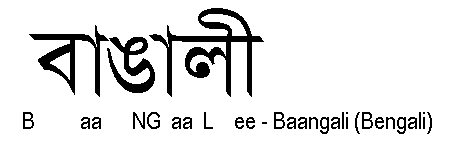\nBengali also known by its endonym Bangla, is an Indo-Aryan language primarily spoken by the Bengalis in South Asia. It is brahmic language which is assumed to be evoloved from Sanskrit\n\n### Dont forget to upvote if you like!!\n## Alphabets\nThe Bengali script can be divided into vowels and vowel diacritics/marks, consonants and consonant conjuncts, diacritical and other symbols, digits, and punctuation marks. Vowels & consonants are used as alphabet and also as diacritical marks. Bengali contains 28 letters\n### Vowels\nThe Bengali script has a total of 9 vowel graphemes, each of which is called swôrôbôrnô \"vowel letter\"\n\n| Vowels | Vowels phoneme | \n|---|---|\n| **অ** |ô|\n| **আ ** | a |\n| **ই** | i |\n| **ঈ** | ī/ee |\n| **উ** | u |\n| **ঊ** | ū/oo |\n|**ঋ** | ṛ/ri |\n| **ৠ** | ṝ/rri |\n| **ঌ** | ḷ/li |\n| **ৡ** | ḹ/lli |\n\n#### Complex Vowels\nBengali also has 4 complex vowels\n\n| Complex Vowels | Vowels phoneme | \n|---|---|\n| **এ ** | e |\n| **ঐ** | oi |\n| **ও** | o |\n| **ঔ** | ou |\n\n### Consonants\nConsonant letters are called bænjônbôrnô \"consonant letter\" in Bengali. The names of the letters are typically just the consonant sound plus the inherent vowel. \n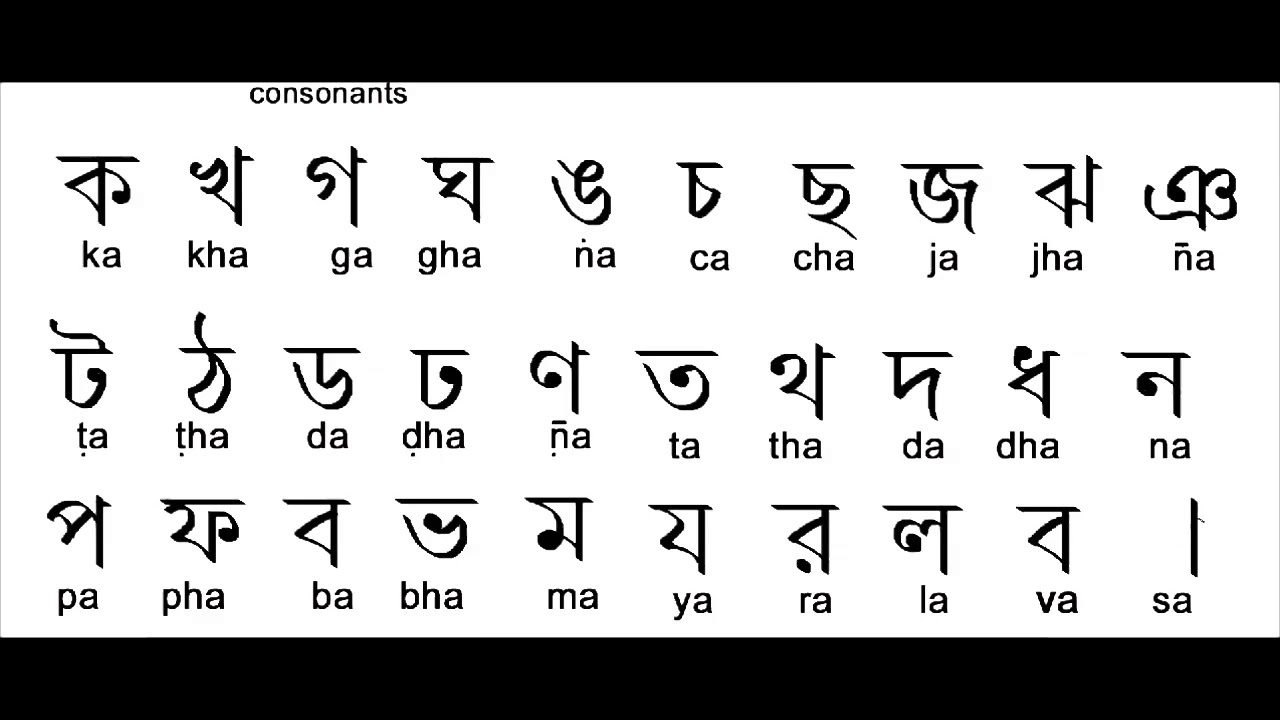\n\n\n\nSince they work on combination there are 19 x 9 letters to be identified."},{"metadata":{"_uuid":"d629ff2d2480ee46fbb7e2d37f6b5fab8052498a","collapsed":true,"_cell_guid":"79c7e3d0-c299-4dcb-8224-4455121ee9b0","trusted":false},"cell_type":"code","source":"\n\nimport numpy as np # linear algebra\nimport pandas as pd # data processing, CSV file I/O (e.g. pd.read_csv)\n\nimport os\nimport seaborn as sns\nimport matplotlib.pyplot as plt\nimport random\n# Any results you write to the current directory are saved as output.","execution_count":null,"outputs":[]},{"metadata":{"trusted":true},"cell_type":"code","source":"Train_data = pd.read_csv('/kaggle/input/bengaliai-cv19/train.csv')\nTest_data = pd.read_csv('/kaggle/input/bengaliai-cv19/test.csv')\nclass_map = pd.read_csv('/kaggle/input/bengaliai-cv19/class_map.csv')\nsample_submission = pd.read_csv('/kaggle/input/bengaliai-cv19/sample_submission.csv')","execution_count":null,"outputs":[]},{"metadata":{},"cell_type":"markdown","source":"## Train_data\nContains,\n1. Image_id -> Id of training Image\n2. grapheme_root -> character number (vowel + consonant)\n3. vowel_diacritic -> root vowel id number\n4. consonant_diacritic -> root consonant id number"},{"metadata":{"trusted":true},"cell_type":"code","source":"Train_data.head()","execution_count":null,"outputs":[]},{"metadata":{},"cell_type":"markdown","source":"## Class_map\n\nProvides us the number of unique elements in each class and their label to be reffered to Train_data"},{"metadata":{"trusted":true},"cell_type":"code","source":"class_map.head()","execution_count":null,"outputs":[]},{"metadata":{"trusted":true},"cell_type":"code","source":"# count the number of classes for each target\nn_classes = class_map.groupby(by=['component_type']).count()","execution_count":null,"outputs":[]},{"metadata":{"trusted":true},"cell_type":"code","source":"n_classes.head()","execution_count":null,"outputs":[]},{"metadata":{"trusted":true},"cell_type":"code","source":"sns.set(style=\"darkgrid\")\nk = ['vowel_diacritic','grapheme_root','consonant_diacritic']\nsns.countplot(data = class_map ,x = 'component_type',order = k)\n","execution_count":null,"outputs":[]},{"metadata":{"trusted":true},"cell_type":"code","source":"HEIGHT = 137\nWIDTH = 236","execution_count":null,"outputs":[]},{"metadata":{"trusted":true},"cell_type":"code","source":"b_train_data = pd.read_parquet(f'/kaggle/input/bengaliai-cv19/train_image_data_0.parquet')\n\nimageid = b_train_data.iloc[:, 0]\nimage = b_train_data.iloc[:, 1:].values.reshape(-1, HEIGHT, WIDTH)\n","execution_count":null,"outputs":[]},{"metadata":{"trusted":true},"cell_type":"code","source":"f, ax = plt.subplots(5, 5, figsize=(16, 8))\nax = ax.flatten()\n\nfor i in range(25):\n ax[i].imshow(image[i], cmap='Greys')\n","execution_count":null,"outputs":[]},{"metadata":{"trusted":true},"cell_type":"code","source":"def listToString(s): \n \n # initialize an empty string \n str1 = \"\" \n \n # traverse in the string \n for ele in s: \n str1 += ele \n \n # return string \n return str1 \n ","execution_count":null,"outputs":[]},{"metadata":{"trusted":true},"cell_type":"code","source":"from wordcloud import WordCloud\n\n\ns = listToString(Train_data['grapheme'] )\n\n# Read the whole text.\ntext = s\n\n# Generate a word cloud image\nwordcloud = WordCloud().generate(text)\n\n# Display the generated image:\n# the matplotlib way:\nimport matplotlib.pyplot as plt\n\n\n# take relative word frequencies into account, lower max_font_size\nwordcloud = WordCloud(background_color=\"white\",max_words=len(s),max_font_size=70, relative_scaling=.5, font_path = \"/kaggle/input/bengalifont/Nikosh.ttf\").generate(text)\nplt.figure(figsize=(30, 30))\nplt.imshow(wordcloud)\nplt.axis(\"off\")\nplt.show()","execution_count":null,"outputs":[]},{"metadata":{},"cell_type":"markdown","source":"## Histogramic Distribution of Grapheme root"},{"metadata":{"trusted":true},"cell_type":"code","source":"\n#sns.set(style=\"darkgrid\")\nplt.figure(figsize=(20, 10))\nsns.countplot(data = Train_data ,x = 'grapheme_root',color=\"c\")\n\n","execution_count":null,"outputs":[]},{"metadata":{"trusted":true},"cell_type":"code","source":"type(image[1])","execution_count":null,"outputs":[]},{"metadata":{},"cell_type":"markdown","source":"# Augmentations\n## Flipping"},{"metadata":{"trusted":true},"cell_type":"code","source":"rand_num = random.randint(0,len(image))\nrand_num","execution_count":null,"outputs":[]},{"metadata":{"trusted":true},"cell_type":"code","source":"plt.imshow(image[rand_num])\nplt.title(\"input_img\")\nplt.show()","execution_count":null,"outputs":[]},{"metadata":{"trusted":true},"cell_type":"code","source":"flipped_img = np.fliplr(image[rand_num])\nplt.imshow(flipped_img)\nplt.title(\"flipped_img\")\nplt.show()","execution_count":null,"outputs":[]},{"metadata":{},"cell_type":"markdown","source":"## Gaussian Noice"},{"metadata":{"trusted":true},"cell_type":"code","source":"import skimage\nimg = image[rand_num]\nimg = skimage.util.random_noise(img, mode='gaussian', seed=None, clip=True)\nplt.imshow(img)\nplt.show()","execution_count":null,"outputs":[]},{"metadata":{},"cell_type":"markdown","source":"## Rotate"},{"metadata":{"trusted":true},"cell_type":"code","source":"from skimage.transform import rotate\nimg = image[rand_num]\nimg = rotate(img, 15)\nplt.imshow(img)\nplt.show()","execution_count":null,"outputs":[]},{"metadata":{"trusted":true},"cell_type":"code","source":"from skimage.transform import rotate\nimg = image[rand_num]\nimg = rotate(img, -15)\nplt.imshow(img)\nplt.show()","execution_count":null,"outputs":[]},{"metadata":{},"cell_type":"markdown","source":"## Change Intensity (Make letters Clear if their intensity is low)"},{"metadata":{"trusted":true},"cell_type":"code","source":"import numpy as np\nfrom skimage import exposure\nimg = image[rand_num]\nv_min, v_max = np.percentile(img, (0.2, 99.8))\nimg = exposure.rescale_intensity(img, in_range=(v_min, v_max))\n\nplt.imshow(img)\nplt.show()\n","execution_count":null,"outputs":[]},{"metadata":{},"cell_type":"markdown","source":"## Classical Research Papers and Repos on bengali letter classifications\n\n1. https://www.researchgate.net/publication/322112791_Handwritten_Bangla_Character_Recognition_Using_The_State-of-Art_Deep_Convolutional_Neural_Networks\n2. https://www.researchgate.net/publication/328214545_BARD_Bangla_Article_Classification_Using_a_New_Comprehensive_Dataset\n3. https://arxiv.org/html/1902.11133 (Bengali Handwritten Character Classification using Transfer Learning on Deep Convolutional Neural Network)\n4. https://github.com/srdg/bangla-dl\n5. https://github.com/dibyatanoy/Bengali-Handwritten-Character-Recognition-Using-Convolutional-Neural-Networks\n6. https://github.com/tanvirfahim15/BARD-Bangla-Article-Classifier"},{"metadata":{},"cell_type":"markdown","source":"## To Start with the Chalange go for\n## Bengali.AI : Design ResNet Layer by Layer\nhttps://www.kaggle.com/chekoduadarsh/bengali-ai-tutorial-design-resnet-layer-by-layer"}],"metadata":{"kernelspec":{"language":"python","display_name":"Python 3","name":"python3"},"language_info":{"pygments_lexer":"ipython3","nbconvert_exporter":"python","version":"3.6.4","file_extension":".py","codemirror_mode":{"name":"ipython","version":3},"name":"python","mimetype":"text/x-python"}},"nbformat":4,"nbformat_minor":1}