
This looks promising!!! Hope it helps in ur experiments.
\n\n
\nData-augmentation is key to the training of neural networks for image classification. This paper first shows that existing augmentations induce a significant discrepancy between the typical size of the objects seen by the classifier at train and test time. We experimentally validate that, for a target test resolution, using a lower train resolution offers better classification at test time. We then propose a simple yet effective and efficient strategy to optimize the classifier performance when the train and test resolutions differ. It involves only a computationally cheap fine-tuning of the network at the test resolution. This enables training strong classifiers using small training images. For instance, we obtain 77.1% top-1 accuracy on ImageNet with a ResNet-50 trained on 128x128 images, and 79.8% with one trained on 224x224 image. In addition, if we use extra training data we get 82.5% with the ResNet-50 train with 224x224 images. Conversely, when training a ResNeXt-101 32x48d pre-trained in weakly-supervised fashion on 940 million public images at resolution 224x224 and further optimizing for test resolution 320x320, we obtain a test top-1 accuracy of 86.4% (top-5: 98.0%) (single-crop). To the best of our knowledge this is the highest ImageNet single-crop, top-1 and top-5 accuracy to date.\n
This looks promising!!! Hope it helps in ur experiments.
\n\n
\nData-augmentation is key to the training of neural networks for image classification. This paper first shows that existing augmentations induce a significant discrepancy between the typical size of the objects seen by the classifier at train and test time. We experimentally validate that, for a target test resolution, using a lower train resolution offers better classification at test time. We then propose a simple yet effective and efficient strategy to optimize the classifier performance when the train and test resolutions differ. It involves only a computationally cheap fine-tuning of the network at the test resolution. This enables training strong classifiers using small training images. For instance, we obtain 77.1% top-1 accuracy on ImageNet with a ResNet-50 trained on 128x128 images, and 79.8% with one trained on 224x224 image. In addition, if we use extra training data we get 82.5% with the ResNet-50 train with 224x224 images. Conversely, when training a ResNeXt-101 32x48d pre-trained in weakly-supervised fashion on 940 million public images at resolution 224x224 and further optimizing for test resolution 320x320, we obtain a test top-1 accuracy of 86.4% (top-5: 98.0%) (single-crop). To the best of our knowledge this is the highest ImageNet single-crop, top-1 and top-5 accuracy to date.\n
Nice paper
", "rawMarkdown": "Nice paper", "votes": null }, { "id": "589879", "postDate": "08/01/2019 14:12:18", "content": "Thanks for sharing.
", "rawMarkdown": "Thanks for sharing.", "votes": null }, { "id": "590218", "postDate": "08/01/2019 22:13:35", "content": "I am not seeing how this may be used in this competition. Based on my understanding, there is no significant train-test-discrepancy, no?
", "rawMarkdown": "I am not seeing how this may be used in this competition. Based on my understanding, there is no significant train-test-discrepancy, no?", "votes": null }, { "id": "590318", "postDate": "08/02/2019 04:17:57", "content": "I am not sure but mayb the scaling strategy could help to match the resolutions of train-test set(which are different)
", "rawMarkdown": "I am not sure but mayb the scaling strategy could help to match the resolutions of train-test set(which are different)", "votes": null }, { "id": "590322", "postDate": "08/02/2019 04:40:19", "content": "Great paper - thanks for sharing.
\n\nI'm thinking that we always want to consider going to opposite way in this competition: train on larger images and test on smaller images, since the eyes in the test set seem to be significantly large than train.
", "rawMarkdown": "Great paper - thanks for sharing.\n\nI'm thinking that we always want to consider going to opposite way in this competition: train on larger images and test on smaller images, since the eyes in the test set seem to be significantly large than train.", "votes": null } ], "comments": [ { "id": 588692, "author_name": "princedemo", "author_url": "", "post_date": "07/30/2019 23:45:13", "content": "Nice paper
", "votes": null, "replies": [] }, { "id": 589879, "author_name": "suneelpatel", "author_url": "", "post_date": "08/01/2019 14:12:18", "content": "Thanks for sharing.
", "votes": null, "replies": [] }, { "id": 590218, "author_name": "tanlikesmath", "author_url": "", "post_date": "08/01/2019 22:13:35", "content": "I am not seeing how this may be used in this competition. Based on my understanding, there is no significant train-test-discrepancy, no?
", "votes": null, "replies": [ { "id": 590318, "author_name": "bibek777", "author_url": "", "post_date": "08/02/2019 04:17:57", "content": "I am not sure but mayb the scaling strategy could help to match the resolutions of train-test set(which are different)
", "votes": null, "replies": [] } ] }, { "id": 590322, "author_name": "lextoumbourou", "author_url": "", "post_date": "08/02/2019 04:40:19", "content": "Great paper - thanks for sharing.
\n\nI'm thinking that we always want to consider going to opposite way in this competition: train on larger images and test on smaller images, since the eyes in the test set seem to be significantly large than train.
", "votes": null, "replies": [] } ], "raw_markdown_by_id": { "588582": "This looks promising!!! Hope it helps in ur experiments.\n\n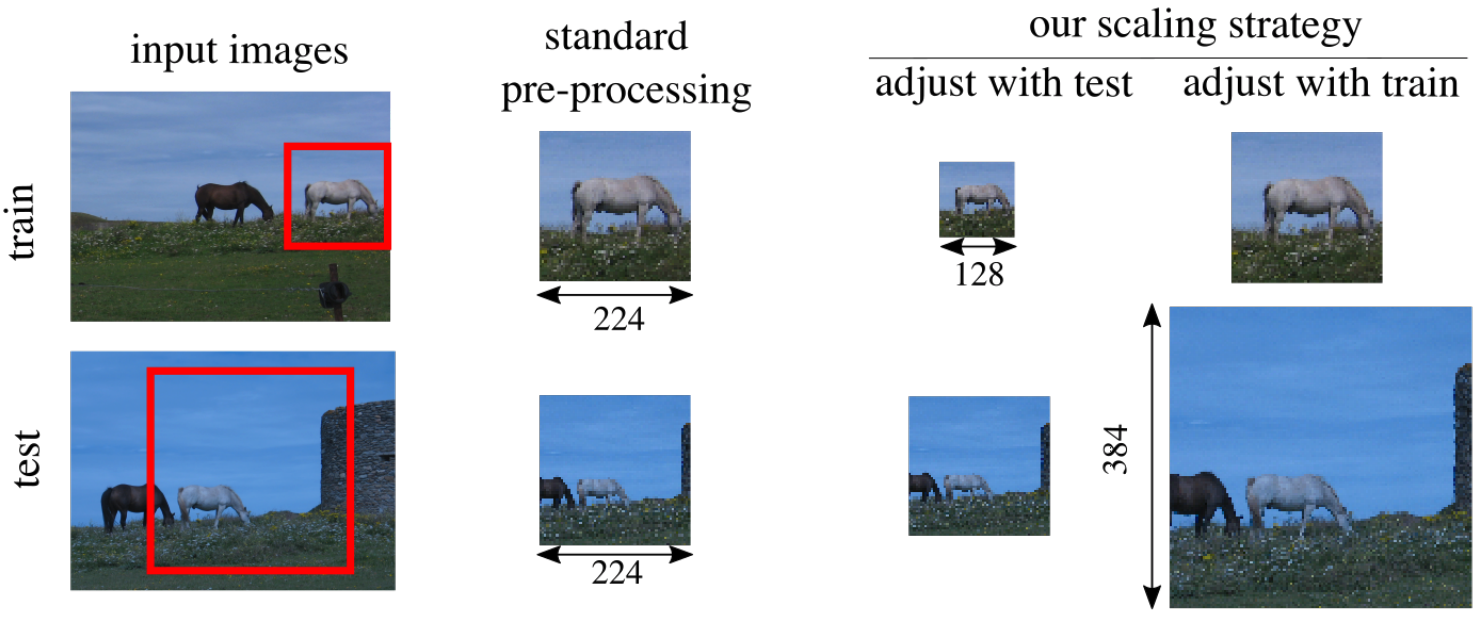\n## Abstract\n```\nData-augmentation is key to the training of neural networks for image classification. This paper first shows that existing augmentations induce a significant discrepancy between the typical size of the objects seen by the classifier at train and test time. We experimentally validate that, for a target test resolution, using a lower train resolution offers better classification at test time. We then propose a simple yet effective and efficient strategy to optimize the classifier performance when the train and test resolutions differ. It involves only a computationally cheap fine-tuning of the network at the test resolution. This enables training strong classifiers using small training images. For instance, we obtain 77.1% top-1 accuracy on ImageNet with a ResNet-50 trained on 128x128 images, and 79.8% with one trained on 224x224 image. In addition, if we use extra training data we get 82.5% with the ResNet-50 train with 224x224 images. Conversely, when training a ResNeXt-101 32x48d pre-trained in weakly-supervised fashion on 940 million public images at resolution 224x224 and further optimizing for test resolution 320x320, we obtain a test top-1 accuracy of 86.4% (top-5: 98.0%) (single-crop). To the best of our knowledge this is the highest ImageNet single-crop, top-1 and top-5 accuracy to date.\n```\n\n[PAPER+CoDE](https://paperswithcode.com/paper/fixing-the-train-test-resolution-discrepancy)", "588692": "Nice paper", "589879": "Thanks for sharing.", "590218": "I am not seeing how this may be used in this competition. Based on my understanding, there is no significant train-test-discrepancy, no?", "590318": "I am not sure but mayb the scaling strategy could help to match the resolutions of train-test set(which are different)", "590322": "Great paper - thanks for sharing.\n\nI'm thinking that we always want to consider going to opposite way in this competition: train on larger images and test on smaller images, since the eyes in the test set seem to be significantly large than train." }, "source": "meta" }