{"cells":[{"metadata":{},"cell_type":"markdown","source":"# Implementation of EfficientNetB5 for the APTOS 2019 competition with Keras"},{"metadata":{},"cell_type":"markdown","source":"In this kernel we will implement EfficientNet for medical images ([APTOS 2019](https://www.kaggle.com/c/aptos2019-blindness-detection) competition). EfficientNet was released this June (2019) by Google AI and is the new state-of-the-art on ImageNet. It introduces a systematic way to scale CNN (Convolutional Neural Networks) in a nearly optimal way. For this kernel we will use the B5 version, but feel free to play with the larger models. This kernel provides weights for EfficientNetB0 through B5. Weights for EfficientNetB6 and B7 can be found in [Google AI's repository for EfficientNet](https://github.com/tensorflow/tpu/tree/master/models/official/efficientnet). I highly recommend you to read [the EfficientNet paper](https://arxiv.org/pdf/1905.11946.pdf) as it signifies a fundamental shift in how the Deep Learning community will approach model scaling!\n\nAlso, check out this [video on EfficientNet by Henry AI Labs](https://youtu.be/3svIm5UC94I) for a clear explanation!\n\nIf you like this Kaggle kernel, feel free to give an upvote and leave a comment!"},{"metadata":{},"cell_type":"markdown","source":"Image: an overview of model architectures and their performance on [ImageNet](http://www.image-net.org/). We can see that EfficientNet achieves state-of-the-art and uses a lot less parameters than most modern CNN architectures.\n\n[Source: EfficientNet Paper](https://arxiv.org/pdf/1905.11946.pdf)\n\n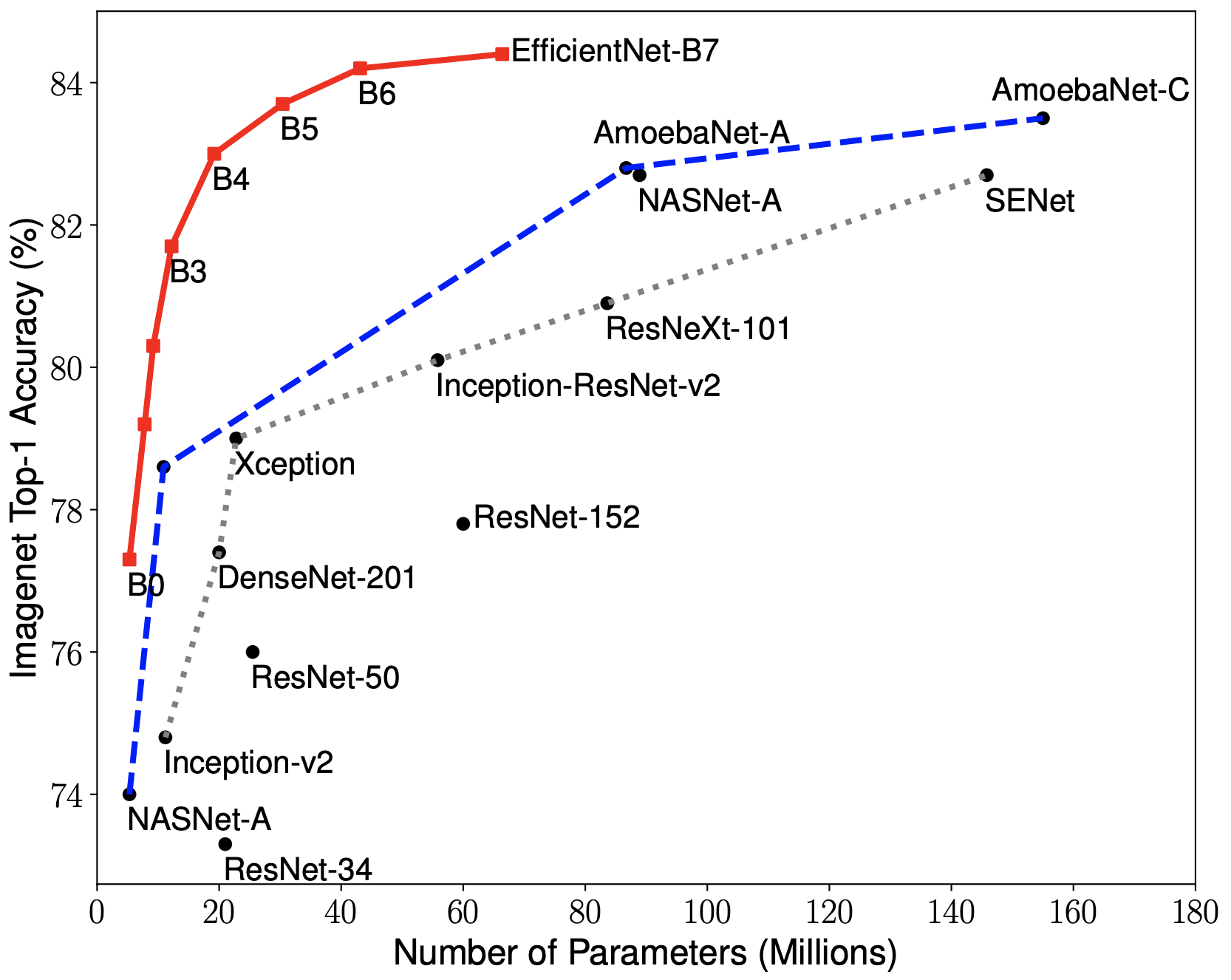"},{"metadata":{},"cell_type":"markdown","source":"## Table Of Contents"},{"metadata":{},"cell_type":"markdown","source":"- [Dependencies](#1)\n- [Preparation](#2)\n- [Metric (Quadratic Weighted Kappa)](#3)\n- [EDA (Exploratory Data Analysis)](#4)\n- [Preprocessing](#5)\n- [Modeling (EfficientNetB5)](#6)\n- [Evaluation](#7)\n- [Submission](#8)"},{"metadata":{},"cell_type":"markdown","source":"## Dependencies "},{"metadata":{},"cell_type":"markdown","source":"Special thanks to [qubvel](https://github.com/qubvel/efficientnet) for sharing an amazing wrapper to get the EfficientNet architecture in one line of code!"},{"metadata":{"_uuid":"8f2839f25d086af736a60e9eeb907d3b93b6e0e5","_cell_guid":"b1076dfc-b9ad-4769-8c92-a6c4dae69d19","trusted":true,"_kg_hide-output":true},"cell_type":"code","source":"import os\nimport sys\n# Repository source: https://github.com/qubvel/efficientnet\nsys.path.append(os.path.abspath('../input/efficientnet/efficientnet-master/efficientnet-master/'))\nfrom efficientnet import EfficientNetB5","execution_count":null,"outputs":[]},{"metadata":{"trusted":true},"cell_type":"code","source":"import json\nimport math\nimport os\n\nimport cv2\nfrom PIL import Image\nimport numpy as np\nfrom keras import layers\n\nfrom keras.layers import Dense, Conv2D, Flatten, GlobalAveragePooling2D, Dropout\nfrom keras.activations import elu\nfrom keras.engine import Layer, InputSpec\nfrom keras.callbacks import Callback, ModelCheckpoint\nfrom keras.preprocessing.image import ImageDataGenerator\nfrom keras.models import Sequential\nfrom keras.optimizers import Adam\nimport matplotlib.pyplot as plt\nimport pandas as pd\nfrom sklearn.model_selection import train_test_split\nfrom sklearn.metrics import cohen_kappa_score, accuracy_score\nimport scipy\nimport tensorflow as tf\nfrom tqdm import tqdm\nimport keras\nfrom keras.datasets import mnist\n\nimport datetime\n\n%matplotlib inline","execution_count":null,"outputs":[]},{"metadata":{"trusted":true},"cell_type":"code","source":"np.random.seed(2019)\ntf.set_random_seed(2019)","execution_count":null,"outputs":[]},{"metadata":{},"cell_type":"markdown","source":"## Preparation "},{"metadata":{},"cell_type":"markdown","source":"By examining the data we can readily see that we do not have that much data (± 700 samples per class). It is probably a good idea to use data augmentation to increase robustness of our model (See the modeling section).\n\nWe could also try to use additional data from previous competitions to increase performance. Although I do not implement this in the kernel, feel free to experiment with adding data. Additional data can be found in [this Kaggle dataset](https://www.kaggle.com/benjaminwarner/resized-2015-2019-blindness-detection-images) (± 35000 additional images)."},{"metadata":{},"cell_type":"markdown","source":"The original image size from the [EfficientNet paper](https://arxiv.org/pdf/1905.11946.pdf) for EfficientNetB5 is 456x456x3. We are however not bound by this and can use a smaller size if we want. The original image sizes used for every version of EfficientNet are:\n\n- EfficientNetB0 - (224, 224, 3)\n- EfficientNetB1 - (240, 240, 3)\n- EfficientNetB2 - (260, 260, 3)\n- EfficientNetB3 - (300, 300, 3)\n- EfficientNetB4 - (380, 380, 3)\n- **EfficientNetB5 - (456, 456, 3)**\n- EfficientNetB6 - (528, 528, 3)\n- EfficientNetB7 - (600, 600, 3)\n"},{"metadata":{"trusted":true},"cell_type":"code","source":"train_df = pd.read_csv('../input/aptos2019-blindness-detection/train.csv')\nprint(train_df.shape)\ntrain_df.head()","execution_count":null,"outputs":[]},{"metadata":{"trusted":true},"cell_type":"code","source":"train_df['diagnosis'].hist()\ntrain_df['diagnosis'].value_counts()","execution_count":null,"outputs":[]},{"metadata":{"trusted":true},"cell_type":"code","source":"def display_samples(df, columns=4, rows=3):\n fig=plt.figure(figsize=(5*columns, 4*rows))\n\n for i in range(columns*rows):\n image_path = df.loc[i,'id_code']\n image_id = df.loc[i,'diagnosis']\n img = cv2.imread(f'../input/aptos2019-blindness-detection/train_images/{image_path}.png')\n img = cv2.cvtColor(img, cv2.COLOR_BGR2RGB)\n \n fig.add_subplot(rows, columns, i+1)\n plt.title(image_id)\n plt.imshow(img)\n \n plt.tight_layout()\n\ndisplay_samples(train_df)","execution_count":null,"outputs":[]},{"metadata":{"trusted":true},"cell_type":"code","source":"def get_pad_width(im, new_shape, is_rgb=True):\n pad_diff = new_shape - im.shape[0], new_shape - im.shape[1]\n t, b = math.floor(pad_diff[0]/2), math.ceil(pad_diff[0]/2)\n l, r = math.floor(pad_diff[1]/2), math.ceil(pad_diff[1]/2)\n if is_rgb:\n pad_width = ((t,b), (l,r), (0, 0))\n else:\n pad_width = ((t,b), (l,r))\n return pad_width\n\ndef preprocess_image(image_path, desired_size=456):\n im = Image.open(image_path)\n im = im.resize((desired_size, )*2, resample=Image.LANCZOS)\n \n return im","execution_count":null,"outputs":[]},{"metadata":{"trusted":true},"cell_type":"code","source":"N = train_df.shape[0]\nx_train = np.empty((N, 456, 456, 3), dtype=np.uint8)\n\nfor i, image_id in enumerate(tqdm(train_df['id_code'])):\n x_train[i, :, :, :] = preprocess_image(\n f'../input/aptos2019-blindness-detection/train_images/{image_id}.png'\n )","execution_count":null,"outputs":[]},{"metadata":{"trusted":true},"cell_type":"code","source":"y_train = pd.get_dummies(train_df['diagnosis']).values\n\nprint(x_train.shape)\nprint(y_train.shape)","execution_count":null,"outputs":[]},{"metadata":{"trusted":true},"cell_type":"code","source":"y_train_multi = np.empty(y_train.shape, dtype=y_train.dtype)\ny_train_multi[:, 4] = y_train[:, 4]\n\nfor i in range(3, -1, -1):\n y_train_multi[:, i] = np.logical_or(y_train[:, i], y_train_multi[:, i+1])\n\nprint(\"Original y_train:\", y_train.sum(axis=0))\nprint(\"Multilabel version:\", y_train_multi.sum(axis=0))","execution_count":null,"outputs":[]},{"metadata":{"trusted":true},"cell_type":"code","source":"x_train_val, x_test, y_train_val, y_test = train_test_split(\n x_train, y_train_multi, \n test_size=0.1, \n random_state=2019\n)\nx_train, x_val, y_train, y_val = train_test_split(\n x_train_val, y_train_val, \n test_size=0.1, \n random_state=2019\n)\nprint(\"shape of train images is :\",x_train.shape)\nprint(\"shape of test images is :\",x_test.shape)\nprint(\"shape of valid images is :\",x_val.shape)\nprint(\"shape of train labels is :\",y_train.shape)\nprint(\"shape of test labels is :\",y_test.shape)\nprint(\"shape of valid labels is :\",y_val.shape)","execution_count":null,"outputs":[]},{"metadata":{},"cell_type":"markdown","source":"## Metric (Quadratic Weighted Kappa) "},{"metadata":{},"cell_type":"markdown","source":"The metric that is used for this competition is Quadratic Weighted Kappa (QWK) ([Kaggle's Explanation](https://www.kaggle.com/c/aptos2019-blindness-detection/overview/evaluation)) \n\nThe formula for weighted kappa is:\n\n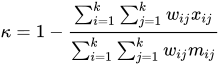\n\nIn this case we are going to optimize Mean Squared Error (MSE) (See Modeling section) since we are using regression and by optimizing MSE we are also optimizing QWK as long as we round predictions afterwards. Additionally we are going to same the model which achieves the best QWK score on the validation data through a custom Keras Callback.\n\nFor a more detailed and practical explanation of QWK I highly recommend [this Kaggle kernel](https://www.kaggle.com/aroraaman/quadratic-kappa-metric-explained-in-5-simple-steps)."},{"metadata":{"trusted":true},"cell_type":"code","source":"class MixupGenerator():\n def __init__(self, X_train, y_train, batch_size=32, alpha=0.2, shuffle=True, datagen=None):\n self.X_train = X_train\n self.y_train = y_train\n self.batch_size = batch_size\n self.alpha = alpha\n self.shuffle = shuffle\n self.sample_num = len(X_train)\n self.datagen = datagen\n\n def __call__(self):\n while True:\n indexes = self.__get_exploration_order()\n itr_num = int(len(indexes) // (self.batch_size * 2))\n\n for i in range(itr_num):\n batch_ids = indexes[i * self.batch_size * 2:(i + 1) * self.batch_size * 2]\n X, y = self.__data_generation(batch_ids)\n\n yield X, y\n\n def __get_exploration_order(self):\n indexes = np.arange(self.sample_num)\n\n if self.shuffle:\n np.random.shuffle(indexes)\n\n return indexes\n\n def __data_generation(self, batch_ids):\n _, h, w, c = self.X_train.shape\n l = np.random.beta(self.alpha, self.alpha, self.batch_size)\n X_l = l.reshape(self.batch_size, 1, 1, 1)\n y_l = l.reshape(self.batch_size, 1)\n\n X1 = self.X_train[batch_ids[:self.batch_size]]\n X2 = self.X_train[batch_ids[self.batch_size:]]\n X = X1 * X_l + X2 * (1 - X_l)\n\n if self.datagen:\n for i in range(self.batch_size):\n X[i] = self.datagen.random_transform(X[i])\n X[i] = self.datagen.standardize(X[i])\n\n if isinstance(self.y_train, list):\n y = []\n\n for y_train_ in self.y_train:\n y1 = y_train_[batch_ids[:self.batch_size]]\n y2 = y_train_[batch_ids[self.batch_size:]]\n y.append(y1 * y_l + y2 * (1 - y_l))\n else:\n y1 = self.y_train[batch_ids[:self.batch_size]]\n y2 = self.y_train[batch_ids[self.batch_size:]]\n y = y1 * y_l + y2 * (1 - y_l)\n\n return X, y","execution_count":null,"outputs":[]},{"metadata":{"trusted":true},"cell_type":"code","source":"BATCH_SIZE = 32\n\ndef create_datagen():\n return ImageDataGenerator(\n zoom_range=0.15, # set range for random zoom\n # set mode for filling points outside the input boundaries\n fill_mode='constant',\n cval=0., # value used for fill_mode = \"constant\"\n horizontal_flip=True, # randomly flip images\n vertical_flip=True, # randomly flip images\n )\n\n# Using original generator\ndata_generator = create_datagen().flow(x_train, y_train, batch_size=BATCH_SIZE, seed=2019)\n# Using Mixup\nmixup_generator = MixupGenerator(x_train, y_train, batch_size=BATCH_SIZE, alpha=0.2, datagen=create_datagen())()","execution_count":null,"outputs":[]},{"metadata":{"trusted":true},"cell_type":"code","source":"class Metrics(Callback):\n def on_train_begin(self, logs={}):\n self.val_kappas = []\n\n def on_epoch_end(self, epoch, logs={}):\n X_val, y_val = self.validation_data[:2]\n y_val = y_val.sum(axis=1) - 1\n \n y_pred = self.model.predict(X_val) > 0.5\n y_pred = y_pred.astype(int).sum(axis=1) - 1\n\n _val_kappa = cohen_kappa_score(\n y_val,\n y_pred, \n weights='quadratic'\n )\n\n self.val_kappas.append(_val_kappa)\n\n print(f\"val_kappa: {_val_kappa:.4f}\")\n \n if _val_kappa == max(self.val_kappas):\n print(\"Validation Kappa has improved. Saving model.\")\n self.model.save('model.h5')\n\n return","execution_count":null,"outputs":[]},{"metadata":{},"cell_type":"markdown","source":"## EDA (Exploratory Data Analysis) "},{"metadata":{},"cell_type":"markdown","source":"For EDA on image datasets I think one should at least examine the label distribution, the images before preprocessing and the images after preprocessing. Through examining these three aspects we can get a good sense of the problem. Note that the distribution on the test set can still vary wildly from the training data."},{"metadata":{},"cell_type":"markdown","source":"We will visualize a random image from every label to get a general sense of the distinctive features that seperate the classes. We will take this into account and try to enhance these features in our preprocessing. For these images there some to be increasingly more spots and stains on the retina as diabetic retinopathy worsens."},{"metadata":{},"cell_type":"markdown","source":"## Preprocessing "},{"metadata":{},"cell_type":"markdown","source":"Here we will use the auto-cropping method with Ben's preprocessing as explained in [this kernel](https://www.kaggle.com/ratthachat/aptos-updatedv14-preprocessing-ben-s-cropping)."},{"metadata":{},"cell_type":"markdown","source":"After preprocessing we have managed to enhance the distinctive features in the images. This will increase performance when we train our EfficientNet model."},{"metadata":{},"cell_type":"markdown","source":"## Modeling (EfficientNetB5) "},{"metadata":{},"cell_type":"markdown","source":"Since we want to optimize the Quadratic Weighted Kappa score we can formulate this challenge as a regression problem. In this way we are more flexible in our optimization and we can yield higher scores than solely optimizing for accuracy. We will optimize a pre-trained EfficientNetB5 with a few added layers. The metric that we try to optimize is the [Mean Squared Error](https://en.wikipedia.org/wiki/Mean_squared_error). This is the mean of squared differences between our predictions and labels, as showed in the formula below. By optimizing this metric we are also optimizing for Quadratic Weighted Kappa if we round the predictions afterwards.\n\n\n\nSince we are not provided with that much data (3662 images), we will augment the data to make the model more robust. We will rotate the data on any angle. Also, we will flip the data both horizontally and vertically. Lastly, we will divide the data by 128 for normalization."},{"metadata":{},"cell_type":"markdown","source":"Thanks to the amazing wrapper by [qubvel](https://github.com/qubvel/efficientnet) we can load in a model like the Keras API. We specify the input shape and that we want the model without the top (the final Dense layer). Then we load in the weights which are provided in [this Kaggle dataset](https://www.kaggle.com/ratthachat/efficientnet-keras-weights-b0b5). Note that we will use the [RAdam optimizer](https://arxiv.org/pdf/1908.03265v1.pdf) since it often yields better convergence than Vanilla Adam. Thanks to CyberZHG who implemented [RAdam for Keras](https://github.com/CyberZHG/keras-radam/blob/master/keras_radam/optimizers.py)."},{"metadata":{"trusted":true},"cell_type":"code","source":"# Load in EfficientNetB5\neffnet = EfficientNetB5(weights=None,\n include_top=False,\n input_shape=(456, 456, 3))\neffnet.load_weights('../input/efficientnet-keras-weights-b0b5/efficientnet-b5_imagenet_1000_notop.h5')","execution_count":null,"outputs":[]},{"metadata":{"trusted":true},"cell_type":"code","source":"def build_model():\n model = Sequential()\n model.add(effnet)\n model.add(GlobalAveragePooling2D())\n model.add(Dropout(0.5))\n model.add(Dense(5, activation=elu))\n model.add(Dense(1, activation=\"linear\"))\n model.compile(loss='mse',\n optimizer=Adam(lr=0.00005), \n metrics=['mse', 'acc'])\n return model","execution_count":null,"outputs":[]},{"metadata":{"trusted":true},"cell_type":"code","source":"model = build_model()\nmodel.summary()","execution_count":null,"outputs":[]},{"metadata":{"trusted":true},"cell_type":"code","source":"def subtime(date1, date2):\n date1 = datetime.datetime.strptime(date1, \"%Y-%m-%d %H:%M:%S\")\n date2 = datetime.datetime.strptime(date2, \"%Y-%m-%d %H:%M:%S\")\n return date2 - date1","execution_count":null,"outputs":[]},{"metadata":{"trusted":true},"cell_type":"code","source":"startdate = datetime.datetime.now() \nstartdate = startdate.strftime(\"%Y-%m-%d %H:%M:%S\") ","execution_count":null,"outputs":[]},{"metadata":{"trusted":true},"cell_type":"code","source":"kappa_metrics = Metrics()\n\nhistory = model.fit_generator(\n data_generator,\n steps_per_epoch=x_train.shape[0] / BATCH_SIZE,\n epochs=15,\n validation_data=(x_val, y_val),\n callbacks=[kappa_metrics]\n \n)","execution_count":null,"outputs":[]},{"metadata":{"trusted":true},"cell_type":"code","source":"enddate = datetime.datetime.now() \nenddate = enddate.strftime(\"%Y-%m-%d %H:%M:%S\")","execution_count":null,"outputs":[]},{"metadata":{"trusted":true},"cell_type":"code","source":"print('start date ',startdate)\nprint('end date ',enddate)\nprint('Time ',subtime(startdate,enddate)) ","execution_count":null,"outputs":[]},{"metadata":{"trusted":true},"cell_type":"code","source":"with open('history.json', 'w') as f:\n json.dump(history.history, f)\n\nhistory_df = pd.DataFrame(history.history)\nhistory_df[['loss', 'val_loss']].plot()\nhistory_df[['acc', 'val_acc']].plot()","execution_count":null,"outputs":[]},{"metadata":{"trusted":true},"cell_type":"code","source":"plt.plot(kappa_metrics.val_kappas)","execution_count":null,"outputs":[]},{"metadata":{"trusted":true},"cell_type":"code","source":"model.load_weights('model.h5')\nresults = model.evaluate(x_test, y_test, verbose=0)\n\nprint(\"test loss:\",results[0])\nprint(\"test accuracy:\",results[1])\n","execution_count":null,"outputs":[]},{"metadata":{"trusted":true},"cell_type":"code","source":"def get_preds_and_labels(model):\n preds = []\n labels = []\n \n preds.append(model.predict(x_test))\n labels.append(y_test)\n \n return np.concatenate(preds).ravel(), np.concatenate(labels).ravel()\ntest_kappas = []\ny_pred, labels = get_preds_and_labels(model)\ny_pred = np.rint(y_pred).astype(np.uint8).clip(0, 4)\n_test_kappa = cohen_kappa_score(labels, y_pred, weights='quadratic')\ntest_kappas.append(_test_kappa)\nprint(f\"test_kappa: {round(_test_kappa, 4)}\")","execution_count":null,"outputs":[]}],"metadata":{"kernelspec":{"language":"python","display_name":"Python 3","name":"python3"},"language_info":{"pygments_lexer":"ipython3","nbconvert_exporter":"python","version":"3.6.4","file_extension":".py","codemirror_mode":{"name":"ipython","version":3},"name":"python","mimetype":"text/x-python"}},"nbformat":4,"nbformat_minor":4}