
Looks Promising ?
\n\n
\nThe RGB stream models visual tampering artifacts, such as unusually\nhigh contrast along object edges, and regresses bounding boxes to the ground-truth. The noise stream first obtains the noise feature map\nby passing input RGB image through an SRM filter layer, and leverages the noise features to provide additional evidence for manipulation\nclassification.\n
```python\ndef setup_srm_weights(input_channels: int = 3) -> torch.Tensor:\n \"\"\"Creates the SRM kernels for noise analysis.\"\"\"\n # note: values taken from Zhou et al., \"Learning Rich Features for Image Manipulation Detection\", CVPR2018\n srm_kernel = torch.from_numpy(np.array([\n [ # srm 1/2 horiz\n [0., 0., 0., 0., 0.], # noqa: E241,E201\n [0., 0., 0., 0., 0.], # noqa: E241,E201\n [0., 1., -2., 1., 0.], # noqa: E241,E201\n [0., 0., 0., 0., 0.], # noqa: E241,E201\n [0., 0., 0., 0., 0.], # noqa: E241,E201\n ], [ # srm 1/4\n [0., 0., 0., 0., 0.], # noqa: E241,E201\n [0., -1., 2., -1., 0.], # noqa: E241,E201\n [0., 2., -4., 2., 0.], # noqa: E241,E201\n [0., -1., 2., -1., 0.], # noqa: E241,E201\n [0., 0., 0., 0., 0.], # noqa: E241,E201\n ], [ # srm 1/12\n [-1., 2., -2., 2., -1.], # noqa: E241,E201\n [2., -6., 8., -6., 2.], # noqa: E241,E201\n [-2., 8., -12., 8., -2.], # noqa: E241,E201\n [2., -6., 8., -6., 2.], # noqa: E241,E201\n [-1., 2., -2., 2., -1.], # noqa: E241,E201\n ]\n ])).float()\n srm_kernel[0] /= 2\n srm_kernel[1] /= 4\n srm_kernel[2] /= 12\n return srm_kernel.view(3, 1, 5, 5).repeat(1, input_channels, 1, 1)
\n\ndef setup_srm_layer(input_channels: int = 3) -> torch.nn.Module:\n \"\"\"Creates a SRM convolution layer for noise analysis.\"\"\"\n weights = setup_srm_weights(input_channels)\n conv = torch.nn.Conv2d(input_channels, out_channels=3, kernel_size=5, stride=1, padding=2, bias=False)\n with torch.no_grad():\n conv.weight = torch.nn.Parameter(weights, requires_grad=False)\n return conv
\n\n```
\n\n```python\nclass AlaskaClassifierSRM(nn.Module):\n def init(self, encoder, dropout_rate=0.5, num_class=4) -> None:\n super().init()\n self.encoder = EfficientNet()\n self.avg_pool = AdaptiveAvgPool2d((1, 1))\n self.srm_conv = setup_srm_layer(3)\n self.dropout = Dropout(dropout_rate)\n self.fc = Linear(encoder_params[encoder][\"features\"], num_class)
\n\ndef forward(self, x):\n noise = self.srm_conv(x)\n x = self.encoder.forward_features(noise)\n x = self.avg_pool(x).flatten(1)\n x = self.dropout(x)\n x = self.fc(x)\n return x\n```
", "messages": [ { "id": "919054", "postDate": "07/07/2020 17:21:49", "content": "Looks Promising ?
\n\n
\nThe RGB stream models visual tampering artifacts, such as unusually\nhigh contrast along object edges, and regresses bounding boxes to the ground-truth. The noise stream first obtains the noise feature map\nby passing input RGB image through an SRM filter layer, and leverages the noise features to provide additional evidence for manipulation\nclassification.\n
```python\ndef setup_srm_weights(input_channels: int = 3) -> torch.Tensor:\n \"\"\"Creates the SRM kernels for noise analysis.\"\"\"\n # note: values taken from Zhou et al., \"Learning Rich Features for Image Manipulation Detection\", CVPR2018\n srm_kernel = torch.from_numpy(np.array([\n [ # srm 1/2 horiz\n [0., 0., 0., 0., 0.], # noqa: E241,E201\n [0., 0., 0., 0., 0.], # noqa: E241,E201\n [0., 1., -2., 1., 0.], # noqa: E241,E201\n [0., 0., 0., 0., 0.], # noqa: E241,E201\n [0., 0., 0., 0., 0.], # noqa: E241,E201\n ], [ # srm 1/4\n [0., 0., 0., 0., 0.], # noqa: E241,E201\n [0., -1., 2., -1., 0.], # noqa: E241,E201\n [0., 2., -4., 2., 0.], # noqa: E241,E201\n [0., -1., 2., -1., 0.], # noqa: E241,E201\n [0., 0., 0., 0., 0.], # noqa: E241,E201\n ], [ # srm 1/12\n [-1., 2., -2., 2., -1.], # noqa: E241,E201\n [2., -6., 8., -6., 2.], # noqa: E241,E201\n [-2., 8., -12., 8., -2.], # noqa: E241,E201\n [2., -6., 8., -6., 2.], # noqa: E241,E201\n [-1., 2., -2., 2., -1.], # noqa: E241,E201\n ]\n ])).float()\n srm_kernel[0] /= 2\n srm_kernel[1] /= 4\n srm_kernel[2] /= 12\n return srm_kernel.view(3, 1, 5, 5).repeat(1, input_channels, 1, 1)
\n\ndef setup_srm_layer(input_channels: int = 3) -> torch.nn.Module:\n \"\"\"Creates a SRM convolution layer for noise analysis.\"\"\"\n weights = setup_srm_weights(input_channels)\n conv = torch.nn.Conv2d(input_channels, out_channels=3, kernel_size=5, stride=1, padding=2, bias=False)\n with torch.no_grad():\n conv.weight = torch.nn.Parameter(weights, requires_grad=False)\n return conv
\n\n```
\n\n```python\nclass AlaskaClassifierSRM(nn.Module):\n def init(self, encoder, dropout_rate=0.5, num_class=4) -> None:\n super().init()\n self.encoder = EfficientNet()\n self.avg_pool = AdaptiveAvgPool2d((1, 1))\n self.srm_conv = setup_srm_layer(3)\n self.dropout = Dropout(dropout_rate)\n self.fc = Linear(encoder_params[encoder][\"features\"], num_class)
\n\ndef forward(self, x):\n noise = self.srm_conv(x)\n x = self.encoder.forward_features(noise)\n x = self.avg_pool(x).flatten(1)\n x = self.dropout(x)\n x = self.fc(x)\n return x\n```
", "rawMarkdown": "Looks Promising ?\n\n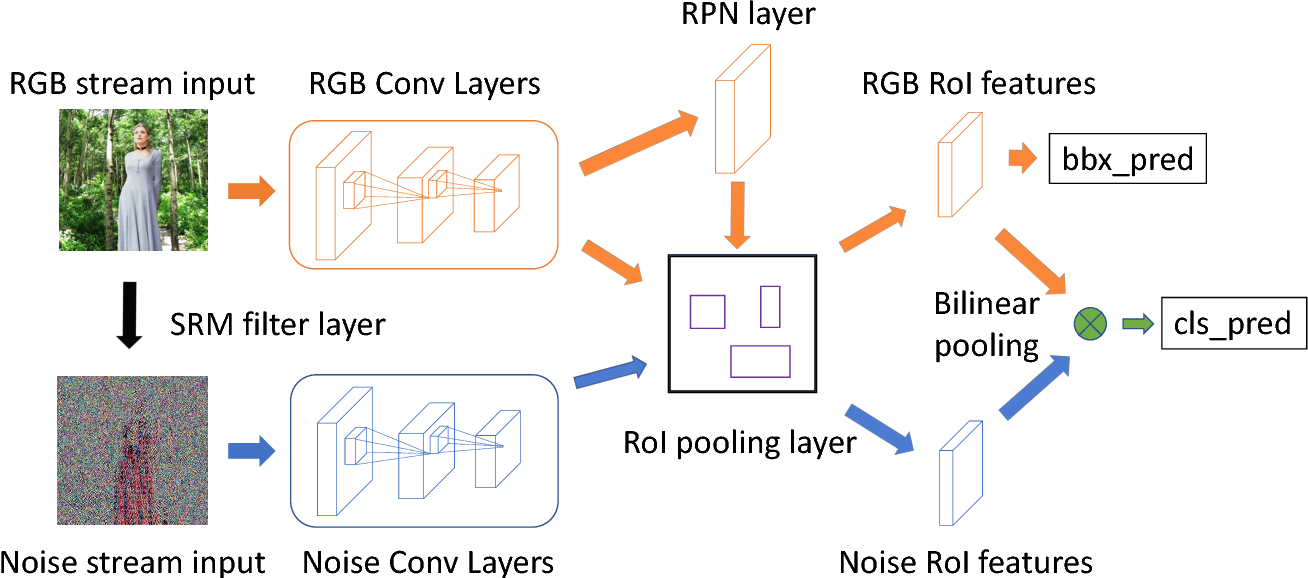\n\n```\nThe RGB stream models visual tampering artifacts, such as unusually\nhigh contrast along object edges, and regresses bounding boxes to the ground-truth. The noise stream first obtains the noise feature map\nby passing input RGB image through an SRM filter layer, and leverages the noise features to provide additional evidence for manipulation\nclassification.\n```\n\n \n```python\ndef setup_srm_weights(input_channels: int = 3) -> torch.Tensor:\n \"\"\"Creates the SRM kernels for noise analysis.\"\"\"\n # note: values taken from Zhou et al., \"Learning Rich Features for Image Manipulation Detection\", CVPR2018\n srm_kernel = torch.from_numpy(np.array([\n [ # srm 1/2 horiz\n [0., 0., 0., 0., 0.], # noqa: E241,E201\n [0., 0., 0., 0., 0.], # noqa: E241,E201\n [0., 1., -2., 1., 0.], # noqa: E241,E201\n [0., 0., 0., 0., 0.], # noqa: E241,E201\n [0., 0., 0., 0., 0.], # noqa: E241,E201\n ], [ # srm 1/4\n [0., 0., 0., 0., 0.], # noqa: E241,E201\n [0., -1., 2., -1., 0.], # noqa: E241,E201\n [0., 2., -4., 2., 0.], # noqa: E241,E201\n [0., -1., 2., -1., 0.], # noqa: E241,E201\n [0., 0., 0., 0., 0.], # noqa: E241,E201\n ], [ # srm 1/12\n [-1., 2., -2., 2., -1.], # noqa: E241,E201\n [2., -6., 8., -6., 2.], # noqa: E241,E201\n [-2., 8., -12., 8., -2.], # noqa: E241,E201\n [2., -6., 8., -6., 2.], # noqa: E241,E201\n [-1., 2., -2., 2., -1.], # noqa: E241,E201\n ]\n ])).float()\n srm_kernel[0] /= 2\n srm_kernel[1] /= 4\n srm_kernel[2] /= 12\n return srm_kernel.view(3, 1, 5, 5).repeat(1, input_channels, 1, 1)\n\n\ndef setup_srm_layer(input_channels: int = 3) -> torch.nn.Module:\n \"\"\"Creates a SRM convolution layer for noise analysis.\"\"\"\n weights = setup_srm_weights(input_channels)\n conv = torch.nn.Conv2d(input_channels, out_channels=3, kernel_size=5, stride=1, padding=2, bias=False)\n with torch.no_grad():\n conv.weight = torch.nn.Parameter(weights, requires_grad=False)\n return conv\n\n```\n\n \n```python\nclass AlaskaClassifierSRM(nn.Module):\n def __init__(self, encoder, dropout_rate=0.5, num_class=4) -> None:\n super().__init__()\n self.encoder = EfficientNet()\n self.avg_pool = AdaptiveAvgPool2d((1, 1))\n self.srm_conv = setup_srm_layer(3)\n self.dropout = Dropout(dropout_rate)\n self.fc = Linear(encoder_params[encoder][\"features\"], num_class)\n \n def forward(self, x):\n noise = self.srm_conv(x)\n x = self.encoder.forward_features(noise)\n x = self.avg_pool(x).flatten(1)\n x = self.dropout(x)\n x = self.fc(x)\n return x\n\n```", "votes": null }, { "id": "920572", "postDate": "07/08/2020 17:17:24", "content": "@bibek777 Thanks for sharing. It's useful.
", "rawMarkdown": "bibek777 Thanks for sharing. It's useful.", "votes": null } ], "comments": [ { "id": 920572, "author_name": "vishnurapps", "author_url": "", "post_date": "07/08/2020 17:17:24", "content": "@bibek777 Thanks for sharing. It's useful.
", "votes": null, "replies": [] } ], "raw_markdown_by_id": { "919054": "Looks Promising ?\n\n\n\n```\nThe RGB stream models visual tampering artifacts, such as unusually\nhigh contrast along object edges, and regresses bounding boxes to the ground-truth. The noise stream first obtains the noise feature map\nby passing input RGB image through an SRM filter layer, and leverages the noise features to provide additional evidence for manipulation\nclassification.\n```\n\n \n```python\ndef setup_srm_weights(input_channels: int = 3) -> torch.Tensor:\n \"\"\"Creates the SRM kernels for noise analysis.\"\"\"\n # note: values taken from Zhou et al., \"Learning Rich Features for Image Manipulation Detection\", CVPR2018\n srm_kernel = torch.from_numpy(np.array([\n [ # srm 1/2 horiz\n [0., 0., 0., 0., 0.], # noqa: E241,E201\n [0., 0., 0., 0., 0.], # noqa: E241,E201\n [0., 1., -2., 1., 0.], # noqa: E241,E201\n [0., 0., 0., 0., 0.], # noqa: E241,E201\n [0., 0., 0., 0., 0.], # noqa: E241,E201\n ], [ # srm 1/4\n [0., 0., 0., 0., 0.], # noqa: E241,E201\n [0., -1., 2., -1., 0.], # noqa: E241,E201\n [0., 2., -4., 2., 0.], # noqa: E241,E201\n [0., -1., 2., -1., 0.], # noqa: E241,E201\n [0., 0., 0., 0., 0.], # noqa: E241,E201\n ], [ # srm 1/12\n [-1., 2., -2., 2., -1.], # noqa: E241,E201\n [2., -6., 8., -6., 2.], # noqa: E241,E201\n [-2., 8., -12., 8., -2.], # noqa: E241,E201\n [2., -6., 8., -6., 2.], # noqa: E241,E201\n [-1., 2., -2., 2., -1.], # noqa: E241,E201\n ]\n ])).float()\n srm_kernel[0] /= 2\n srm_kernel[1] /= 4\n srm_kernel[2] /= 12\n return srm_kernel.view(3, 1, 5, 5).repeat(1, input_channels, 1, 1)\n\n\ndef setup_srm_layer(input_channels: int = 3) -> torch.nn.Module:\n \"\"\"Creates a SRM convolution layer for noise analysis.\"\"\"\n weights = setup_srm_weights(input_channels)\n conv = torch.nn.Conv2d(input_channels, out_channels=3, kernel_size=5, stride=1, padding=2, bias=False)\n with torch.no_grad():\n conv.weight = torch.nn.Parameter(weights, requires_grad=False)\n return conv\n\n```\n\n \n```python\nclass AlaskaClassifierSRM(nn.Module):\n def __init__(self, encoder, dropout_rate=0.5, num_class=4) -> None:\n super().__init__()\n self.encoder = EfficientNet()\n self.avg_pool = AdaptiveAvgPool2d((1, 1))\n self.srm_conv = setup_srm_layer(3)\n self.dropout = Dropout(dropout_rate)\n self.fc = Linear(encoder_params[encoder][\"features\"], num_class)\n \n def forward(self, x):\n noise = self.srm_conv(x)\n x = self.encoder.forward_features(noise)\n x = self.avg_pool(x).flatten(1)\n x = self.dropout(x)\n x = self.fc(x)\n return x\n\n```", "920572": "bibek777 Thanks for sharing. It's useful." }, "source": "meta" }