
Update: Feature importance label fixed (5th June GMT 3 am)
\n\nI select segments from the traning data and create a private-set-like data based on the inter-earthquake times seen in the figure \"Are data from p4677?\"
\n\nmykper: https://www.kaggle.com/c/LANL-Earthquake-Prediction/discussion/90664#latest-535844
\n\n
The dashed line is 11.5 sec.
\n\nThe first segment is counted twice; the private set has 8 segments. The last segment is created from the 14-sec segment and shifted up by 2 seconds, and the last 4.5 second is cut, treating that as the public part.
\n\nI use 32 features:
\n\nI choose combinations such as 95 percentile - 5 percentile to avoid direct dependence on the mean; which is drifting with time. Same for the peak height; the peak height is defined as (max - min)/2.
\n\nThe std_truncated (std instead of kurtosis in kurtosis_truncated) works almost as well as std_nopeak.
\n\nI randomly select 2000x1000 training chunks of length 150_000 from my private-like set, which is 1000 times the number of independent/non-overlapping chunks and put all of them into CatBoost. I do not provide CV data to the regressor; eveything is the training set.
\n\nI also tried to predict time since failure using all the training set and tried to stitch together with time to failure, but I was not able to do that successfully.
\n\nThis is the feature importance:
\n\n
Update: Feature importance label fixed (5th June GMT 3 am)
\n\nI select segments from the traning data and create a private-set-like data based on the inter-earthquake times seen in the figure \"Are data from p4677?\"
\n\nmykper: https://www.kaggle.com/c/LANL-Earthquake-Prediction/discussion/90664#latest-535844
\n\n
The dashed line is 11.5 sec.
\n\nThe first segment is counted twice; the private set has 8 segments. The last segment is created from the 14-sec segment and shifted up by 2 seconds, and the last 4.5 second is cut, treating that as the public part.
\n\nI use 32 features:
\n\nI choose combinations such as 95 percentile - 5 percentile to avoid direct dependence on the mean; which is drifting with time. Same for the peak height; the peak height is defined as (max - min)/2.
\n\nThe std_truncated (std instead of kurtosis in kurtosis_truncated) works almost as well as std_nopeak.
\n\nI randomly select 2000x1000 training chunks of length 150_000 from my private-like set, which is 1000 times the number of independent/non-overlapping chunks and put all of them into CatBoost. I do not provide CV data to the regressor; eveything is the training set.
\n\nI also tried to predict time since failure using all the training set and tried to stitch together with time to failure, but I was not able to do that successfully.
\n\nThis is the feature importance:
\n\n
At first heartily congrats @junkoda and thanks a ton for sharing the solution
", "rawMarkdown": "At first heartily congrats @junkoda and thanks a ton for sharing the solution ", "votes": 4 }, { "id": 542964, "postDate": "2019-06-04T08:36:23.613Z", "content": "Сongratulations!\nHow did you select these features? What was your feature selection/feature generation approach?
", "rawMarkdown": "Сongratulations!\nHow did you select these features? What was your feature selection/feature generation approach?", "votes": 4, "replies": [ { "id": 542987, "postDate": "2019-06-04T08:53:18.253Z", "content": "Umm, that's difficult to answer. I felt there aren't much information we can extract from the acustic data and I felt I have more than enough features to get all the information. This is intuitive, not logical. I did some trial and errors trying more percentiles, switching std_truncated/std_nopeak, but those were manual and not systematic. For FFT, I don't think real, imag, phase are translational invariant; that is, depends on where you choose time 0, so I only use magnitude (abs), but percentiles of abs are reasonable; simply, I forgot trying that. Short answer: intution and some trial and error 😅
", "rawMarkdown": "Umm, that's difficult to answer. I felt there aren't much information we can extract from the acustic data and I felt I have more than enough features to get all the information. This is intuitive, not logical. I did some trial and errors trying more percentiles, switching std_truncated/std_nopeak, but those were manual and not systematic. For FFT, I don't think real, imag, phase are translational invariant; that is, depends on where you choose time 0, so I only use magnitude (abs), but percentiles of abs are reasonable; simply, I forgot trying that. Short answer: intution and some trial and error 😅", "votes": 5 }, { "id": 542990, "postDate": "2019-06-04T08:56:07.647Z", "content": "PS: FFT features are not ranking high in my feature importance, and that is also so in one of the organizers' random-forest paper, so I though FFT features are not effective (which is probably not true)
", "rawMarkdown": "PS: FFT features are not ranking high in my feature importance, and that is also so in one of the organizers' random-forest paper, so I though FFT features are not effective (which is probably not true)", "votes": 2 }, { "id": 543017, "postDate": "2019-06-04T09:20:48.627Z", "content": "FFT features did not do much for my score, but then the score isn't very reliable :)
\n\nIntuitively, I suspected using Wavelets is the right way to go but I wasn't sure how to apply them.
", "rawMarkdown": "FFT features did not do much for my score, but then the score isn't very reliable :)\n\nIntuitively, I suspected using Wavelets is the right way to go but I wasn't sure how to apply them.", "votes": 2 }, { "id": 544017, "postDate": "2019-06-05T03:25:00.280Z", "content": "I fixed the feature importance ordering. FFT features (power spectrum power n) are working. I saw somewhere that low-frequency power spectrum is an intererting feature near the earthquake, and the high rank of power0 confirms that.
", "rawMarkdown": "I fixed the feature importance ordering. FFT features (power spectrum power n) are working. I saw somewhere that low-frequency power spectrum is an intererting feature near the earthquake, and the high rank of power0 confirms that.", "votes": 1 } ] }, { "id": 542912, "postDate": "2019-06-04T07:25:03.573Z", "content": "Congrats! You did well also in VSB Power Line Fault Detection. I feel you're really great because you always make such robust model.
\n\nI'd like to ask one thing: Have you tried other machine learning algorithm like LightGBM/XGboost? If there is a reason why you use Catboost, I want to know.
", "rawMarkdown": "Congrats! You did well also in [VSB Power Line Fault Detection](https://www.kaggle.com/c/vsb-power-line-fault-detection). I feel you're really great because you always make such robust model. \n\nI'd like to ask one thing: Have you tried other machine learning algorithm like LightGBM/XGboost? If there is a reason why you use Catboost, I want to know.", "votes": 4, "replies": [ { "id": 542931, "postDate": "2019-06-04T08:00:53.263Z", "content": "Thank you! Seems I have a strong will and not moved by the Public Leaderboard score. No, I didn't mix with other gradient-boosting results; I will do so next time because I would regret if I did not do so and lost by a score like 0.001. I did not expect such small differences in the prize zone. No reason using Catboost, it was simply the first gradient boosting library I saw in a public kernel. 🐣
", "rawMarkdown": "Thank you! Seems I have a strong will and not moved by the Public Leaderboard score. No, I didn't mix with other gradient-boosting results; I will do so next time because I would regret if I did not do so and lost by a score like 0.001. I did not expect such small differences in the prize zone. No reason using Catboost, it was simply the first gradient boosting library I saw in a public kernel. 🐣", "votes": 6 }, { "id": 542981, "postDate": "2019-06-04T08:50:37.843Z", "content": "I tried a few gradient boosters with my kernel template. For reference, I used this to give insight into the different gradient boosters:\nCatBoost vs Light GBM vs XGBoost.
\n\nXGBoost performed the best. With the same features, and only changing the booster, Cat Boost achieved 2.34994, while XGBoost managed a public score of 1.60521.
\n\nHope this helps!
", "rawMarkdown": "I tried a few gradient boosters with my kernel template. For reference, I used this to give insight into the different gradient boosters:\n[CatBoost vs Light GBM vs XGBoost](https://towardsdatascience.com/catboost-vs-light-gbm-vs-xgboost-5f93620723db).\n\nXGBoost performed the best. With the same features, and only changing the booster, Cat Boost achieved 2.34994, while XGBoost managed a public score of 1.60521.\n\nHope this helps!", "votes": -1 } ] }, { "id": 543990, "postDate": "2019-06-05T02:32:34.943Z", "content": "Congratulation for the 2nd place and sharing your thoughts, this post truly gave me a deep understanding!
", "rawMarkdown": "Congratulation for the 2nd place and sharing your thoughts, this post truly gave me a deep understanding!", "votes": 1 }, { "id": 543864, "postDate": "2019-06-04T22:29:38.887Z", "content": "Congrats on the result. I'm totally new to this and I really learn a lot from your post.
", "rawMarkdown": "Congrats on the result. I'm totally new to this and I really learn a lot from your post.", "votes": 1 }, { "id": 543081, "postDate": "2019-06-04T10:16:16.430Z", "content": "Congrats on the result and the method!
", "rawMarkdown": "Congrats on the result and the method!", "votes": 1 }, { "id": 543580, "postDate": "2019-06-04T15:51:09.203Z", "content": "Did you tried Lightgbm or Xgboost on your solution ?
", "rawMarkdown": "Did you tried Lightgbm or Xgboost on your solution ?", "votes": 2, "replies": [ { "id": 543975, "postDate": "2019-06-05T02:11:27.957Z", "content": "No. I have installed them..., but I mistakenly remember the deadline for 1 week and didn't have time for the stacking phase. Default parameter CatBoost single model 😅
", "rawMarkdown": "No. I have installed them..., but I mistakenly remember the deadline for 1 week and didn't have time for the stacking phase. Default parameter CatBoost single model 😅", "votes": 2 } ] }, { "id": 543227, "postDate": "2019-06-04T11:53:08.093Z", "content": "Congrats! \nThe idea of tweaking the training data to create virtual test set is interesting.
", "rawMarkdown": "Congrats! \nThe idea of tweaking the training data to create virtual test set is interesting.", "votes": 2 }, { "id": 542895, "postDate": "2019-06-04T07:08:59.007Z", "content": "Congratulations! Thank you for the update and for explaining your solution!
", "rawMarkdown": "Congratulations! Thank you for the update and for explaining your solution!", "votes": 2 }, { "id": 542869, "postDate": "2019-06-04T06:44:00.133Z", "content": "Well done!
", "rawMarkdown": "Well done!", "votes": 2 }, { "id": 542850, "postDate": "2019-06-04T06:32:05.450Z", "content": "Congrats!
", "rawMarkdown": "Congrats!", "votes": 2 }, { "id": 547184, "postDate": "2019-06-07T11:28:59.483Z", "content": "Congratulation for the solution and 2nd place ! \nWhat exactly means that \"14-sec segment and shifted up by 2 seconds\" ? You just simply added 2 sec or did you do something more fancy ?
", "rawMarkdown": "Congratulation for the solution and 2nd place ! \nWhat exactly means that \"14-sec segment and shifted up by 2 seconds\" ? You just simply added 2 sec or did you do something more fancy ?", "replies": [ { "id": 547200, "postDate": "2019-06-07T11:55:39.273Z", "content": "Thanks. Exaclty, just added 2.* something to the time to failure.
", "rawMarkdown": "Thanks. Exaclty, just added 2.* something to the time to failure.", "votes": 1 } ] }, { "id": 545951, "postDate": "2019-06-06T04:42:03.473Z", "content": "Congratulations on the position and thanks for sharing!
", "rawMarkdown": "Congratulations on the position and thanks for sharing!" }, { "id": 543982, "postDate": "2019-06-05T02:16:21.763Z", "content": "Congratulations @junkoda. Thank you for sharing.
", "rawMarkdown": "Congratulations @junkoda. Thank you for sharing. " }, { "id": 543579, "postDate": "2019-06-04T15:50:12.727Z", "content": "Congrats @junkoda and thanks for sharing.
", "rawMarkdown": "Congrats @junkoda and thanks for sharing. " }, { "id": 544077, "postDate": "2019-06-05T05:14:58.200Z", "rawMarkdown": "", "votes": 2, "isDeleted": true }, { "id": 542968, "postDate": "2019-06-04T08:40:52.090Z", "content": "Thanks for sharing! Good job!
", "rawMarkdown": "Thanks for sharing! Good job!", "votes": 1 }, { "id": 542945, "postDate": "2019-06-04T08:11:57.570Z", "content": "Congrats and thanks for sharing !
", "rawMarkdown": "Congrats and thanks for sharing !", "votes": 1 }, { "id": 543568, "postDate": "2019-06-04T15:45:04.120Z", "content": "Great job!\nThanks for sharing.
", "rawMarkdown": "Great job!\nThanks for sharing." }, { "id": 543124, "postDate": "2019-06-04T10:42:27.667Z", "content": "Great work! Thanks for sharing.
", "rawMarkdown": "Great work! Thanks for sharing." }, { "id": 543087, "postDate": "2019-06-04T10:19:20.613Z", "content": "Thank you for sharing.\nCongratulations!
", "rawMarkdown": "Thank you for sharing.\nCongratulations!" }, { "id": 543043, "postDate": "2019-06-04T09:46:06.583Z", "content": "Congrats! Thanks for sharing :)
", "rawMarkdown": "Congrats! Thanks for sharing :)" } ], "comments": [ { "id": 564291, "author_name": "Raju Kumar Mishra", "author_url": "", "post_date": "2019-06-29T08:42:26.190000", "content": "At first heartily congrats @junkoda and thanks a ton for sharing the solution
", "votes": 4, "replies": [] }, { "id": 542964, "author_name": "Nickolay Safronov", "author_url": "", "post_date": "2019-06-04T08:36:23.613000", "content": "Сongratulations!\nHow did you select these features? What was your feature selection/feature generation approach?
", "votes": 4, "replies": [ { "id": 542987, "author_name": "🐢 Jun Koda", "author_url": "", "post_date": "2019-06-04T08:53:18.253000", "content": "Umm, that's difficult to answer. I felt there aren't much information we can extract from the acustic data and I felt I have more than enough features to get all the information. This is intuitive, not logical. I did some trial and errors trying more percentiles, switching std_truncated/std_nopeak, but those were manual and not systematic. For FFT, I don't think real, imag, phase are translational invariant; that is, depends on where you choose time 0, so I only use magnitude (abs), but percentiles of abs are reasonable; simply, I forgot trying that. Short answer: intution and some trial and error 😅
", "votes": 5, "replies": [] }, { "id": 542990, "author_name": "🐢 Jun Koda", "author_url": "", "post_date": "2019-06-04T08:56:07.647000", "content": "PS: FFT features are not ranking high in my feature importance, and that is also so in one of the organizers' random-forest paper, so I though FFT features are not effective (which is probably not true)
", "votes": 2, "replies": [] }, { "id": 543017, "author_name": "DevilEars", "author_url": "", "post_date": "2019-06-04T09:20:48.627000", "content": "FFT features did not do much for my score, but then the score isn't very reliable :)
\n\nIntuitively, I suspected using Wavelets is the right way to go but I wasn't sure how to apply them.
", "votes": 2, "replies": [] }, { "id": 544017, "author_name": "🐢 Jun Koda", "author_url": "", "post_date": "2019-06-05T03:25:00.280000", "content": "I fixed the feature importance ordering. FFT features (power spectrum power n) are working. I saw somewhere that low-frequency power spectrum is an intererting feature near the earthquake, and the high rank of power0 confirms that.
", "votes": 1, "replies": [] } ] }, { "id": 542912, "author_name": "u++", "author_url": "", "post_date": "2019-06-04T07:25:03.573000", "content": "Congrats! You did well also in VSB Power Line Fault Detection. I feel you're really great because you always make such robust model.
\n\nI'd like to ask one thing: Have you tried other machine learning algorithm like LightGBM/XGboost? If there is a reason why you use Catboost, I want to know.
", "votes": 4, "replies": [ { "id": 542931, "author_name": "🐢 Jun Koda", "author_url": "", "post_date": "2019-06-04T08:00:53.263000", "content": "Thank you! Seems I have a strong will and not moved by the Public Leaderboard score. No, I didn't mix with other gradient-boosting results; I will do so next time because I would regret if I did not do so and lost by a score like 0.001. I did not expect such small differences in the prize zone. No reason using Catboost, it was simply the first gradient boosting library I saw in a public kernel. 🐣
", "votes": 6, "replies": [] }, { "id": 542981, "author_name": "DevilEars", "author_url": "", "post_date": "2019-06-04T08:50:37.843000", "content": "I tried a few gradient boosters with my kernel template. For reference, I used this to give insight into the different gradient boosters:\nCatBoost vs Light GBM vs XGBoost.
\n\nXGBoost performed the best. With the same features, and only changing the booster, Cat Boost achieved 2.34994, while XGBoost managed a public score of 1.60521.
\n\nHope this helps!
", "votes": -1, "replies": [] } ] }, { "id": 543990, "author_name": "Beans", "author_url": "", "post_date": "2019-06-05T02:32:34.943000", "content": "Congratulation for the 2nd place and sharing your thoughts, this post truly gave me a deep understanding!
", "votes": 1, "replies": [] }, { "id": 543864, "author_name": "Ziteng Pang", "author_url": "", "post_date": "2019-06-04T22:29:38.887000", "content": "Congrats on the result. I'm totally new to this and I really learn a lot from your post.
", "votes": 1, "replies": [] }, { "id": 543081, "author_name": "CPMP", "author_url": "", "post_date": "2019-06-04T10:16:16.430000", "content": "Congrats on the result and the method!
", "votes": 1, "replies": [] }, { "id": 543580, "author_name": "Giba", "author_url": "", "post_date": "2019-06-04T15:51:09.203000", "content": "Did you tried Lightgbm or Xgboost on your solution ?
", "votes": 2, "replies": [ { "id": 543975, "author_name": "🐢 Jun Koda", "author_url": "", "post_date": "2019-06-05T02:11:27.957000", "content": "No. I have installed them..., but I mistakenly remember the deadline for 1 week and didn't have time for the stacking phase. Default parameter CatBoost single model 😅
", "votes": 2, "replies": [] } ] }, { "id": 543227, "author_name": "corochann", "author_url": "", "post_date": "2019-06-04T11:53:08.093000", "content": "Congrats! \nThe idea of tweaking the training data to create virtual test set is interesting.
", "votes": 2, "replies": [] }, { "id": 542895, "author_name": "DevilEars", "author_url": "", "post_date": "2019-06-04T07:08:59.007000", "content": "Congratulations! Thank you for the update and for explaining your solution!
", "votes": 2, "replies": [] }, { "id": 542869, "author_name": "Yassine Alouini", "author_url": "", "post_date": "2019-06-04T06:44:00.133000", "content": "Well done!
", "votes": 2, "replies": [] }, { "id": 542850, "author_name": "Timmmmmms", "author_url": "", "post_date": "2019-06-04T06:32:05.450000", "content": "Congrats!
", "votes": 2, "replies": [] }, { "id": 547184, "author_name": "rafzy", "author_url": "", "post_date": "2019-06-07T11:28:59.483000", "content": "Congratulation for the solution and 2nd place ! \nWhat exactly means that \"14-sec segment and shifted up by 2 seconds\" ? You just simply added 2 sec or did you do something more fancy ?
", "votes": 0, "replies": [ { "id": 547200, "author_name": "🐢 Jun Koda", "author_url": "", "post_date": "2019-06-07T11:55:39.273000", "content": "Thanks. Exaclty, just added 2.* something to the time to failure.
", "votes": 1, "replies": [] } ] }, { "id": 545951, "author_name": "Ricard Delgado", "author_url": "", "post_date": "2019-06-06T04:42:03.473000", "content": "Congratulations on the position and thanks for sharing!
", "votes": 0, "replies": [] }, { "id": 543982, "author_name": "Massoud Hosseinali", "author_url": "", "post_date": "2019-06-05T02:16:21.763000", "content": "Congratulations @junkoda. Thank you for sharing.
", "votes": 0, "replies": [] }, { "id": 543579, "author_name": "Giba", "author_url": "", "post_date": "2019-06-04T15:50:12.727000", "content": "Congrats @junkoda and thanks for sharing.
", "votes": 0, "replies": [] }, { "id": 544077, "author_name": "", "author_url": "", "post_date": "2019-06-05T05:14:58.200000", "content": "", "votes": 2, "replies": [] }, { "id": 542968, "author_name": "Stanislav Blinov", "author_url": "", "post_date": "2019-06-04T08:40:52.090000", "content": "Thanks for sharing! Good job!
", "votes": 1, "replies": [] }, { "id": 542945, "author_name": "Wonho Song", "author_url": "", "post_date": "2019-06-04T08:11:57.570000", "content": "Congrats and thanks for sharing !
", "votes": 1, "replies": [] }, { "id": 543568, "author_name": "Eric Vos", "author_url": "", "post_date": "2019-06-04T15:45:04.120000", "content": "Great job!\nThanks for sharing.
", "votes": 0, "replies": [] }, { "id": 543124, "author_name": "Karan Jakhar", "author_url": "", "post_date": "2019-06-04T10:42:27.667000", "content": "Great work! Thanks for sharing.
", "votes": 0, "replies": [] }, { "id": 543087, "author_name": "mocobt", "author_url": "", "post_date": "2019-06-04T10:19:20.613000", "content": "Thank you for sharing.\nCongratulations!
", "votes": 0, "replies": [] }, { "id": 543043, "author_name": "Prashanth Thangavel", "author_url": "", "post_date": "2019-06-04T09:46:06.583000", "content": "Congrats! Thanks for sharing :)
", "votes": 0, "replies": [] } ], "raw_markdown_by_id": { "542827": "Update: Feature importance label fixed (5th June GMT 3 am) \n\nI select segments from the traning data and create a private-set-like data based on the inter-earthquake times seen in the figure \"Are data from p4677?\"\n\nmykper: https://www.kaggle.com/c/LANL-Earthquake-Prediction/discussion/90664#latest-535844\n\n\n\nThe dashed line is 11.5 sec.\n\nThe first segment is counted twice; the private set has 8 segments. The last segment is created from the 14-sec segment and shifted up by 2 seconds, and the last 4.5 second is cut, treating that as the public part.\n\nI use 32 features:\n\n- standard deviation (std)\n- std_nopeak: Std of data that are not part of peaks\n- kurtosis_truncated: Kurtosis of data with abs(v - mean(v)) < 20\n- 7 peak counts: Number of peaks with hight > 50, 75, ..., 200\n- 5 percentiles: 95 percentile - 5 percentile, 80 - 20, 70 - 30, 60 - 40.\n- trend: slope of robust linear regression to 30 sub chunks of std_truncated\n- trend_error: Abs difference in the slope of RANSAC and Huber fit\n- power spectrum; Fast-Fourier Transform the data and average the absolute value in 15 bins\n\nI choose combinations such as 95 percentile - 5 percentile to avoid direct dependence on the mean; which is drifting with time. Same for the peak height; the peak height is defined as (max - min)/2.\n\nThe std_truncated (std instead of kurtosis in kurtosis_truncated) works almost as well as std_nopeak.\n\n\nI randomly select 2000x1000 training chunks of length 150_000 from my private-like set, which is 1000 times the number of independent/non-overlapping chunks and put all of them into CatBoost. I do not provide CV data to the regressor; eveything is the training set.\n\n\nI also tried to predict time since failure using all the training set and tried to stitch together with time to failure, but I was not able to do that successfully.\n\nThis is the feature importance:\n\n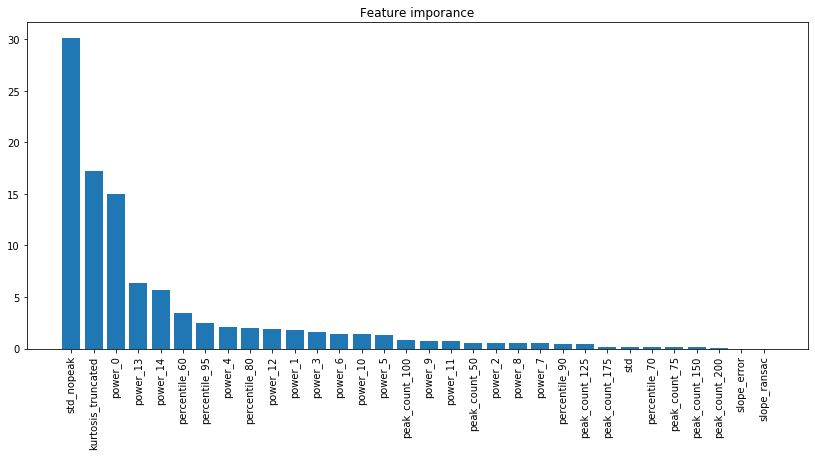", "564291": "At first heartily congrats @junkoda and thanks a ton for sharing the solution ", "542964": "Сongratulations!\nHow did you select these features? What was your feature selection/feature generation approach?", "542912": "Congrats! You did well also in [VSB Power Line Fault Detection](https://www.kaggle.com/c/vsb-power-line-fault-detection). I feel you're really great because you always make such robust model. \n\nI'd like to ask one thing: Have you tried other machine learning algorithm like LightGBM/XGboost? If there is a reason why you use Catboost, I want to know.", "543990": "Congratulation for the 2nd place and sharing your thoughts, this post truly gave me a deep understanding!", "543864": "Congrats on the result. I'm totally new to this and I really learn a lot from your post.", "543081": "Congrats on the result and the method!", "543580": "Did you tried Lightgbm or Xgboost on your solution ?", "543227": "Congrats! \nThe idea of tweaking the training data to create virtual test set is interesting.", "542895": "Congratulations! Thank you for the update and for explaining your solution!", "542869": "Well done!", "542850": "Congrats!", "547184": "Congratulation for the solution and 2nd place ! \nWhat exactly means that \"14-sec segment and shifted up by 2 seconds\" ? You just simply added 2 sec or did you do something more fancy ?", "545951": "Congratulations on the position and thanks for sharing!", "543982": "Congratulations @junkoda. Thank you for sharing. ", "543579": "Congrats @junkoda and thanks for sharing. ", "544077": "", "542968": "Thanks for sharing! Good job!", "542945": "Congrats and thanks for sharing !", "543568": "Great job!\nThanks for sharing.", "543124": "Great work! Thanks for sharing.", "543087": "Thank you for sharing.\nCongratulations!", "543043": "Congrats! Thanks for sharing :)" } }