I have been tuning parameters based on Vettejeep's kernel and discovered something incomprehensible.
\n\nI tuned the parameters one by one and observed the connection with CV and LB. When I use XGB, tuning parameters like \"learning_rate\" and \"max_depth\" can give me a better CV and LB score. However when I use LGB, there appears to be almost no correlation between CV and LB, parameters with low CV score gets high score in LB.
\n\nIn addition, I found great CV by tuning \"num_features\" always got bad LB, both using XGB and LGB. These phenomena distressed me because without decrease in LB I can't be convinced these parameters are better.
\n\nHas anyone encountered a similar situation? I'm not familiar with principles of XGB and LGB, can anyone explain these phenomenon? Thanks!
", "messages": [ { "id": "535804", "postDate": "05/23/2019 13:24:14", "content": "I have been tuning parameters based on Vettejeep's kernel and discovered something incomprehensible.
\n\nI tuned the parameters one by one and observed the connection with CV and LB. When I use XGB, tuning parameters like \"learning_rate\" and \"max_depth\" can give me a better CV and LB score. However when I use LGB, there appears to be almost no correlation between CV and LB, parameters with low CV score gets high score in LB.
\n\nIn addition, I found great CV by tuning \"num_features\" always got bad LB, both using XGB and LGB. These phenomena distressed me because without decrease in LB I can't be convinced these parameters are better.
\n\nHas anyone encountered a similar situation? I'm not familiar with principles of XGB and LGB, can anyone explain these phenomenon? Thanks!
", "rawMarkdown": "I have been tuning parameters based on [Vettejeep's kernel](https://www.kaggle.com/vettejeep/masters-final-project-model-lb-1-392) and discovered something incomprehensible. \n\nI tuned the parameters one by one and observed the connection with CV and LB. When I use XGB, tuning parameters like \"learning\\_rate\" and \"max\\_depth\" can give me a better CV and LB score. However when I use LGB, there appears to be almost no correlation between CV and LB, parameters with low CV score gets high score in LB.\n\nIn addition, I found great CV by tuning \"num\\_features\" always got bad LB, both using XGB and LGB. These phenomena distressed me because without decrease in LB I can't be convinced these parameters are better.\n\nHas anyone encountered a similar situation? I'm not familiar with principles of XGB and LGB, can anyone explain these phenomenon? Thanks!", "votes": null }, { "id": "535819", "postDate": "05/23/2019 13:43:31", "content": "I always found xgb easier to tune than lgb. I can't comment on your case as I did not use the code you start from, but I'm not that surprised.
", "rawMarkdown": "I always found xgb easier to tune than lgb. I can't comment on your case as I did not use the code you start from, but I'm not that surprised.", "votes": null }, { "id": "535835", "postDate": "05/23/2019 13:54:13", "content": "@wanliyu you may find this article helpful https://towardsdatascience.com/catboost-vs-light-gbm-vs-xgboost-5f93620723db
\n\n\n\nanother topic in this competition you may find relevant.https://www.kaggle.com/c/LANL-Earthquake-Prediction/discussion/89909#latest-520304 .
", "rawMarkdown": "wanliyu you may find this article helpful https://towardsdatascience.com/catboost-vs-light-gbm-vs-xgboost-5f93620723db\n\n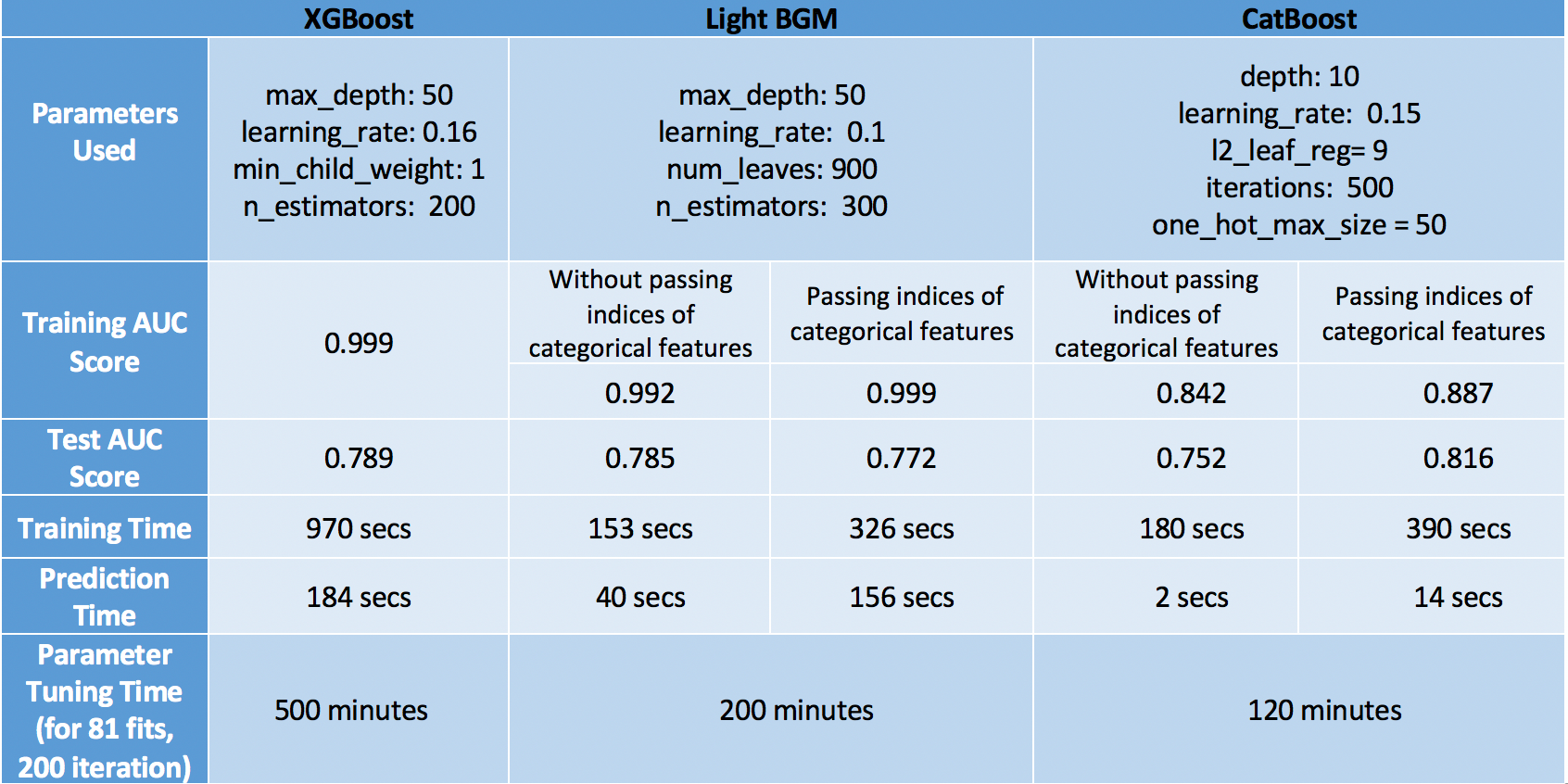\n\nanother topic in this competition you may find relevant.https://www.kaggle.com/c/LANL-Earthquake-Prediction/discussion/89909#latest-520304 .", "votes": null }, { "id": "535847", "postDate": "05/23/2019 14:10:35", "content": "This article is crap. Parameters are tuned for overfitting.
\n\nFor instance having both max depth 50 and min child weight 1 for xgb is just stupid. You can see it with a very clear overfit to training data. And this large depth results in way too long running times.
", "rawMarkdown": "This article is crap. Parameters are tuned for overfitting.\n\nFor instance having both max depth 50 and min child weight 1 for xgb is just stupid. You can see it with a very clear overfit to training data. And this large depth results in way too long running times.", "votes": null }, { "id": "535874", "postDate": "05/23/2019 15:05:05", "content": "I have experienced the similar issues. With 65 features and 1.89 for 8 fold cv my LB is 1.55 but with 200 features and 1.98 cv my LB is under 1.4.
", "rawMarkdown": "I have experienced the similar issues. With 65 features and 1.89 for 8 fold cv my LB is 1.55 but with 200 features and 1.98 cv my LB is under 1.4.", "votes": null }, { "id": "535878", "postDate": "05/23/2019 15:11:17", "content": "Do you have the same opinion for people who use max_depth= -1? I ask, because -1 depth means there is no limit, i.e. max_depth = +infinity. Is it considered bad practice to have depth of -1?
It depends if you have other parameters for regularization. If you use max_depth -1 with min child weight 1 then it is the worst possible case. Both parameters are the main parameters to use to limit model complexity.
", "rawMarkdown": "It depends if you have other parameters for regularization. If you use max_depth -1 with min child weight 1 then it is the worst possible case. Both parameters are the main parameters to use to limit model complexity.", "votes": null }, { "id": "535883", "postDate": "05/23/2019 15:14:40", "content": "For lgb replace max depth by num leaves as the main complexity controlling parameter.
", "rawMarkdown": "For lgb replace max depth by num leaves as the main complexity controlling parameter.", "votes": null }, { "id": "535887", "postDate": "05/23/2019 15:21:03", "content": "Why do you think num leaves is the main complexity controlling parameter in lgbm, instead of max depth?
", "rawMarkdown": "Why do you think num leaves is the main complexity controlling parameter in lgbm, instead of max depth?", "votes": null }, { "id": "535891", "postDate": "05/23/2019 15:24:06", "content": "Because it is written in lgb documentation, see https://lightgbm.readthedocs.io/en/latest/Parameters-Tuning.html.
", "rawMarkdown": "Because it is written in lgb documentation, see https://lightgbm.readthedocs.io/en/latest/Parameters-Tuning.html.", "votes": null }, { "id": "535900", "postDate": "05/23/2019 15:38:04", "content": "@returnofsputnik lightgbm grows the tree with a \"leaf-wise\" approach, as opposed to xgboost which utilises a \"depth-wise\" approach. This is the reason why num_leaves should be the parameter to tune for lightgbm
", "rawMarkdown": "returnofsputnik lightgbm grows the tree with a \"leaf-wise\" approach, as opposed to xgboost which utilises a \"depth-wise\" approach. This is the reason why num_leaves should be the parameter to tune for lightgbm", "votes": null }, { "id": "535921", "postDate": "05/23/2019 16:19:05", "content": "I used LGB configured as follow:
\n\nmodel = lgb.LGBMRegressor(\n num_leaves=10,
\n min_child_samples=9,
\n objective='gamma',
\n max_depth= 4,
\n learning_rate= 0.001,\n boosting_type= \"gbdt\", \n metric= 'mae',\n reg_alpha=1,\n reg_lambda =1, \n verbosity= -1,\n random_state= 11, \n n_estimators = 50_000, \n n_jobs = -1)
model.fit(X_tr, \n y_tr, \n eval_set=[(X_tr, y_tr), (X_val, y_val)], \n eval_metric='mae',\n verbose=10000, \n early_stopping_rounds=500,\n )
I select parameters after doing some test, and now i do not change them until i have a mature model, i explain:
\n\n\n\n\n\n
objective='gamma'
Gamma distribution is sometimes used to model the waiting times in statistical process (ex queue theory).\nHere I do not kwow if all the hipothesys for a gamma distributition are true, but i have assumed (all here is an absumption :-)
\n\nI have a little hardware, so i work with 4k of samples, and less than 30 features, so i have found this trade off:
\n\n\n\n\n\n
num_leaves=10,
\n     min_child_samples=9,
\n     max_depth= 4,
this parameters are control of complexity: Little trees, but not with a high \nmin_child_samples, because with my features, i have find that \nthere are some situation that are predicted better.
\n\n\n\n\n\n
learning_rate= 0.001,
you have to tune for the accuracy of the model
\n\n\n\n\n\n
reg_alpha=1,\n reg_lambda =1,
regularization, i find that this value are acceptable, i think i'll tune them at the end
\n\n\n\n\n\n
early_stopping_rounds=500,
very good (and fast) in my opinion!
\n\nI hope it is useful.
", "rawMarkdown": "I used LGB configured as follow:\n\n`model = lgb.LGBMRegressor(\n num_leaves=10, \n min_child_samples=9, \n objective='gamma', \n max_depth= 4, \n learning_rate= 0.001,\n boosting_type= \"gbdt\", \n metric= 'mae',\n reg_alpha=1,\n reg_lambda =1, \n verbosity= -1,\n random_state= 11, \n n_estimators = 50_000, \n n_jobs = -1)`\n\n`model.fit(X_tr, \n y_tr, \n eval_set=[(X_tr, y_tr), (X_val, y_val)], \n eval_metric='mae',\n verbose=10000, \n early_stopping_rounds=500,\n )`\n\n\nI select parameters after doing some test, and now i do not change them until i have a mature model, i explain:\n\n> `objective='gamma'`\n\nGamma distribution is sometimes used to model the waiting times in statistical process (ex queue theory).\nHere I do not kwow if all the hipothesys for a gamma distributition are true, but i have assumed (all here is an absumption :-)\n\nI have a little hardware, so i work with 4k of samples, and less than 30 features, so i have found this trade off:\n> `num_leaves=10, \n min_child_samples=9, \n max_depth= 4,` \n\nthis parameters are control of complexity: Little trees, but not with a high \nmin_child_samples, because with my features, i have find that \nthere are some situation that are predicted better.\n\n> `learning_rate= 0.001,`\n\nyou have to tune for the accuracy of the model\n\n> `reg_alpha=1,\n reg_lambda =1,` \n\nregularization, i find that this value are acceptable, i think i'll tune them at the end\n\n> `early_stopping_rounds=500,`\n\nvery good (and fast) in my opinion!\n\nI hope it is useful.", "votes": null }, { "id": "536107", "postDate": "05/24/2019 01:06:37", "content": "It is useful, thank you very much.
", "rawMarkdown": "It is useful, thank you very much.", "votes": null }, { "id": "536846", "postDate": "05/25/2019 12:11:08", "content": "For reference, the LGB num_leaves parameters scales at 2**max_depth. So the LGB equivalent of max_depth=50 in XGB would be num_leaves over 1.125e15! Both their docs, and common sense, indicate that num_leaves should be much, much lower than this to avoid overfitting. Not to mention the runtime and RAM usage...
", "rawMarkdown": "For reference, the LGB num_leaves parameters scales at 2**max_depth. So the LGB equivalent of max_depth=50 in XGB would be num_leaves over 1.125e15! Both their docs, and common sense, indicate that num_leaves should be much, much lower than this to avoid overfitting. Not to mention the runtime and RAM usage...", "votes": null }, { "id": "536865", "postDate": "05/25/2019 13:44:43", "content": "Number of leaves cannot exceed the number of samples, therefore a very high limit means no limit.
", "rawMarkdown": "Number of leaves cannot exceed the number of samples, therefore a very high limit means no limit.", "votes": null } ], "comments": [ { "id": 535819, "author_name": "cpmpml", "author_url": "", "post_date": "05/23/2019 13:43:31", "content": "I always found xgb easier to tune than lgb. I can't comment on your case as I did not use the code you start from, but I'm not that surprised.
", "votes": null, "replies": [] }, { "id": 535835, "author_name": "cyberia", "author_url": "", "post_date": "05/23/2019 13:54:13", "content": "@wanliyu you may find this article helpful https://towardsdatascience.com/catboost-vs-light-gbm-vs-xgboost-5f93620723db
\n\n\n\nanother topic in this competition you may find relevant.https://www.kaggle.com/c/LANL-Earthquake-Prediction/discussion/89909#latest-520304 .
", "votes": null, "replies": [ { "id": 535847, "author_name": "cpmpml", "author_url": "", "post_date": "05/23/2019 14:10:35", "content": "This article is crap. Parameters are tuned for overfitting.
\n\nFor instance having both max depth 50 and min child weight 1 for xgb is just stupid. You can see it with a very clear overfit to training data. And this large depth results in way too long running times.
", "votes": null, "replies": [] }, { "id": 535878, "author_name": "returnofsputnik", "author_url": "", "post_date": "05/23/2019 15:11:17", "content": "Do you have the same opinion for people who use max_depth= -1? I ask, because -1 depth means there is no limit, i.e. max_depth = +infinity. Is it considered bad practice to have depth of -1?
It depends if you have other parameters for regularization. If you use max_depth -1 with min child weight 1 then it is the worst possible case. Both parameters are the main parameters to use to limit model complexity.
", "votes": null, "replies": [] }, { "id": 535883, "author_name": "cpmpml", "author_url": "", "post_date": "05/23/2019 15:14:40", "content": "For lgb replace max depth by num leaves as the main complexity controlling parameter.
", "votes": null, "replies": [] }, { "id": 535887, "author_name": "returnofsputnik", "author_url": "", "post_date": "05/23/2019 15:21:03", "content": "Why do you think num leaves is the main complexity controlling parameter in lgbm, instead of max depth?
", "votes": null, "replies": [] }, { "id": 535891, "author_name": "cpmpml", "author_url": "", "post_date": "05/23/2019 15:24:06", "content": "Because it is written in lgb documentation, see https://lightgbm.readthedocs.io/en/latest/Parameters-Tuning.html.
", "votes": null, "replies": [] }, { "id": 535900, "author_name": "stecasasso", "author_url": "", "post_date": "05/23/2019 15:38:04", "content": "@returnofsputnik lightgbm grows the tree with a \"leaf-wise\" approach, as opposed to xgboost which utilises a \"depth-wise\" approach. This is the reason why num_leaves should be the parameter to tune for lightgbm
", "votes": null, "replies": [] }, { "id": 536846, "author_name": "bigironsphere", "author_url": "", "post_date": "05/25/2019 12:11:08", "content": "For reference, the LGB num_leaves parameters scales at 2**max_depth. So the LGB equivalent of max_depth=50 in XGB would be num_leaves over 1.125e15! Both their docs, and common sense, indicate that num_leaves should be much, much lower than this to avoid overfitting. Not to mention the runtime and RAM usage...
", "votes": null, "replies": [] }, { "id": 536865, "author_name": "cpmpml", "author_url": "", "post_date": "05/25/2019 13:44:43", "content": "Number of leaves cannot exceed the number of samples, therefore a very high limit means no limit.
", "votes": null, "replies": [] } ] }, { "id": 535874, "author_name": "siavrez", "author_url": "", "post_date": "05/23/2019 15:05:05", "content": "I have experienced the similar issues. With 65 features and 1.89 for 8 fold cv my LB is 1.55 but with 200 features and 1.98 cv my LB is under 1.4.
", "votes": null, "replies": [] }, { "id": 535921, "author_name": "bellofilippo", "author_url": "", "post_date": "05/23/2019 16:19:05", "content": "I used LGB configured as follow:
\n\nmodel = lgb.LGBMRegressor(\n num_leaves=10,
\n min_child_samples=9,
\n objective='gamma',
\n max_depth= 4,
\n learning_rate= 0.001,\n boosting_type= \"gbdt\", \n metric= 'mae',\n reg_alpha=1,\n reg_lambda =1, \n verbosity= -1,\n random_state= 11, \n n_estimators = 50_000, \n n_jobs = -1)
model.fit(X_tr, \n y_tr, \n eval_set=[(X_tr, y_tr), (X_val, y_val)], \n eval_metric='mae',\n verbose=10000, \n early_stopping_rounds=500,\n )
I select parameters after doing some test, and now i do not change them until i have a mature model, i explain:
\n\n\n\n\n\n
objective='gamma'
Gamma distribution is sometimes used to model the waiting times in statistical process (ex queue theory).\nHere I do not kwow if all the hipothesys for a gamma distributition are true, but i have assumed (all here is an absumption :-)
\n\nI have a little hardware, so i work with 4k of samples, and less than 30 features, so i have found this trade off:
\n\n\n\n\n\n
num_leaves=10,
\n     min_child_samples=9,
\n     max_depth= 4,
this parameters are control of complexity: Little trees, but not with a high \nmin_child_samples, because with my features, i have find that \nthere are some situation that are predicted better.
\n\n\n\n\n\n
learning_rate= 0.001,
you have to tune for the accuracy of the model
\n\n\n\n\n\n
reg_alpha=1,\n reg_lambda =1,
regularization, i find that this value are acceptable, i think i'll tune them at the end
\n\n\n\n\n\n
early_stopping_rounds=500,
very good (and fast) in my opinion!
\n\nI hope it is useful.
", "votes": null, "replies": [ { "id": 536107, "author_name": "wanliyu", "author_url": "", "post_date": "05/24/2019 01:06:37", "content": "It is useful, thank you very much.
", "votes": null, "replies": [] } ] } ], "raw_markdown_by_id": { "535804": "I have been tuning parameters based on [Vettejeep's kernel](https://www.kaggle.com/vettejeep/masters-final-project-model-lb-1-392) and discovered something incomprehensible. \n\nI tuned the parameters one by one and observed the connection with CV and LB. When I use XGB, tuning parameters like \"learning\\_rate\" and \"max\\_depth\" can give me a better CV and LB score. However when I use LGB, there appears to be almost no correlation between CV and LB, parameters with low CV score gets high score in LB.\n\nIn addition, I found great CV by tuning \"num\\_features\" always got bad LB, both using XGB and LGB. These phenomena distressed me because without decrease in LB I can't be convinced these parameters are better.\n\nHas anyone encountered a similar situation? I'm not familiar with principles of XGB and LGB, can anyone explain these phenomenon? Thanks!", "535819": "I always found xgb easier to tune than lgb. I can't comment on your case as I did not use the code you start from, but I'm not that surprised.", "535835": "wanliyu you may find this article helpful https://towardsdatascience.com/catboost-vs-light-gbm-vs-xgboost-5f93620723db\n\n\n\nanother topic in this competition you may find relevant.https://www.kaggle.com/c/LANL-Earthquake-Prediction/discussion/89909#latest-520304 .", "535847": "This article is crap. Parameters are tuned for overfitting.\n\nFor instance having both max depth 50 and min child weight 1 for xgb is just stupid. You can see it with a very clear overfit to training data. And this large depth results in way too long running times.", "535874": "I have experienced the similar issues. With 65 features and 1.89 for 8 fold cv my LB is 1.55 but with 200 features and 1.98 cv my LB is under 1.4.", "535878": "Do you have the same opinion for people who use `max_depth= -1`? I ask, because -1 depth means there is no limit, i.e. `max_depth = +infinity`. Is it considered bad practice to have depth of -1?", "535882": "It depends if you have other parameters for regularization. If you use max_depth -1 with min child weight 1 then it is the worst possible case. Both parameters are the main parameters to use to limit model complexity.", "535883": "For lgb replace max depth by num leaves as the main complexity controlling parameter.", "535887": "Why do you think num leaves is the main complexity controlling parameter in lgbm, instead of max depth?", "535891": "Because it is written in lgb documentation, see https://lightgbm.readthedocs.io/en/latest/Parameters-Tuning.html.", "535900": "returnofsputnik lightgbm grows the tree with a \"leaf-wise\" approach, as opposed to xgboost which utilises a \"depth-wise\" approach. This is the reason why num_leaves should be the parameter to tune for lightgbm", "535921": "I used LGB configured as follow:\n\n`model = lgb.LGBMRegressor(\n num_leaves=10, \n min_child_samples=9, \n objective='gamma', \n max_depth= 4, \n learning_rate= 0.001,\n boosting_type= \"gbdt\", \n metric= 'mae',\n reg_alpha=1,\n reg_lambda =1, \n verbosity= -1,\n random_state= 11, \n n_estimators = 50_000, \n n_jobs = -1)`\n\n`model.fit(X_tr, \n y_tr, \n eval_set=[(X_tr, y_tr), (X_val, y_val)], \n eval_metric='mae',\n verbose=10000, \n early_stopping_rounds=500,\n )`\n\n\nI select parameters after doing some test, and now i do not change them until i have a mature model, i explain:\n\n> `objective='gamma'`\n\nGamma distribution is sometimes used to model the waiting times in statistical process (ex queue theory).\nHere I do not kwow if all the hipothesys for a gamma distributition are true, but i have assumed (all here is an absumption :-)\n\nI have a little hardware, so i work with 4k of samples, and less than 30 features, so i have found this trade off:\n> `num_leaves=10, \n min_child_samples=9, \n max_depth= 4,` \n\nthis parameters are control of complexity: Little trees, but not with a high \nmin_child_samples, because with my features, i have find that \nthere are some situation that are predicted better.\n\n> `learning_rate= 0.001,`\n\nyou have to tune for the accuracy of the model\n\n> `reg_alpha=1,\n reg_lambda =1,` \n\nregularization, i find that this value are acceptable, i think i'll tune them at the end\n\n> `early_stopping_rounds=500,`\n\nvery good (and fast) in my opinion!\n\nI hope it is useful.", "536107": "It is useful, thank you very much.", "536846": "For reference, the LGB num_leaves parameters scales at 2**max_depth. So the LGB equivalent of max_depth=50 in XGB would be num_leaves over 1.125e15! Both their docs, and common sense, indicate that num_leaves should be much, much lower than this to avoid overfitting. Not to mention the runtime and RAM usage...", "536865": "Number of leaves cannot exceed the number of samples, therefore a very high limit means no limit." }, "source": "meta" }